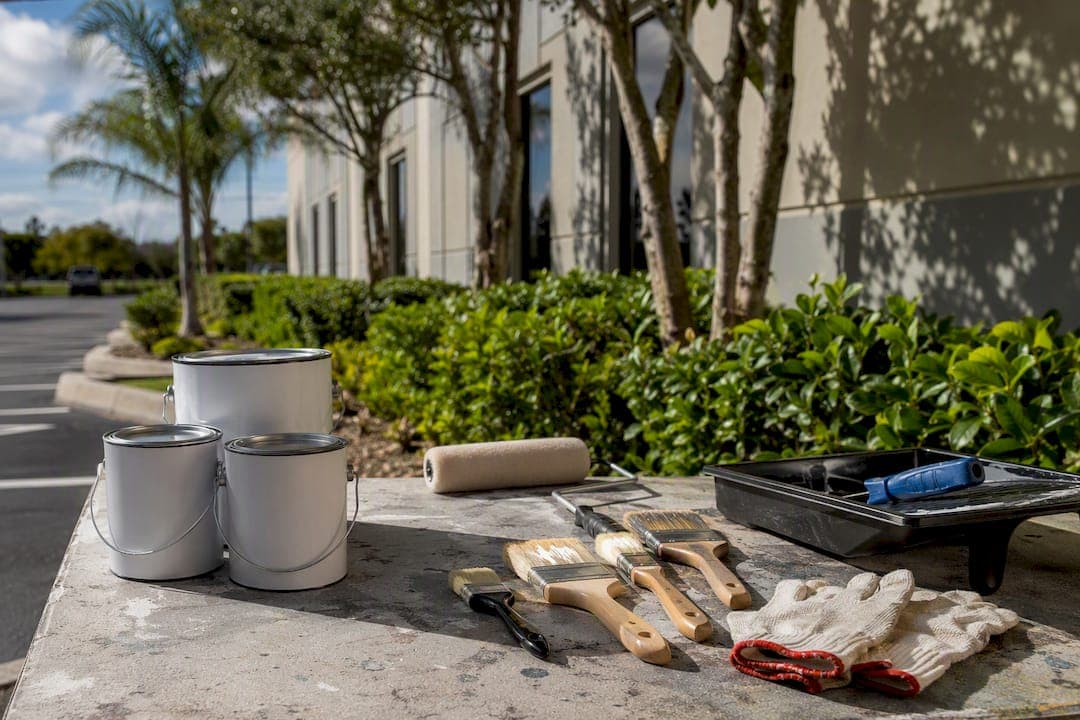
Most commercial projects land between $2 and $6 per square foot depending on surface condition and access needs, so use that range to sanity-check any bid you receive. If a number falls wildly outside it, ask why before you sign anything. Your next move is simple: schedule a site survey and request a line-item bid before you lock in a number.
TL;DR:
- Commercial painting costs typically range from $2 to $6 per square foot, with exterior work and high-access projects near the top of that range.
- Surface preparation accounts for 25% to 35% of the budget and can cause significant cost variation due to unknown underlying damage.
- Proper site surveys are essential to identify scope, including inspecting for rust, moisture, lead risks, and accurately measuring paintable areas.
- Line-item bids that detail scope, labor, materials, and access are crucial for fair comparison and avoiding scope creep during projects.
- Budgeting should include contingencies for weather delays, unforeseen damage, and sustainable materials, especially on older buildings needing lead abatement.
Table of Contents
- What Goes Into a Commercial Repaint Budget?
- How Do You Run a Site Survey That Avoids Surprises?
- How Do You Compare Contractor Bids Fairly?
- When Should You Schedule Commercial Repainting?
- What Does a Multi-Year Repaint Budget Look Like?
- Where Do Repaint Budgets Actually Go Wrong?
- How Do You Choose the Right Painting Contractor?
- What Does This Look Like on a Real Commercial Project?
- How Does Budget Approval Actually Work?
- How Do You Track Spending Once the Project Starts?
- What Does Sustainability Add to the Budget?
- What's the Real Risk in a Commercial Repaint Budget?
- Why Prep Quality Determines Your Real Cost
- How Trupainting LLC Turns a Budget Into a Real Proposal
- Sources
What Goes Into a Commercial Repaint Budget?
Every commercial paint budget breaks down into the same five buckets, and knowing the typical share of each one helps you spot a bid that's out of balance before you sign it. Surface preparation is usually the biggest line item and the biggest wild card, because you can't always tell how much rust, moisture damage, or old coating failure is hiding under the surface until crews start scraping.
Here's how the money typically splits on a well-scoped commercial job:
- Labor: 35% to 45% of total cost
- Materials: 20% to 30%
- Surface preparation: 25% to 35%
- Equipment and access: 5% to 10%
- Contingency: 10% to 15%
These figures come from Moorhouse Coating's cost analysis of commercial projects, and prep sits highest because it's the one category where nobody knows the true scope until they're standing in front of the wall.
Statistic to remember: Commercial painting typically runs $2 to $6 per square foot, with interior work trending toward the lower end and exterior work with lift access pushing toward the top.
A quick example: a 20,000 square foot office building at $4 per square foot runs about $80,000 upfront. Spread that over a 7-year coating lifespan, and you're looking at roughly $11,400 per year. Compare that to a cheaper $2.50 per square foot job that only lasts 4 years, and the annualized cost actually comes out higher. First cost and true cost are rarely the same number.
How Do You Run a Site Survey That Avoids Surprises?
A rushed walkthrough is how budgets blow up mid-project. A proper site survey converts guesswork into line items, and it's the single best investment you can make before requesting bids.
- Inspect the substrate. Note whether you're dealing with stucco, EIFS, metal, wood, or masonry, since each demands different prep and materials.
- Check coating age and condition. Chalking, peeling, and chronic mildew usually mean a full strip rather than a simple recoat.
- Flag rust and moisture issues. Rust bleeding through metal railings or moisture staining near rooflines almost always means added labor hours.
- Screen for lead risk. Buildings painted before 1978 may require lead-safe practices that add cost and time.
- Measure paintable area precisely. Multiply wall height by width for each face and sum the totals rather than estimating from square footage of floor space, which routinely undercounts vertical surface area.
Repairs like caulking, wood rot replacement, and drywall patching should get their own line items rather than getting buried inside "prep," because that's exactly where budgets quietly grow.
How Do You Compare Contractor Bids Fairly?
The biggest budgeting mistake property managers make is comparing a lump-sum number from one contractor against another without checking whether they scoped the same work. Line-item proposals fix that, because they let you value-engineer specific pieces without losing the ability to compare bids apples-to-apples.
Ask every bidder for a proposal that breaks out:
- Surface preparation, itemized by area or defect type
- Labor hours and crew size assumptions
- Coating brand, product line, and number of coats
- Access equipment (scaffolding, boom lifts, swing stages) and daily rates
- Allowances for unknown repairs discovered during prep
Once you have three bids in hand, normalize them against the same assumptions. If one bidder assumes two coats and another assumes one, that price gap isn't really a discount, it's a different scope hiding as a lower number.
Pro Tip: Ask every bidder for the same unit price on common change orders, like per-square-foot drywall patching or a lift day rate, before you sign. That single request turns mid-project negotiations from a fight into a formality.
Watch for red flags too: no proof of insurance, vague warranty language, or a refusal to itemize labor and materials separately. A contractor confident in their pricing will show you the math.
When Should You Schedule Commercial Repainting?
Timing changes your price more than most property managers expect. Exterior work scheduled during a region's shoulder season, rather than peak summer, often comes with better pricing and wider contractor availability simply because demand drops.
Weather remains the biggest wildcard for outdoor projects, which is why contractors typically build in a 10% to 20% schedule contingency for exterior jobs. Rain delays and temperature restrictions on coating application are common enough that skipping this buffer almost guarantees a schedule fight later.
A few other cost multipliers to factor into your timeline:
- After-hours or weekend work to avoid disrupting tenants typically adds a labor premium.
- Occupied-building phasing, where crews work floor by floor around active business hours, extends the schedule and the price.
- Bundling multiple buildings or a multi-site contract often earns a volume discount, since it reduces a contractor's mobilization costs.
Weather patterns for your specific region matter enough to plan around them; a closer look at how weather affects exterior painting can help you pick a smarter window before you request bids.
What Does a Multi-Year Repaint Budget Look Like?
Facilities with multiple buildings or a large campus rarely repaint everything in one year, and they shouldn't try to. A 3 to 5 year rolling plan built on a full facility condition assessment smooths out capital spending and prevents every building from needing attention in the same fiscal year.
A common allocation pattern looks like this:
- Year 1: 35% to 40% of the multi-year budget, focused on the highest-risk buildings identified in the condition assessment
- Year 2: 30% to 35%, covering core scheduled repaints
- Year 3: 25% to 30%, focused on enhancement and lower-priority assets
Statistic to remember: That 35-40-30-35-25-30 spread comes directly from Moorhouse's multi-year budget framework, and it's built around risk and business impact, not just calendar convenience.
To compare a premium coating against a budget option fairly, divide total project cost by expected service life in years. A $90,000 premium coating system lasting 10 years costs $9,000 annually. An $80,000 budget system lasting 5 years costs $16,000 annually, nearly double, despite the lower sticker price. Locking in pricing across a multi-year contract and bundling maintenance visits are two of the simplest ways to bring that annualized number down further, and a maintenance scheduling program can help formalize the cadence.
Where Do Repaint Budgets Actually Go Wrong?
Scope creep is the other quiet budget killer. It rarely shows up as one big surprise. It's a dozen small "while we're up there" additions that never got priced.
- Build unit pricing for common change orders into the original contract, not after work starts.
- Request a phased mockup on large or unusual surfaces before committing to full production pricing.
- Use allowances for known unknowns, like suspected rot behind trim, rather than guessing a flat number.
Access equipment deserves its own scrutiny too. Boom lifts and swing stages can add $200 to $800 per day depending on building height and rental duration, and that cost multiplies fast on tall or oddly shaped structures.
How Do You Choose the Right Painting Contractor?
Budget discipline falls apart fast if the contractor you hire doesn't operate with the same transparency you're bringing to the table.
- Verify insurance and bonding. General liability, workers' compensation, and bonding (for larger jobs) should be current and easy to produce on request.
- Request a full schedule of values. A real SOV breaks out labor, materials, prep, and access rather than one lump number, and it should include unit pricing for likely change orders.
- Ask for paint specifications and submittals. You want the exact product line, coat count, and manufacturer data sheet, not just a color name.
- Check references from comparable commercial jobs. A contractor who mostly does residential work may not have the crew size or equipment for a multi-story building.
- Review warranty terms and payment schedule. Milestone-based payments tied to completed work protect you better than a large deposit upfront.
Crews trained on current safety practices, including guidance from resources like OSHA's training programs, tend to run tighter, more predictable job sites, which shows up in fewer delays and cost surprises.
What Does This Look Like on a Real Commercial Project?
Trupainting LLC structures its commercial interior and exterior work around three-tier packages, so property owners in Lake County and Central Florida can match investment level to how long they need the coating to last. Every project starts with a line-item schedule of values and a phasing plan built around occupied hours, not guesswork. Kyle, who covers painting and property maintenance topics for Trupainting LLC's blog, has written on contractor selection and coating longevity that inform much of this guidance.
How Does Budget Approval Actually Work?
Most commercial repaint budgets die in committee, not on the job site. Getting a number approved requires a different document than the one you'd hand a contractor.
Facility managers typically need three things ready before presenting to ownership, a board, or a finance committee: the line-item proposal itself, a one-page summary that translates contractor language into business impact, and a clear contingency line that's labeled as such rather than buried in the total.
Stakeholders respond better to framing tied to asset protection than to aesthetics alone. A peeling exterior isn't just a cosmetic issue, it's a moisture entry point that risks structural repair costs down the line. Leading with that framing tends to move approval faster than leading with color swatches.
Build in a communication checkpoint at each phase transition, not just at the start and end of the project. If prep reveals more rust or rot than the site survey caught, and it will happen occasionally, the stakeholders should hear about the change order before it happens, not after the invoice arrives. A short weekly update, even a two-line email, does more to protect trust than a perfect budget ever will.
For multi-year plans, get sign-off on the full 3 to 5 year framework upfront rather than re-litigating the budget every single year. Once ownership approves the overall allocation pattern, each year's spend becomes a formality instead of a fresh negotiation, which saves everyone time and keeps priorities from getting reshuffled based on whoever complains loudest that quarter.
How Do You Track Spending Once the Project Starts?
A budget only works if someone is checking it against reality while the work happens, not just at the final invoice. Variance analysis, comparing what you budgeted against what you're actually spending at each milestone, catches problems while they're still small.
Set up tracking against the schedule of values, not just the total contract price. Contractors working from a proper SOV can usually provide percentage-complete updates by category on request.
Change orders deserve their own running log, separate from the base contract. Track the date, the reason, the unit price applied, and running total against your contingency reserve.
Weekly site walks paired with photo documentation catch quality issues before they compound into rework, which is its own hidden budget risk. A coat applied over inadequately dried prep work doesn't show its failure for months, by which point it's a warranty claim instead of a same-day fix.
Compare actual costs against your original per-square-foot estimate at each phase completion, not just at project close.
What Does Sustainability Add to the Budget?
Environmental compliance and sustainable material choices affect commercial repaint budgets in ways that go beyond a simple markup on "green" paint, and property managers who skip this line item often get surprised later.
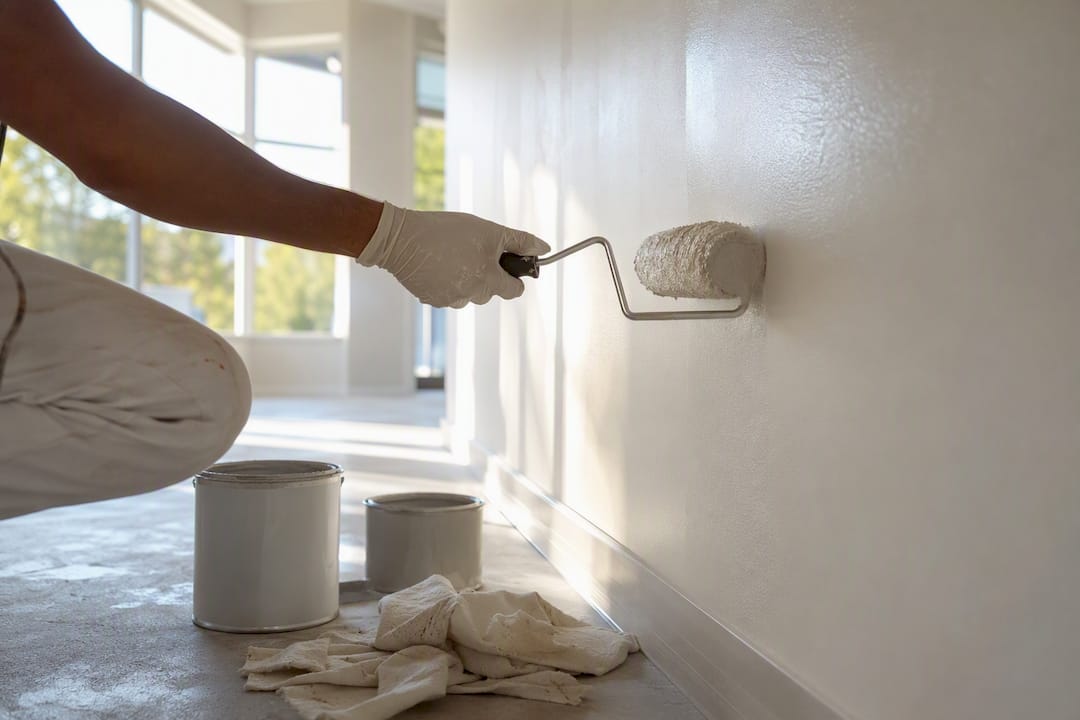
Low-VOC and zero-VOC coatings typically carry a modest premium over conventional paint, but many commercial tenants and property certifications now expect them, particularly in occupied office buildings where air quality complaints during a repaint can halt work entirely. Building that expectation into your original bid request avoids a mid-project material swap that resets your color-match and warranty timeline.
Lead paint testing and abatement compliance apply to buildings constructed before 1978 and can add meaningful cost if old coatings need to be safely removed rather than simply painted over. This isn't optional, and skipping it isn't a legal option either, so any site survey on an older building should include lead screening as a line item, not an afterthought.
Disposal costs for old coating materials, contaminated rags, and rinse water from pressure washing also belong in the budget, since many municipalities regulate how painting contractors handle runoff and waste. A contractor who can't speak clearly to how they handle disposal compliance is a contractor who might be cutting corners elsewhere too.
The upside: sustainable coating choices often extend service life, which folds back into the lifecycle costing math covered earlier. A higher upfront environmental compliance cost frequently pays for itself through fewer recoat cycles over a decade.
What's the Real Risk in a Commercial Repaint Budget?
Unforeseen damage and change orders are where well-planned budgets actually get tested, and how you've structured the contract beforehand determines whether that testing is manageable or chaotic.
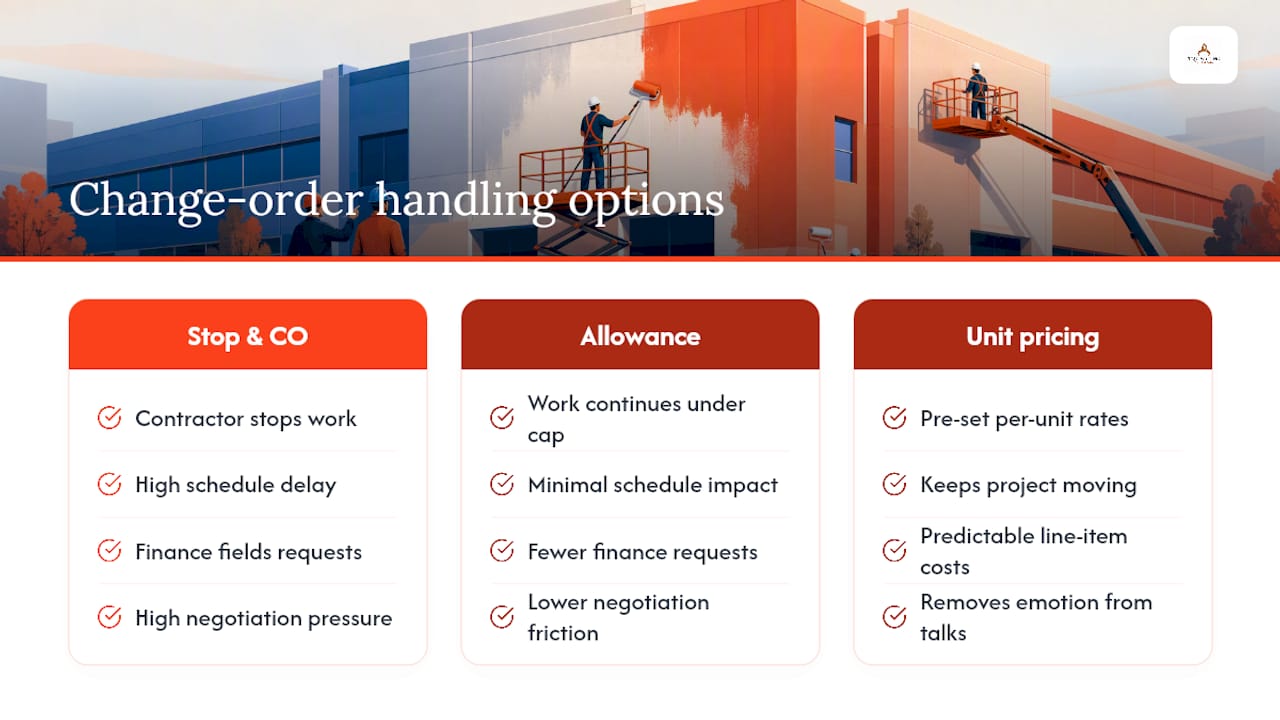
The biggest unknowns typically surface during prep: rot hidden behind trim, corrosion under old caulk joints, or moisture damage that wasn't visible until old coating came off. This is exactly why unit pricing for common change-order items belongs in the original contract rather than getting negotiated under pressure once the wall is already open. A pre-agreed per-square-foot rate for drywall patching or per-linear-foot rate for caulk replacement removes the emotion from a conversation that otherwise tends to favor whoever has more leverage in the moment.
Weather-related risk on exterior projects gets absorbed by the schedule contingency discussed earlier, but damage risk needs its own conversation. Ask contractors directly how they handle discovered damage: do they stop and request a change order, or is there a pre-agreed allowance that covers minor findings without a full renegotiation? The second approach keeps projects moving and keeps your finance team from fielding a change order request every other week.
Public-sector or prevailing-wage projects carry an additional layer of risk worth flagging early, since labor premiums and administrative requirements like certified payroll can add real cost that a private-sector cost guide won't reflect. If your property falls into that category, budget for the premium from the start rather than discovering it in the first bid.
Why Prep Quality Determines Your Real Cost
Every dollar you save on surface preparation now tends to show up as two or three dollars in early recoat costs later. That's not a guess, it's the math behind the lifecycle costing covered earlier in this guide, and it's the single biggest lever property owners control.
Reactive repainting, waiting until peeling or failure forces your hand, almost always costs more than planned maintenance on a rolling schedule. You lose the ability to negotiate shoulder-season pricing, you lose bundling leverage across buildings, and you often lose the option to phase work around tenant schedules. Budget for the plan, not the emergency.
— Kyle
How Trupainting LLC Turns a Budget Into a Real Proposal
Trupainting LLC is the direct route to turning everything above into an actual number for your building. Instead of a vague estimate, you get a proposal built the way this guide describes: a full site survey, a line-item schedule of values, and a contingency built in from the start rather than tacked on when problems appear.
The three-tier packages give you a real choice between budget-conscious and premium coating systems, mapped to how long you actually need the finish to last, without a salesperson pushing you toward the most expensive option. Whether your building needs interior work around occupied hours or exterior coatings that can handle Central Florida's weather swings, the proposal you receive will show prep, labor, materials, and access as separate line items, so you can compare it against any other bid using the same math this article just walked through.
Request a site survey and ask for the schedule of values, proposed schedule, and warranty terms in writing before you compare quotes. That's the fastest way to know if a number reflects real scope or a rough guess.
Sources
- Multi-Year Painting Budget Planning Guide | Moorhouse Resources
- Commercial Painting Cost — Moorhouse Coating blog
- Commercial painting cost guide | HomeGuide
- How to bid commercial painting jobs | ServiceTitan
- Commercial exterior painting cost and considerations | Angi