
An "insured" painter carries policies, most importantly general liability and often workers' compensation, that can pay for covered third-party property damage or injuries so you don't have to. That's the whole idea in one sentence. The catch is that "insured" isn't a single guarantee. It's a set of policies with limits and exclusions, so before anyone touches a brush to your walls, ask for a certificate of insurance and read what it actually covers.
TL;DR:
- Many contractors carry limits that may be insufficient for large damages, so verify each policy's per-occurrence and aggregate limits before hiring.
- Confirm the contractor's insurance policy is active, matches the coverage types needed, and includes you as an additionally insured for the project duration.
- Be aware that uninsured subcontractors or lapses in coverage can leave property owners liable for injuries or damages, increasing financial risk.
- Bonding provides a direct guarantee to homeowners that covers unfulfilled work or deposit theft, especially on larger or licensed projects.
- The most crucial step is calling the insurer to verify the policy is "in force" for the project dates and that coverage extends to subcontractors if applicable.
Table of Contents
- What Being "Insured" Actually Means for a Painting Contractor
- Common Types of Insurance Painters Carry and What Each Covers
- Bonded vs. Insured: How a Surety Bond Differs From Insurance
- Real Risks of Hiring an Uninsured Painter
- How to Verify a Painter's Insurance Before You Hire
- How Tru Painting Protects Homeowners on Every Job
- Why Most Homeowners Check the Wrong Thing First
- Ready to Hire a Locally Insured Painting Crew?
- Sources
What Being "Insured" Actually Means for a Painting Contractor
Insurance is a financial backstop, not a promise that nothing will go wrong. When a covered incident happens, whether a ladder puts a hole in your drywall or a crew member gets hurt on your property, the contractor's insurer is supposed to pay that claim instead of the money coming out of your pocket or the painter's.
That last part matters more than most homeowners realize. If a painter has no coverage and damages your floors, you're negotiating directly with them for reimbursement, and that conversation rarely goes well when the bill is thousands of dollars. General liability insurance is the coverage that does most of that work, paying for third-party bodily injury and property damage caused by the contractor's operations.
You can strengthen your own position by asking to be named as additionally insured on the policy for the duration of the project. This doesn't cost you anything, and it extends a layer of the contractor's coverage to protect you directly if a claim touches your property.
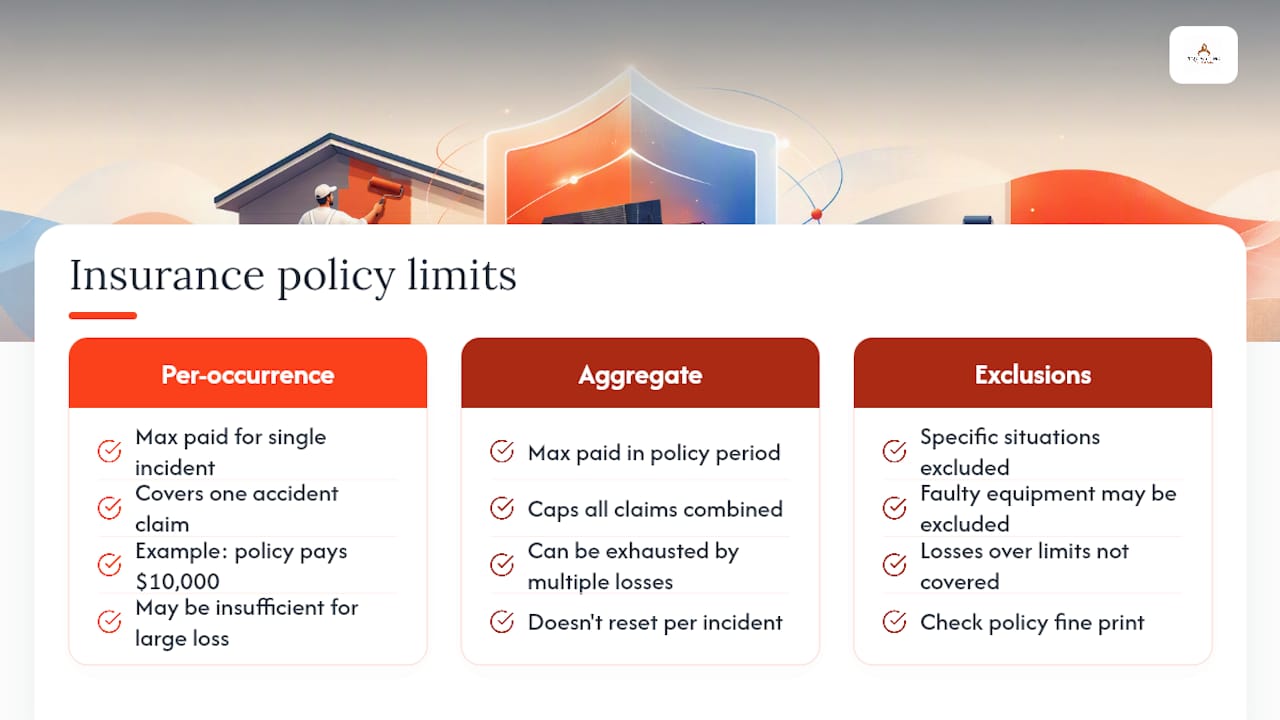
None of this is unlimited, though. Every policy has a per-occurrence limit (the max paid for a single incident) and an aggregate limit (the max paid across the whole policy period), plus exclusions that carve out specific situations. A painter with a policy that maxes out at $10,000 per incident isn't much help if a fire caused by faulty equipment does $80,000 in damage. Limits are the difference between "insured" on paper and actually protected.
Common Types of Insurance Painters Carry and What Each Covers
"Insured" is shorthand for a stack of separate policies, and each one covers a different kind of risk. Homeowners rarely need all of them explained in depth, but you should recognize each name when it shows up on a certificate of insurance.
- General liability covers third-party bodily injury and property damage: think paint spilled on antique hardwood floors, or a ladder that knocks over a $600 planter on its way down.
- Workers' compensation covers medical costs and lost wages if a crew member gets hurt on your job, so you aren't the one absorbing that liability.
- Commercial auto covers damage if a company truck or trailer dings your driveway, clips a mailbox, or causes an accident while on the job.
- Professional liability (errors and omissions) is less common for painters but relevant if a dispute arises over workmanship advice or a specification error that caused a costly redo.
Small-business insurance costs and coverage combinations vary widely depending on crew size, job scope, and the state a contractor operates in. As a rough baseline, many contractors carry general liability limits often starting in the high hundreds of thousands per occurrence, and larger commercial jobs often call for higher limits given the higher dollar value at risk.
Bonded vs. Insured: How a Surety Bond Differs From Insurance
Insurance and bonding sound like a matched pair, but they protect different people. Insurance protects the business: the insurer pays covered claims so a single accident doesn't bankrupt the contractor. A surety bond works differently and protects you, the customer, when the contractor fails to deliver.
A bond involves three parties:
- The principal (the painter), who purchases the bond.
- The obligee (you, or sometimes a licensing board), who benefits if a claim is paid.
- The surety (the bonding company), which pays a valid claim and then requires the contractor to reimburse it.
That reimbursement clause is the key difference: a bond isn't free money the way an insurance payout can feel. It's a loan the contractor has to pay back, which is exactly why bonding matters most on larger contracts, in states with licensing rules tied to job value, or any time you're worried about a deposit disappearing without work to show for it.
Real Risks of Hiring an Uninsured Painter
Skip the coverage check and you inherit the risk yourself. Two scenarios show up again and again with uninsured contractors.
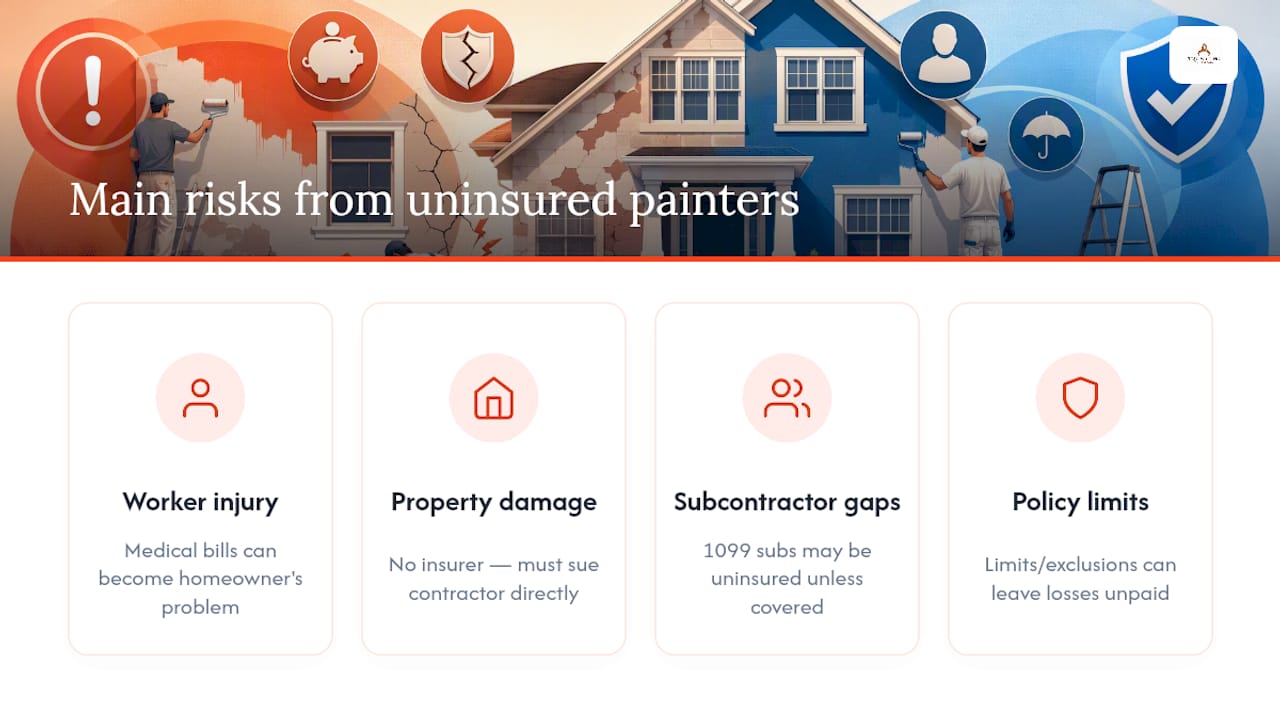
If a worker falls off a ladder on your property and the painter carries no workers' compensation, that worker's medical bills can potentially become your problem, especially if the injured person argues you bear some liability as the property owner. Separately, if an uninsured crew damages your cabinets, floors, or landscaping, you have no insurer to file a claim with. Your only recourse is suing the contractor directly, which costs time and money you may never recover.
Subcontractor arrangements add another wrinkle. A painter might carry solid coverage personally but bring in 1099 subcontractors who don't. If that's the setup, ask explicitly whether subs are covered under the same policy, because a gap there defeats the whole point of checking in the first place. Even with full coverage, remember that limits and exclusions can still leave a slice of a large loss unpaid.
How to Verify a Painter's Insurance Before You Hire
Verification takes ten minutes and it's the single highest-leverage step in this entire process. Work through it in order.
- Request a certificate of insurance (COI) and confirm it lists the insurer's name, policy numbers, and effective and expiration dates.
- Ask to be named as additionally insured for the project period. Legitimate insurers can add this in a day or two.
- Check the policy limits. Ask for both the per-occurrence limit and the aggregate limit, and make sure the coverage types match what your job needs.
- Call the insurer directly, using the contact information on the COI, and confirm the policy is active and matches what's on the certificate.
- Ask about workers' compensation separately, including whether it extends to any subcontractors on the crew.
Watch for red flags along the way: a COI issued directly by the contractor rather than the insurer, dates that have already lapsed, or a painter who hesitates when you ask to verify anything by phone. Any of those should slow you down before you sign a contract. Our painting contractor selection checklist walks through the rest of the vetting process alongside insurance, and a resource like this contractor vetting checklist offers additional example questions you can adapt when you're on the phone with an insurer.
Pro Tip: When you call the insurer, ask them to confirm the policy is "in force" for the exact dates of your project, not just "currently active." Some policies lapse mid-renewal in ways that don't show up unless you ask that specific question.
How Tru Painting Protects Homeowners on Every Job
Trupainting LLC provides a certificate of insurance on request for every residential and commercial job in Lake County and Central Florida, and we maintain workers' compensation coverage on our crews as a standard practice, not an upsell. Our three-tier service packages spell out the level of protection and documentation included at each tier, so you know exactly what you're getting before work starts.
If you want to see how we document coverage or talk through a specific project's requirements, ask us directly, we're glad to walk through it. You can use this same verification language with any contractor you're considering, insured painter or not. Confidence in a contract starts with confirming the paperwork behind it.
Why Most Homeowners Check the Wrong Thing First
The conventional advice on this topic spends too much time on definitions and not enough on the phone call that actually matters. Knowing what "general liability" means is useless if you never dial the insurer to confirm the certificate is real. That single verification step catches the vast majority of the problems homeowners actually run into: expired policies, COIs issued by the contractor instead of the insurer, and coverage that quietly excludes subcontractors.
I'd also push back on treating bonding as optional paperwork. It gets waved off as something only relevant to big commercial jobs, but it's the one protection that covers you when a contractor takes a deposit and vanishes, a scenario insurance does nothing for. If you prioritize one thing from this entire guide, prioritize the call to the insurer and the question about subcontractor coverage. Everything else is context that supports that one decision.
— Kyle
Ready to Hire a Locally Insured Painting Crew?
Trupainting LLC is the straightforward alternative to hiring blind: every job comes with a certificate of insurance on request, active workers' compensation coverage, and a written contract that spells out scope before we start, no guesswork required on your end.

We serve homeowners and business owners across Lake County and Central Florida, and we'd rather answer your insurance questions upfront than leave you checking paperwork after the fact. If you're planning an interior repaint, visit our residential interior painting services page to request a free estimate and your copy of our COI. Commercial property managers can find the same documentation on our commercial interior painting page. Either way, ask for the certificate before the crew shows up, not after.
Sources
- What Does Bonded And Insured Mean? | Forbes Advisor
- What Does It Mean to Be Bonded and Insured? | NFP
- What Does Bonded And Insured Mean For Small Businesses? | Next Insurance