Professional cabinet painting takes 3 to 5 calendar days from start to finish; a DIY job usually runs 4 to 8 days. Neither number reflects how many hours you'll actually spend with a brush or sprayer in hand. Most of that calendar time is waiting: primer needs to dry, color coats need to cure, and rushing either step is how finishes fail. In fact, a professional crew's actual working time often totals just 2 to 2.5 days, with the rest of the week reserved for drying between coats.
Three things to lock in before you schedule anything:
- Budget a 3 to 5 day pro window as your baseline, and add a buffer day for anything larger than a standard kitchen.
- Plan on primer plus two color coats as the industry standard finish schedule, not a single heavy coat.
- If the calendar doesn't work for your household, Trupainting LLC and similar local contractors can compress hands-on labor, though not the required cure time.
Key Takeaways
Cabinet painting timelines run 3 to 8 calendar days because thin coats need 24 to 48 hours to dry between applications, not because the labor itself takes that long.
| Point | Details |
|---|---|
| Pro timeline | Expect 3 to 5 calendar days, with only 2 to 2.5 days of actual working time. |
| DIY timeline | Budget 4 to 8 days, factoring in slower pace and possible recoat mistakes. |
| Cure controls the clock | Full hardness takes up to 30 days, so treat doors gently after reinstall. |
| Speed-ups have limits | Spraying and climate control cut hours, not the required cure windows. |
| Local pro option | Trupainting LLC offers tiered cabinet refinishing packages with written timelines for Lake County and Central Florida homeowners. |
Table of Contents
- Cabinet Painting Timeline Breakdown by Stage
- Sample Calendar Schedules for Small, Medium, and Large Kitchens
- What Affects How Long Cabinet Painting Takes?
- Can You Speed Up a Cabinet Painting Timeline?
- Common Causes of Cabinet Painting Delays
- How Long Until Cabinets Are Fully Cured and Usable?
- Should You DIY or Hire a Cabinet Painting Pro?
- A Contractor's View on Realistic Cabinet Timelines
- Get a Realistic Cabinet Painting Estimate
- Sources
Cabinet Painting Timeline Breakdown by Stage
Every cabinet job follows the same sequence, whether you hire it out or do it yourself. What changes is how fast each stage moves and how much you're willing to risk by skipping steps.
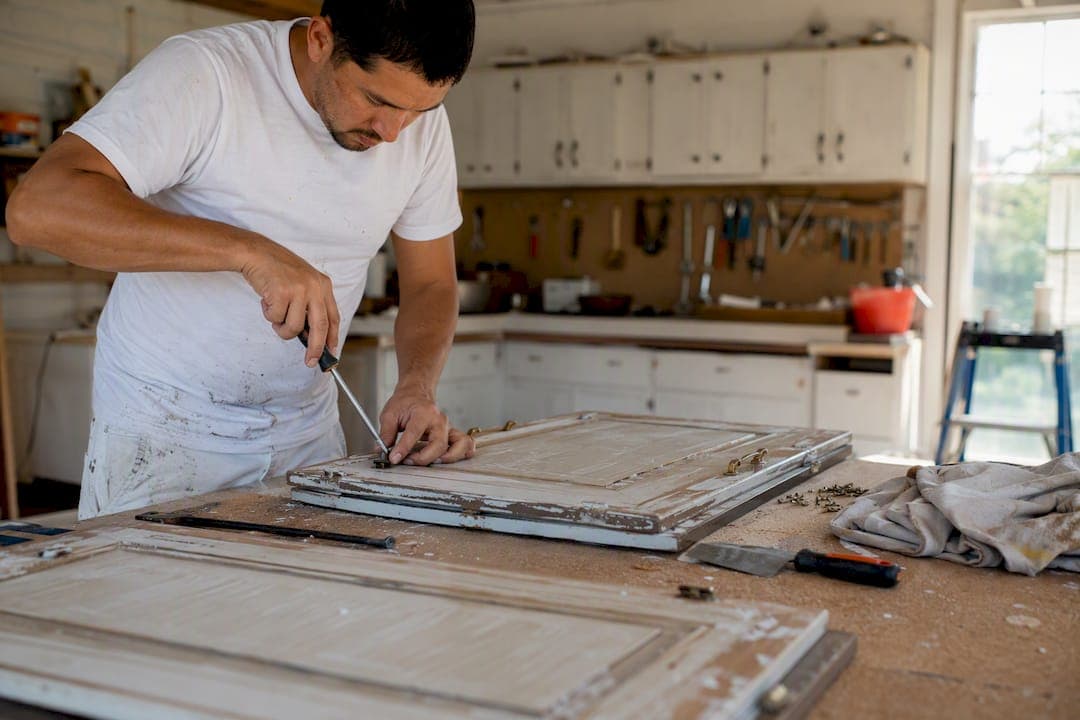
Removal and labeling comes first: doors, drawer fronts, and hardware get taken off and tagged so everything goes back where it started, as part of selecting the right pantry door during kitchen remodeling. This takes a few hours for a small kitchen, longer if hinges are painted shut or hardware is stripped.
Degreasing and cleaning is next, and it's the step DIYers skip most often. Kitchen cabinets accumulate cooking grease that ordinary cleaners don't fully remove, and any residue left behind becomes a bonding barrier under your primer. This is a same-day task, but it has to be thorough.
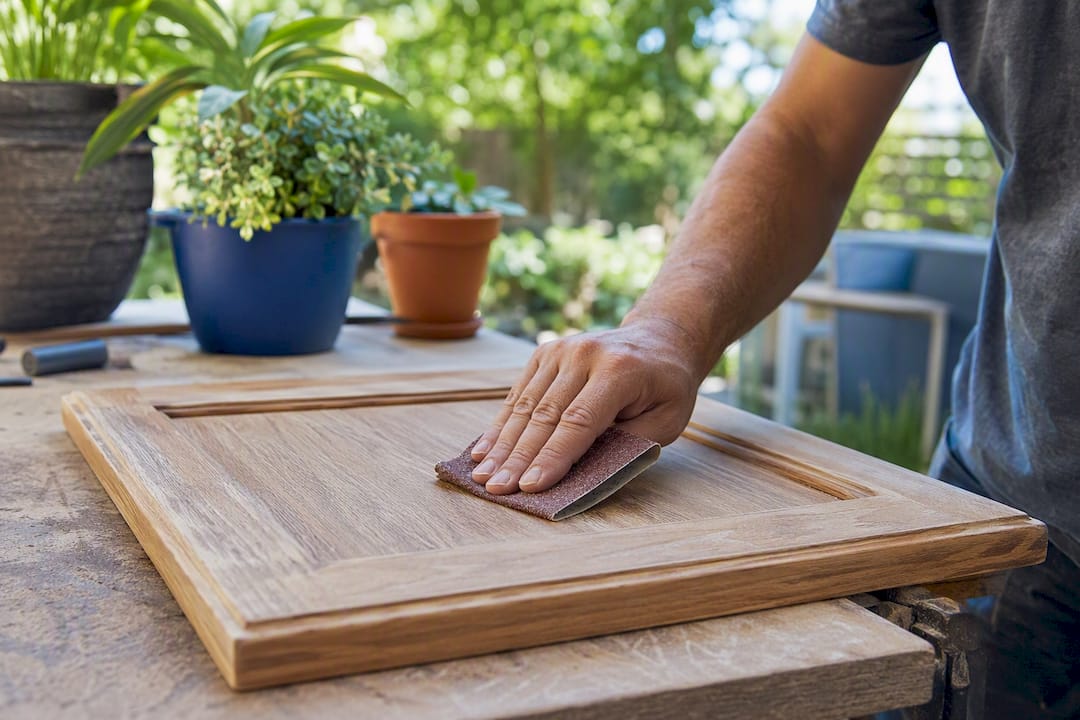
Sanding or scuffing roughens the surface so primer has something to grip. On top of new prep work, Sherwin-Williams recommends testing adhesion with your chosen primer before committing to the whole kitchen, since some finishes bond poorly to certain existing coatings.
Priming follows, and this is where the calendar starts stretching. Benjamin Moore's guidance calls for at least 24 hours of primer dry time before you move to sanding or color coats.
Color coats typically mean two applications, with 24 to 48 hours between each one. This single requirement is why a "two-day paint job" becomes a five-day project.
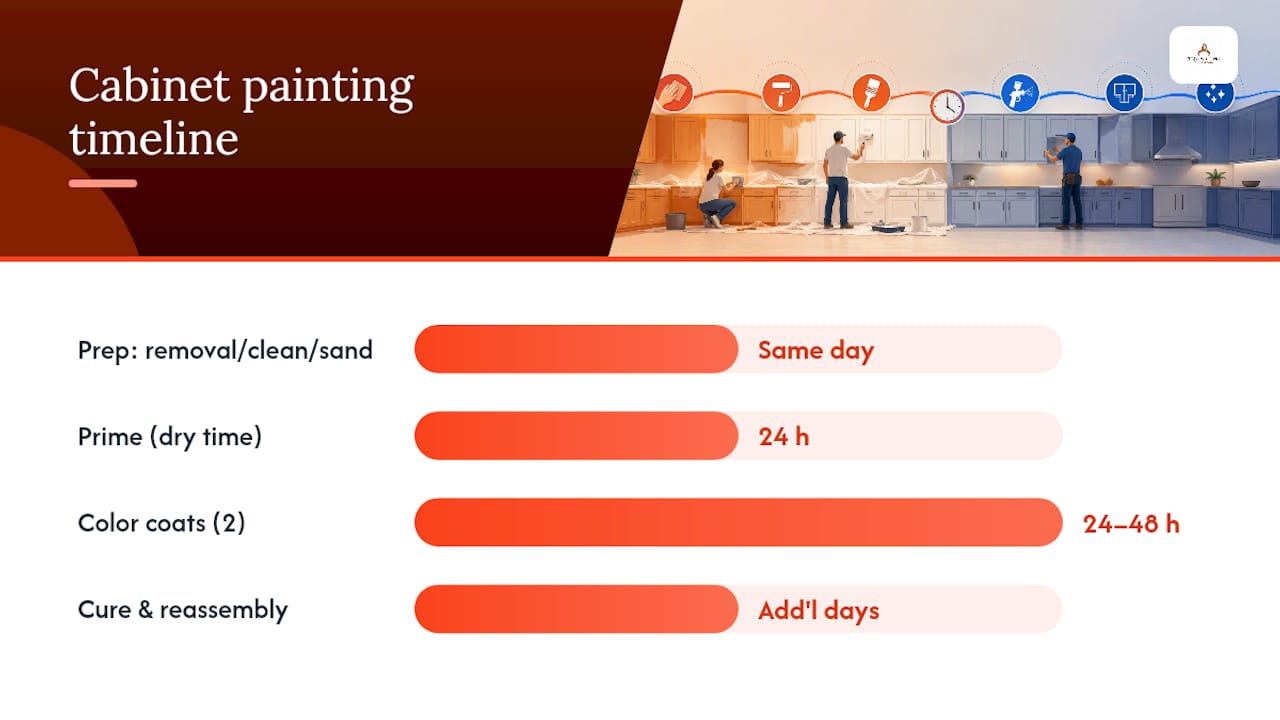
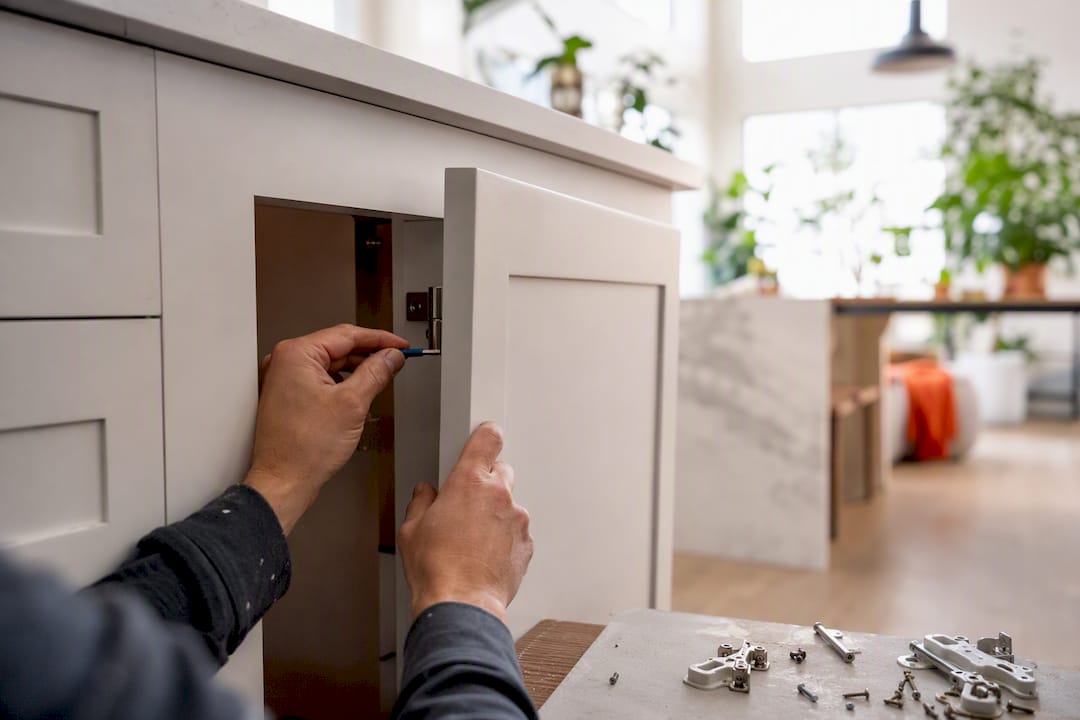
Curing and reassembly close things out. Doors can usually go back on once the final coat is dry to handle, but the finish keeps hardening for weeks afterward.
| Stage | Working time | Calendar time |
|---|---|---|
| Removal and labeling | A few hours | Same day |
| Degrease and clean | A few hours | Same day |
| Sand or scuff | A few hours | Same day |
| Prime | About an hour or two | At least one day for drying |
| Color coats (two) | A few hours total | Multiple days with 24 to 48 hours drying between coats |
| Cure before reinstall | None | Additional days as needed |
A few checkpoints matter more than the rest:
- Skipping the degrease step is a common cause of peeling months later.
- Recoating before the primer has fully dried can trap moisture under the topcoat.
- Rehanging doors too early may leave soft spots that dent or scuff during normal use.
Pro Tip: Take a photo of each door and drawer front before removal, and number the back edge with painter's tape. You'll save an hour of guesswork on reassembly day.
Sample Calendar Schedules for Small, Medium, and Large Kitchens
These schedules assume a standard primer-plus-two-coats system, normal indoor temperature, and decent ventilation. Adjust up if your kitchen runs colder, more humid, or has more doors than listed.
- Small kitchen (10 to 15 doors and drawers): Day 1, removal and prep; Day 2, prime; Days 3 to 4, two color coats; Day 5, cure and reinstall. Total: 4 to 5 days.
- Medium kitchen (16 to 25 doors and drawers): Day 1, removal and degrease; Day 2, sand and prime; Days 3 to 5, color coats with full dry windows; Day 6, cure and reassembly. Total: 5 to 6 days.
- Large kitchen (26+ doors, an island, or a pantry wall): Days 1 to 2, removal and prep; Day 3, prime; Days 4 to 6, color coats; Days 7 to 8, cure and full reassembly. Total: 7 to 8 days.
A few notes apply across all three sizes:
- Staging doors off-site (in a garage or shop) doesn't shrink the calendar, but it does let you keep cooking in a mostly functional kitchen while cabinet boxes stay in place.
- Expect the kitchen to be functionally out of use, no doors or drawer fronts, for roughly 60 to 70% of the total project window.
- Color coat days are the most delay-prone stretch. A missed recoat window because of unexpected humidity can add a full day.
What Affects How Long Cabinet Painting Takes?
Every timeline above assumes a fairly standard kitchen. Real projects shift based on a handful of variables you can usually spot before you start.
- Door and drawer count: More surfaces mean more time drying and more coats to manage. A rough guide is one extra day of schedule padding for every 10 doors beyond a standard 20 to 25 door kitchen.
- Cabinet condition: Water damage, swollen MDF, or loose veneer found during removal adds repair time before painting can even begin.
- Color change magnitude: Going from dark wood to white typically needs an extra coat or a stain-blocking primer, adding a full day.
- Finish type: Oil-based coatings dry and cure slower than modern waterborne cabinet enamels, which is one reason most professionals have shifted away from oil for cabinet work.
- Spray versus brush: Spraying lays down a thinner, more even coat that dries faster per application, though it doesn't change the required hours between coats.
- Humidity and temperature: High humidity and cooler temperatures extend cure time significantly, sometimes stretching a 5-day pro job closer to 10.
Florida homeowners in particular should treat humidity as a scheduling variable, not an afterthought. A muggy stretch in July can add a day or two to a project that would move faster in a dry, air-conditioned January.
Can You Speed Up a Cabinet Painting Timeline?
Some tactics genuinely cut calendar days. Others just make the work feel faster while the clock keeps running at the same pace.
Spraying versus brushing is a good example of the difference. Professional spray equipment, often used off-site in a controlled shop, produces a smoother finish and speeds up the application step. It does not shorten the required drying and cure windows between coats, because those are set by paint chemistry, not application method.
Tactics that actually move the calendar:
- Climate control: Running a dehumidifier or air conditioner in the work area speeds up evaporation and can shave a full day off a humid-season project.
- Parallel staging: Working on doors in batches, primed together and coated together, means the whole batch moves through drying windows at once instead of one door at a time.
- Fast-dry professional products: Some waterborne enamels are formulated for shorter recoat windows than standard products, though they still require testing for adhesion.
Pro Tip: If a contractor promises a full cabinet repaint in two days flat, ask what product they're using and whether that timeline includes full cure. A fast finish that skips cure time is a fast callback.
Common Causes of Cabinet Painting Delays
Most schedule blowups trace back to one of a handful of predictable mistakes.
- Skipping or rushing degreasing, which causes peeling weeks or months later.
- Sanding too lightly, leaving a slick surface that primer can't grip.
- Recoating before the manufacturer's minimum window, trapping solvent under the next layer.
- Discovering water damage or rotted MDF once doors come off, which stops the schedule cold until it's repaired.
- Painting during a cold or humid stretch that extends every dry time on the schedule.
Before you start, run through this checklist:
- Label every door and drawer before removal.
- Test your primer and topcoat on a hidden panel or the inside of a door.
- Build one buffer day into your schedule for weather or unexpected repairs.
- Confirm your product's exact recoat window in writing, not from memory.
If you find hidden damage mid-project, pause and repair it before priming. Painting over compromised wood guarantees a redo.
How Long Until Cabinets Are Fully Cured and Usable?
Dry to the touch happens within hours. Handle-dry, safe for careful use, usually takes about a day. Recoat-dry (safe to apply the next layer) needs 24 to 48 hours per manufacturer guidance. Full cure, when the finish reaches its final hardness and abrasion resistance, can take up to 30 days.
That gap matters for how you treat your kitchen right after reinstall:
- Rehang doors once they're handle-dry, but treat them gently for the first two to four weeks.
- Avoid harsh cleaners or scrubbing for at least 5 to 7 days after the final coat.
- Skip heat sources near cabinet fronts, like an open oven door, during the first month.
- Close doors softly rather than slamming them until full cure is complete.
Should You DIY or Hire a Cabinet Painting Pro?
Run through this before deciding:
- Do you have a full week where the kitchen can be partly unusable?
- Are you comfortable spraying, or will you brush and risk visible strokes?
- Do repairs (water damage, loose veneer) feel manageable to you?
- Does a warranty on the finish matter to you?
A professional crew typically compresses the hands-on hours through experience, better equipment, and parallel workflows. That won't compress the cure windows chemistry demands, but it does reduce the number of things that can go wrong along the way.
When you talk to a contractor, ask these four questions:
Pro Tip: Get the timeline in writing, including cure days and the reassembly date, before signing. A vague verbal estimate is the most common source of "why isn't my kitchen done yet."
- What's the full calendar timeline, including cure time?
- Is the finish warrantied, and for how long?
- What prep steps are included, degreasing, sanding, repairs?
- Is spraying done off-site or in my home?
A Contractor's View on Realistic Cabinet Timelines
Most of the frustration we see with cabinet projects has nothing to do with paint and everything to do with expectations. Homeowners picture two days of work; the calendar delivers five to eight because the finish needs time to cure properly, not because anyone is dragging their feet. Florida's humidity makes this worse in summer, which is why we always ask about climate control before locking in a schedule. Respecting the cure window is the difference between a finish that lasts years and one that needs a redo by fall.
Get a Realistic Cabinet Painting Estimate
If the schedule above sounds tight for your household, Trupainting LLC handles the parts of a cabinet project that eat up the most time and risk, degreasing, repairs, spraying, and cure management, so you don't have to guess at recoat windows or troubleshoot adhesion problems yourself.

We serve Lake County and Central Florida homeowners with cabinet refinishing built around three service tiers, so you choose the level of prep and protection that fits your kitchen and your budget. Before hiring anyone for a cabinet project, ask:
- What's the full written timeline, cure days included?
- Is the finish warrantied?
- What prep and repair work is covered?
- Is spraying done off-site or on-site?
If you'd rather hand off the degreasing, sanding, and spray work and just get your kitchen back on a predictable schedule, request a cabinet refinishing estimate and we'll walk you through a written timeline before any work begins.
Sources
- How Long Does Cabinet Painting Take? Kitchen Timeline Guide
- How to Paint Kitchen Cabinets Like an Expert in 9 Steps | Benjamin Moore
- How to Update Kitchen Cabinets | Sherwin‑Williams
- How Long Does Cabinet Painting Take? What to Expect