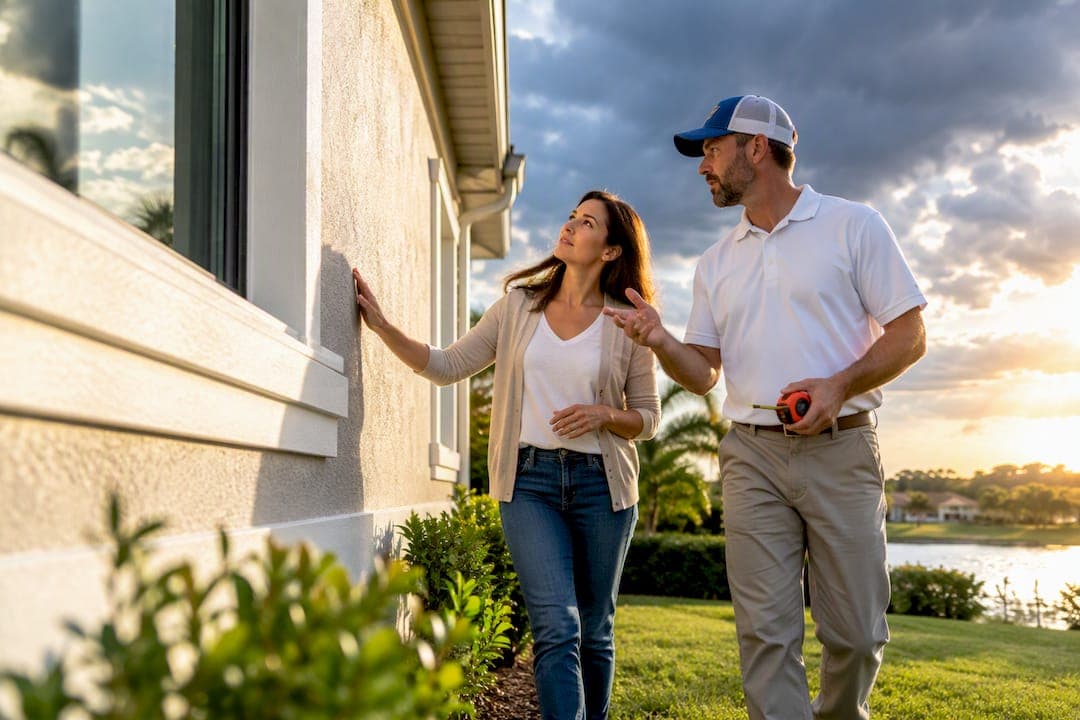
A standard exterior repaint on a Florida home typically takes 3 to 8 calendar days from the first pressure wash to the final coat, though the exact number swings on humidity, rain, and how much repair work your walls need. Stucco, mildew, and wet-season storms are the usual reasons a job stretches longer than a homeowner expects. Booking during the dry season and giving your contractor lead time helps keep your project on track.
TL;DR:
- Weather conditions and repairs, especially stucco patching and mildew remediation, can extend project timelines by several days beyond the typical 3 to 8 days.
- Storm seasons and humidity levels in Florida significantly influence recoat windows and drying times, with the dry season from November to April being the most reliable for scheduling.
- Preparation tasks like pressure washing, scraping, sanding, and stucco repair dominate schedule delays, often adding at least one full day per step.
- Booking a project 4 to 8 weeks in advance is essential to secure a dry-season slot due to high demand during peak months and holidays.
- A detailed on-site inspection and documentation before contract signing help set accurate expectations and prevent unexpected delays.
Table of Contents
- Realistic timelines by house size and scope
- What actually controls the schedule
- Best months to paint and how Florida weather shifts the schedule
- Drying versus curing: what happens after the final coat
- Permits, HOA approvals, and paperwork that add weeks
- How to plan and keep your project on schedule
- How holidays and busy seasons affect contractor availability
- What we see on the ground in Lake County and Central Florida
- Getting a realistic timeline for your home
- Sources
- FAQ
Realistic timelines by house size and scope
The bigger and more complex the house, the more calendar days you should plan for, though crew hours and elapsed days aren't the same thing. A small single-story home with minimal prep usually needs 2 to 4 days of actual crew work, but 3 to 7 elapsed days once you factor in drying time between coats. A typical single-story house runs 3 to 5 crew days and 4 to 8 elapsed days, a range that lines up with what local contractor estimates show for the Orlando market. A two-story home with stucco repairs or heavy carpentry work can push past 10 elapsed days.
Crew hours measure how long painters are actually on your walls. Elapsed calendar days include the waiting: primer curing, caulk setting, and weather pauses that don't show up in a labor estimate.
- Small single-story home: a few crew days and about a week elapsed.
- Typical single-story home: multiple crew days with up to a week elapsed.
- Two-story or stucco-heavy home: potentially more than a week elapsed.
When stucco patching or carpentry repairs run alongside the painting schedule, those trades often need their own drying or curing windows before a coat can go on top, which stretches the calendar even when the paint crew itself isn't the bottleneck.
What actually controls the schedule
Prep work is where most of the calendar time goes, not the painting itself. Pressure washing a typical home takes half a day to a full day, followed by scraping and sanding loose paint, which can add another day depending on how much failure is present. Caulking gaps and joints usually adds a few more hours before primer goes on.
Stucco surfaces add real time to the schedule. Cracks need patching, hairline cracks need bridging with flexible fillers, and the surface typically needs an alkali-resistant primer before topcoating, a sequence that commonly adds a day or more to the job compared with painting wood or fiber cement siding, according to local cost and timeline data. Mildew and mold growth, common on shaded or north-facing walls in Florida's humidity, require a wash-down and sometimes a full remediation step before painting can start safely, which can add multiple days if the growth is extensive.
- Pressure washing: half a day to a full day.
- Scraping and sanding: a half day to a full day, depending on paint failure.
- Stucco crack repair and priming: typically adds a day or more.
- Mildew remediation: can add multiple days for heavy growth.
Crew logistics matter too. Setting up lifts or scaffolding for a two-story home takes time, and a larger crew can work multiple elevations at once, which shortens the calendar even though the total labor hours stay similar.
Pro Tip: Ask your contractor to walk the exterior with you before the bid and point out every crack, stain, and soft spot. Surprises found mid-project are the number one reason timelines slip.
Best months to paint and how Florida weather shifts the schedule

Florida's dry season runs roughly November through April, while the wet season, with daily afternoon thunderstorms, runs from mid-May through mid-October. That dry stretch is the window most Central Florida contractors recommend for exterior work, and local market data points to mid-November through mid-May as the most reliable painting season.
A regional NWS climatology shows Florida's rainy season builds through distinct phases: late May and June bring the first wave of storms, July through early September is typically the wettest stretch, and activity winds down by early October, according to NWS Tampa Bay's thunderstorm climatology. Daily afternoon thunderstorms during that period don't just cause rain delays. They shorten the window between coats, since high humidity slows drying, and rushing a recoat under those conditions raises the risk of trapped moisture that shows up later as blistering.
- Dry season (November through April): the most reliable painting window.
- Wet season (May through October): higher chance of afternoon storms and recoat delays.
- Coastal and south Florida see earlier storm onset than central or north Florida, shifting ideal months slightly.
Because of this, many contractors build a weather contingency into bids and recommend booking 4 to 8 weeks ahead for peak dry-season slots, since that window fills up fast.
Drying versus curing: what happens after the final coat

Paint drying and paint curing are not the same thing, and mixing them up leads to premature furniture moves, fixture reinstalls, or pressure washing that damages a fresh coat. Surface dry, when the paint no longer transfers to a light touch, typically happens within an hour or two for acrylic latex in good conditions. Tack-free, when the surface won't pick up dust or fingerprints, usually follows within a few hours. Full cure, when the coating reaches its complete hardness and washability, can take up to 30 days.
High humidity slows every stage of that process. Building science guidance warns that finishing over damp substrates or trapping moisture behind a coating raises the risk of blistering and long-term enclosure damage, based on vapor-open assembly guidance from the Building Science Corporation, which is part of why Florida crews check substrate moisture before applying a topcoat rather than working strictly off a calendar.
- Avoid pressure washing or heavy rain exposure for at least 24 to 48 hours after the final coat.
- Wait until paint is fully cured, not just dry, before reinstalling shutters or fixtures.
- Treat the warranty clock as starting at project completion, not at first touch-dry.
Permits, HOA approvals, and paperwork that add weeks
Homeowners association approval is often the slowest part of a Florida repaint, and it has nothing to do with weather or crew scheduling. Most HOAs require a submission package with color chips and product data sheets, and approval can take anywhere from a few days to several weeks depending on how often the board meets. Historic districts may also require a Certificate of Appropriateness before any exterior color change, and scaffold setups on some properties can trigger local permitting requirements.
- Submit color samples and data sheets to your HOA as soon as you have a bid, not after.
- Ask your contractor whether your neighborhood or district has historic review requirements.
- Build HOA review time into your project calendar separately from the painting schedule itself.
How to plan and keep your project on schedule
A little homework before you sign a contract prevents most of the delays homeowners run into.
- Document problem areas with photos and get 2 to 3 written estimates for comparison.
- Verify the contractor's license and insurance through Myfloridalicense before signing anything.
- Request product data sheets so you know exactly what system is going on your walls.
- Confirm a start window, ask for weather-contingency language in the contract, and agree on a progress update cadence.
- Ask about crew size, the lift or scaffold plan, expected daily milestones, warranty scope, and who handles cleanup.
Rain mid-project isn't unusual in Florida. A prepared contractor tarps exposed surfaces, adjusts the recoat schedule once conditions dry out, and documents any change orders in writing so nobody is surprised by the final invoice.
Pro Tip: Ask your contractor how they handle a rained-out day. A clear answer up front tells you a lot about how the rest of the project will go.
How holidays and busy seasons affect contractor availability
Late fall and spring, the exact months that make up Florida's dry season, are also when every homeowner wants their house painted. That overlap means the best contractors book up fast, and Thanksgiving through New Year's often creates a scheduling gap as crews take time off and homeowners wait until after the holidays to start new projects. Spring break weeks and the run-up to Easter can create a similar crunch in Central Florida, especially in retirement communities where seasonal residents want work done before they head north for the summer.
The practical result is that the exact weeks homeowners most want, cool mornings, low humidity, minimal rain risk, are the same weeks with the longest contractor waitlists. Booking 4 to 8 weeks ahead of your preferred start date gives you a real shot at a dry-season slot instead of getting pushed into the early wet season by default. Reputable local contractors are usually upfront about how far out their calendar is booked, and asking that question during your first phone call is one of the simplest ways to avoid a summer start you didn't plan for.
What we see on the ground in Lake County and Central Florida
Working across Lake County and Central Florida, we see stucco repairs and Florida humidity extend timelines more than anything else. We offer flexible service packages that reflect different levels of preparation and protection: more prep time upfront typically means a longer project but a finish that holds up longer.
— Kyle
Getting a realistic timeline for your home

Every estimate starts with a free on-site inspection, not a guess over the phone. The contractor walks the exterior, documents any stucco cracks, mildew, or wood repairs, and provides a written timeline along with product data sheets and warranty details before any work begins. That means you know your schedule window, and any weather contingency built into it, before you sign anything.
If you're ready to see what a realistic timeline looks like for your own home, visit our residential exterior painting page to request your estimate.
Sources
For readers who want the underlying climate and building science data, the NWS Tampa Bay thunderstorm climatology and Building Science Corporation vapor guidance are worth a read.
- NWS Tampa Bay thunderstorm climatology quick reference
- Vapor open assemblies — Building Science Corporation (BSC) Information Sheet 311
- Exterior Painting Orlando FL: 2026 Cost Guide & Painters — FacadeColorizer
FAQ
How often do you need to paint your house exterior in Florida?
Most Florida homes need repainting every 5 to 8 years, though intense sun and humidity can shorten that for south-facing walls. Stucco homes and those with heavy tree shade often show wear sooner due to mildew growth.
What exterior paint lasts 25 years?
Paint longevity depends more on prep quality and coating system than the product label alone, and no single paint reliably lasts decades without maintenance. Choosing a well-prepped substrate with a quality acrylic system, like the options included in our Enhanced Prep & Durability package, gives you the best shot at a long-lasting finish.
What is the best month to paint a house in Florida?
Any month between November and April works well, since that stretch avoids Florida's daily afternoon thunderstorms and offers lower humidity for proper drying, based on regional dry season timing. Coastal areas may see slightly earlier storm activity than inland Central Florida, so local timing can shift by a few weeks.
How much to paint a 1500 sq ft house exterior in Florida?
Pricing depends on substrate, prep needs, and paint system, so an exact figure isn't available without an on-site inspection. Free estimates are provided after walking the property so you get a number based on your home's actual condition rather than a generic square-foot rate.