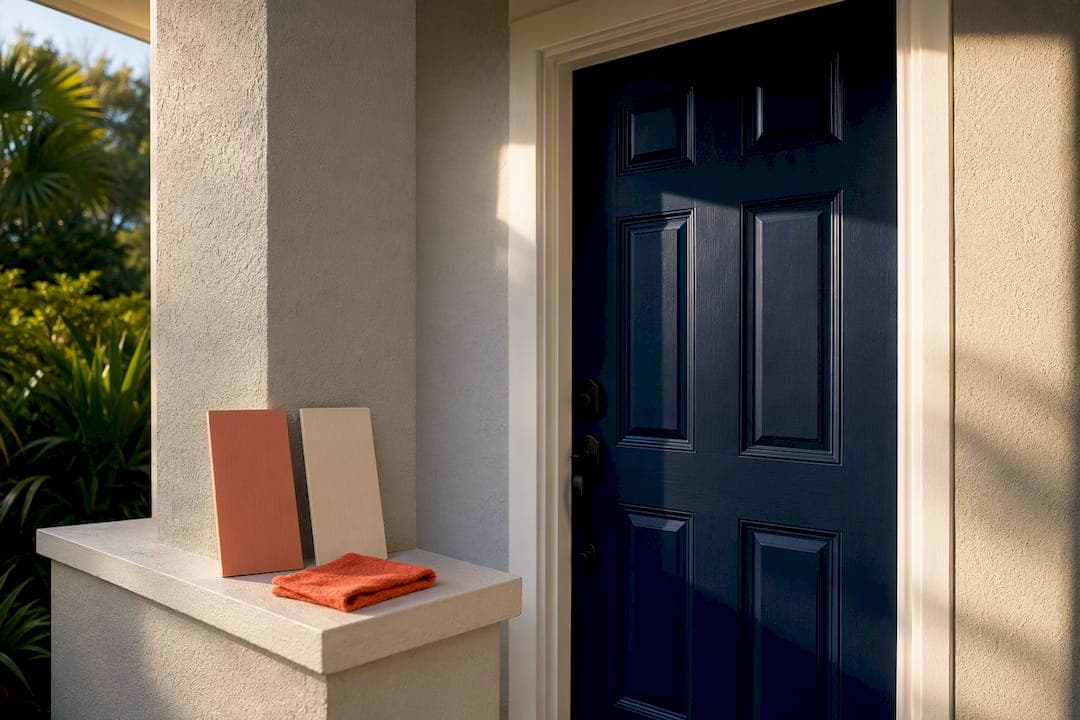
Soft black, deep navy, forest green, and jewel tones like teal or sapphire are the front door colors homeowners are choosing most right now, alongside warm terracotta and quiet putty neutrals. Pick a dark, saturated shade for a bold contrast against a light-colored house, or match a warm neutral to your siding if you want the door to blend in rather than stand out.
TL;DR:
- Dark, saturated colors like black, deep navy, and jewel tones are the most popular choices for front doors in 2026, offering bold contrast or personality.
- Proper surface preparation, including cleaning, sanding, priming, and timing, is crucial for paint durability and avoiding early peeling or chipping.
- Satin or semi-gloss enamels are recommended finishes for exterior doors, with gloss highlighting imperfections and matte finishes breaking down faster under weather exposure.
- Color choices should consider the house's architecture, surrounding materials, and lighting conditions to ensure the door enhances the overall exterior palette.
- Professional painting may be necessary for damaged doors or when aiming for maximum longevity, especially in challenging climates like Central Florida.
Table of Contents
- Front Door Paint Colors That Are Leading in 2026
- How to Choose the Right Door Color for Your House
- Which Paint Finish Actually Holds Up on an Exterior Door?
- Prep, Application, and Longevity: What Actually Makes Paint Last
- Color Pairings That Work on Real Houses
- What Your Front Door Color Says Before Anyone Rings the Bell
- Test Before You Commit: Samples, Light, and Patience
- Keeping Your Door Looking Fresh Year After Year
- A Contractor's Take on Front Door Color Decisions
- Ready for a Front Door That Actually Lasts
- Sources
- FAQ
Front Door Paint Colors That Are Leading in 2026
Your front door gets more attention than almost any other painted surface on your house, and the color families rising to the top this year prove homeowners want personality without gimmicks. We pulled this list from designer trend reports and what we're actually seeing requested on job sites across Lake County.
- Black or soft black. This remains a top pick among designers, with survey data cited by Martha Stewart showing it as a heavily favored choice for exterior doors. It reads formal and sharp against almost any siding color, but full-sun exposure can bake a standard black finish, so ask about a heat-reflective exterior formula if your door faces south or west.
- Deep navy. Navy behaves like a neutral in most lighting conditions, which is why it pairs so easily with white trim, red brick, or gray siding. It's a safer bet than black if you want depth without quite as much drama.
- Forest green and sage. Nature-inspired greens are one of the defining stories of this year's front door color trends, especially on homes with stone accents or mature landscaping. A muted sage softens a craftsman facade; a deeper forest green adds weight to a colonial.
- Jewel tones (teal, sapphire, ruby). These are the statement-makers. The Spruce points to moody teal and smoky jade as standouts for homeowners who want their entry to feel curated rather than default. Choose your hardware finish carefully here. Warm brass can clash with a cool sapphire.
- Warm reds and terracotta. These shades were made for brick homes. Terracotta especially pulls warmth out of tan or red brick in a way that gray or black tones flatten.
- Charcoal or anthracite gray. Think of this as black's softer cousin. It gives you the modern, grounded look without the stark contrast, which works well if your siding is already light and busy.
- Warm neutrals and putty tones. For homeowners who want quiet luxury rather than a focal point, a warm greige or putty door blends into a sophisticated exterior palette instead of shouting for attention.
- Bright accents like yellow or coral. High risk, high reward. These work best on doors that are sheltered from direct sun and relatively small in surface area, since a full-size door in daisy yellow can overwhelm a facade that isn't built to support it.
How to Choose the Right Door Color for Your House
Picking paint colors for entry doors gets a lot easier once you stop starting with "what's trendy" and start with what your house is already telling you.
- Match undertones to what you can't change. Look at your brick, stone, or roof shingles first. A cool grayish-blue door looks off against warm yellow brick, no matter how much you love it on Pinterest.
- Let your architecture set the tone. A colonial can carry a classic navy or black. A craftsman leans into earthy greens and warm neutrals. Modern builds often handle bold jewel tones or high-contrast charcoal better than traditional trim details allow.
- Account for light direction. Behr's guidance notes that north-facing doors sit in cooler, flatter light, so warmer or brighter colors keep them from looking dull. South-facing doors get more direct sun and can handle deeper, darker tones without looking washed out.
- Decide: contrast or blend. A door painted a few shades darker than your house body creates the classic contrast effect. Going lighter or matching closer to the body color makes a smaller home read larger from the street.
- Check the practical limits. HOA rules, existing hardware finishes, and how much upkeep you're willing to do all narrow the list before color even enters the conversation.
Which Paint Finish Actually Holds Up on an Exterior Door?
Recommended door paint finishes come down to two real contenders: satin and semi-gloss exterior enamel. Both wipe clean easily and stand up to years of hands, weather, and the occasional slammed screen door.
- Satin or semi-gloss urethane enamel gives you the durability and cleanability a front door needs without looking plastic.
- Skip flat finishes. They absorb dirt, resist cleaning, and break down faster under UV exposure. A front door is not the place for a matte statement.
- Very high gloss has a downside too. It reflects light in a way that exaggerates every dent, brush stroke, and wood grain imperfection, which is rarely what you want on a door people see up close every day.
- Ask about specialty exterior formulas. Sherwin-Williams recommends door and trim enamels built for weather resistance, some formulated specifically to resist fading and cracking in direct sun.
- Sheen changes how color reads. A semi-gloss navy looks noticeably deeper and richer than the same navy in eggshell, which matters if you're trying to match a paint chip exactly.
Prep, Application, and Longevity: What Actually Makes Paint Last
Color choice matters, but preparation is what determines whether that color still looks good in three years. We've refinished enough front doors to know that skipped steps here are the number one reason a paint job fails early.
Start with a clean, degreased surface, then sand or deglos any existing finish so the new coat actually bonds. Repair rot, gaps, or cracked caulk before you touch a brush to the door, and remove hardware and hinges where you can instead of taping around them. Bare wood or metal, along with any patched sections, needs a dedicated primer. Skipping it is one of the fastest ways to see peeling within a year.
Timing matters more than most homeowners expect. Avoid painting in direct midday sun or high humidity, since both cause uneven drying and lap marks. Spring and fall generally give you the most workable conditions in Central Florida. Plan on two coats minimum, applied with quality brushes or a sprayer for a smooth finish, and give each coat its full dry time before handling.
Pro Tip: If your door has raised panels or heavy trim detail, a sprayer applied by a professional gets into those grooves far more evenly than a brush, which is often the difference between a good repaint and a great one.
- Clean and degloss before sanding
- Prime bare wood, metal, and patched spots
- Paint in mild, dry weather, not midday heat
- Apply two coats with quality tools
If your door has structural issues, uneven wood grain, or you just don't have a free weekend, hiring a professional makes sense. Tru Painting's residential exterior packages are built in three tiers so you can match the scope, and the investment, to what your door actually needs.
Color Pairings That Work on Real Houses
Seeing a color on a paint chip is one thing. Picturing it on your actual house is another. A few combinations show up again and again for good reason.
- Navy on white siding creates a crisp, classic look that photographs well and never feels dated.
- Forest green against stone pulls the exterior together on homes with natural stone accents, echoing the landscaping instead of fighting it.
- Terracotta on warm brick intensifies the brick's natural tone rather than clashing with it.
- Soft black with cream trim gives you sharp contrast without the starkness of pure black on pure white.
Hardware finish shifts the whole effect. Brass and bronze warm up a navy or forest green door, while matte black hardware sharpens the contrast on lighter colors. Because a door is a small surface, it can carry a saturated color that would feel like too much on an entire house facade, which is exactly why jewel tones work here when they wouldn't work as a siding choice.
What Your Front Door Color Says Before Anyone Rings the Bell
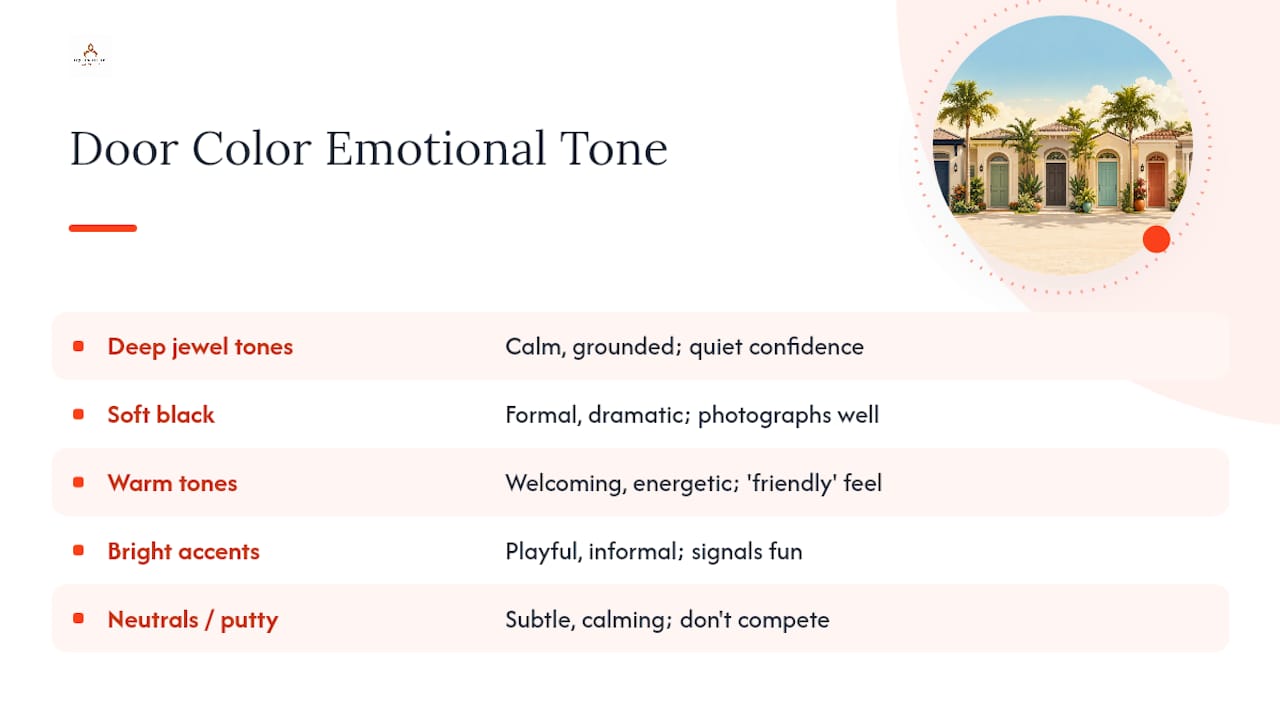
A front door does something no other exterior surface does: it sets an emotional tone before a single word is exchanged. Deep, saturated colors like navy or forest green tend to read as calm and grounded, giving visitors a sense of quiet confidence rather than showiness. Soft black leans formal and a little dramatic, which is part of why it photographs so well on real estate listings.
Warm tones like terracotta or a rich red create a more welcoming, energetic first impression, often described as "friendly" in design surveys because warm hues trigger a different emotional response than cool ones. Bright accents like coral or daisy yellow push further into playful territory, signaling that a house doesn't take itself too seriously.
Neutrals and putty tones do the opposite job on purpose. They create calm by refusing to compete with anything else on the facade, which works well if your landscaping or architectural details are already doing the visual heavy lifting. None of these effects are universal law. A lot depends on your region's design norms and your own house's proportions. But the psychology holds up often enough that it's worth thinking about the feeling you want before you think about the shade card. A bold jewel tone door on a quiet, understated street can look intentional and confident, or it can look out of place — for guidance on choosing these shades based on your door's style and material, see what is the best color to paint interior doors. Context does most of the emotional work.
Test Before You Commit: Samples, Light, and Patience
Never trust a paint chip alone, and don't fully trust your screen either. Sunlight changes color more dramatically on a vertical door surface than it does on interior walls, so a shade that looks perfect on a swatch app can shift entirely once it's outside.
Buy a small sample pot in your top two or three finalists and paint a patch directly on the door itself, not on cardboard or a scrap of wood. Cover an area at least a foot wide so you get a real sense of depth and sheen. Then do the part most homeowners skip: check it at different times of day. Morning light, harsh midday sun, and late afternoon shadow can each make the same color look like three different colors. If your door doesn't get much direct sun, check it on both a cloudy and a bright day, since overcast light tends to flatten warm tones and mute cool ones.
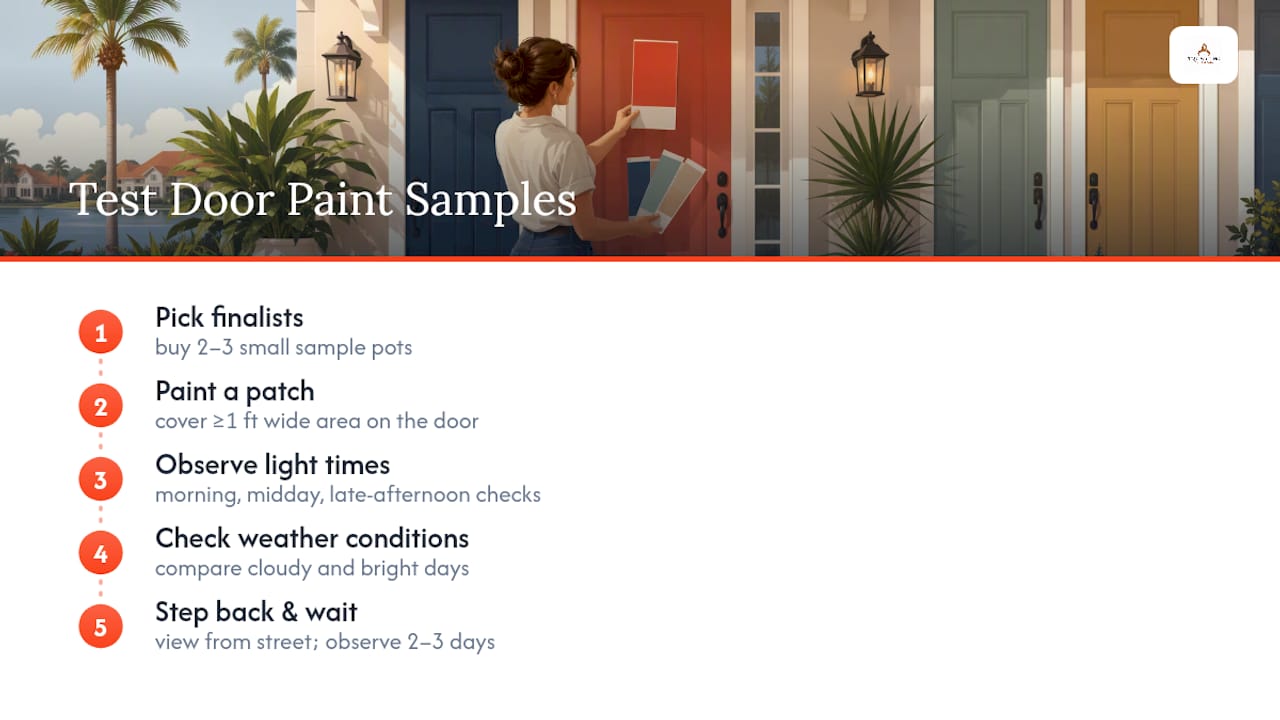
Step back across the street, too. Colors that look great up close sometimes lose their punch or turn muddy when viewed from a normal approach distance. Give yourself at least two or three days of observation before locking in a final choice. A little patience here saves you from repainting a color you only liked in one specific light.
Keeping Your Door Looking Fresh Year After Year
Different colors age differently, and knowing what to expect keeps small issues from becoming full repaints. Dark colors like black and navy show dust and pollen more visibly but hide small scuffs well; a quick wipe-down with mild soap and water every few weeks keeps them looking sharp. Bright and saturated colors like coral or teal are more prone to visible fading under direct sun, so doors in full exposure may need a fresh coat sooner than shaded ones.
Warm neutrals and putty tones tend to hide fading and dirt the longest, which is part of their quiet appeal for busy households. Whatever color you choose, keep a small amount of leftover paint labeled and stored indoors so touch-ups match exactly. Even a tiny color shift from mismatched batches stands out on a high-visibility surface like a front door.
Check your door's finish annually for chalking, cracking, or peeling, especially around the bottom edge where moisture collects. Catching those issues early usually means a quick touch-up rather than a full strip-and-repaint job. Cleaning schedules matter more in coastal or high-pollen areas of Central Florida, where salt air and organic debris build up faster than in more sheltered neighborhoods.
A Contractor's Take on Front Door Color Decisions
The homeowners who get the best results aren't the ones with the trendiest color. They're the ones who nail prep, match undertones honestly, and pick a finish suited to real weather. Skipping primer, choosing the wrong sheen, or ignoring which direction your door faces causes more disappointment than any color choice ever does. When your door has damage, tricky trim, or you just want it done right the first time, bringing in a professional beats guessing.
— Kyle
Ready for a Front Door That Actually Lasts
Picking the right front door color is only half the job. Getting a finish that survives Central Florida sun, humidity, and afternoon storms without chalking or peeling within a year is where most DIY repaints fall short. Professional painting contractors build durability in from the start, with surface prep, primer selection, and enamel formulas matched to how much sun and weather your specific door takes on.

Painting service providers often offer tiered packages allowing customers to choose the level of prep and product that fits their home and budget, whether refreshing one door or repainting the entire exterior. If your front door needs more than a quick refresh, or you want a color consult from someone who's matched hundreds of doors to Central Florida homes, request an estimate through our residential exterior painting services page and we'll walk you through what your specific door needs.
Sources
- The Most Popular Front Door Paint Colors for 2026 | Martha Stewart
- We’re Calling It: 6 Front Door Paint Colors That Will Be Huge in 2026 | The Spruce
- How to choose a front door color | Behr
- Front Door Paint Colors | Expert Picks | Sherwin-Williams
FAQ
What's the best color to paint a front door?
There isn't one universal best color. Black and deep navy consistently rank among the most popular choices because they pair well with almost any siding, while forest green and warm terracotta work especially well on stone or brick homes.
What are the three colors not to paint your front door?
Avoid flat black or overly trendy shades that will look dated within a few years, matte finishes in any color since they wear poorly, and colors that clash with fixed materials like brick or stone undertones you can't easily change.
What is a popular front door color for 2026?
Nature-inspired greens, moody jewel tones like teal and sapphire, and classic navy are leading the front door color trends this year, alongside warm earth tones like terracotta.
What is the most popular front door color right now?
Black and soft black remain the most consistently favored choice among designers, according to survey data highlighted by Martha Stewart, with deep navy following closely as a versatile runner-up.
Should I hire a professional to repaint my front door?
If your door has rot, uneven wood grain, or heavy trim detail, a professional finish using proper primer and spray application in the panel grooves typically outlasts a DIY job.