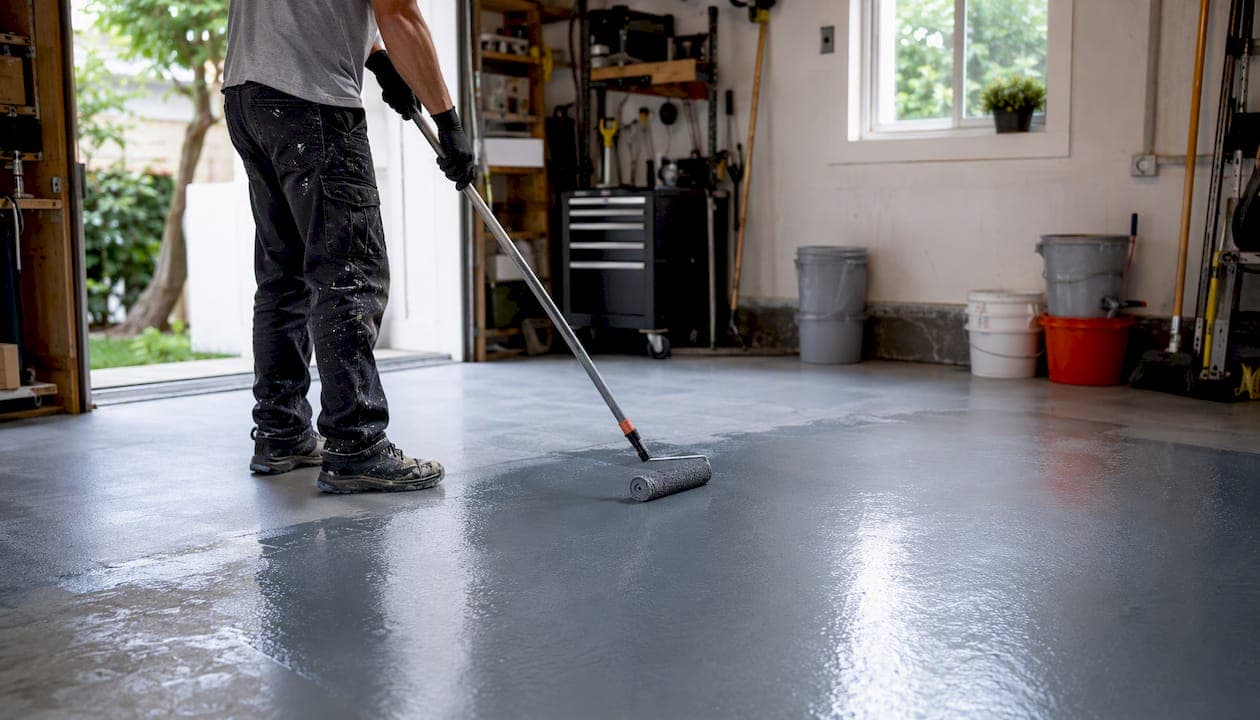
For most residential garages, a polyaspartic topcoat over an epoxy basecoat, or a full polyaspartic system, is the better long-term investment. It cures faster, resists UV yellowing, handles hot-tire pickup better, and typically outlasts a standalone epoxy floor by several years under real garage conditions.
The decisive advantages that drive that verdict:
- Cure time: Polyaspartic systems can reach walk-on readiness in as little as a few hours and drive-on readiness within 24 hours, versus 3–7 days for a full epoxy cure.
- UV and color stability: Polyaspartic coatings resist yellowing from sunlight, which matters in any garage with windows, an open door, or Florida sun exposure.
- Hot-tire resistance: Polyaspartic topcoats hold up against the heat transferred from car tires far better than standard epoxy alone.
- Lifecycle cost: A longer service life and fewer recoat cycles often offset the higher upfront cost over a 10–20 year window.
Epoxy is still a solid choice when the budget is the primary driver, the garage is interior-only with minimal sun exposure, and traffic is light. A well-prepped, high-solids epoxy system can last years in those conditions.
Key Takeaways
Polyaspartic outperforms standalone epoxy for most residential garages on UV stability, hot-tire resistance, and cure time, making it the better long-term value despite a higher upfront cost.
| Point | Details |
|---|---|
| Polyaspartic wins for most garages | UV stability, hot-tire resistance, and fast cure time make it the stronger long-term choice. |
| Epoxy is still valid for low-UV, low-traffic use | A high-solids epoxy system is a reasonable option when budget is the primary constraint and sun exposure is minimal. |
| Moisture testing is non-negotiable | Pre-install vapor drive testing prevents delamination; skip it and any coating system will eventually fail. |
| Diamond grinding beats acid etching | CSP-3 surface prep is the standard for lasting adhesion; acid etching produces a shallower profile and shorter floor life. |
| Trupainting LLC installs both systems | Trupainting LLC offers specialty coatings with diamond grinding, moisture testing, and written warranties for Lake County and Central Florida homeowners. |
Table of Contents
- How do epoxy and polyaspartic compare side by side?
- What are epoxy and polyaspartic coatings, exactly?
- What performance differences actually matter in your garage?
- What does the installation process look like, and how long will your garage be out of commission?
- Should you DIY or hire a professional?
- Pros and cons at a glance
- A contractor's honest take on what actually works in Florida garages
- Trupainting LLC handles the whole job, from prep to topcoat
- Sources and further reading
How do epoxy and polyaspartic compare side by side?
| Dimension | Epoxy | Polyaspartic |
|---|---|---|
| Best for / recommended use | Budget-focused, low-traffic, interior garages | High-traffic, UV-exposed, or fast-turnaround projects |
| Durability and abrasion resistance | Good with high-solids formulas; can chip under heavy impact | Excellent; harder surface film resists abrasion and impact |
| UV stability / yellowing | Yellows with sun exposure; not suitable for outdoor or bright-light areas | UV-stable; holds color and gloss long-term |
| Chemical and oil resistance | Good resistance to motor oil; weaker against gasoline and brake fluid over time | Strong resistance to gasoline, oil, and brake fluid |
| Cure time / downtime | Walk-on: 24 hours; drive-on: 3–7 days | Walk-on: 2–6 hours; drive-on: 24 hours |
| DIY friendliness | Box-store water-based epoxies are DIY-accessible; 100% solids requires experience | Short pot life makes DIY risky; professional application strongly recommended |
| Temperature and moisture sensitivity | Needs 50–90°F and low humidity; sensitive to moisture vapor | Wider application window; some formulas work in higher humidity |
| Appearance and customization | Full-flake broadcast, solid color, metallic effects; topcoat can yellow | Same decorative options; topcoat stays clear and vibrant longer |
| Typical cost and lifespan | Lower upfront; 5–10 year lifespan with proper prep | Higher upfront; 10–15+ year lifespan with proper prep |
| Warranty and maintenance | Varies by installer; recoat cycles more frequent | Longer warranties common with professional systems; easier to clean |
A few plain-language takeaways from that table: the cure-time gap is the single biggest practical difference for most homeowners, since getting your car back in the garage in 24 hours versus a week is a real quality-of-life issue. The UV stability gap is the second most important factor for Florida and Sun Belt garages specifically.
What are epoxy and polyaspartic coatings, exactly?
Epoxy is a thermoset resin system formed when two components, a resin and a hardener, are mixed and react chemically to form a rigid, cross-linked film. Professional-grade garage floor epoxies are typically 100% solids formulas, meaning nearly all of the applied material stays on the floor as a cured film rather than evaporating as solvent. That high volume solids content is what builds a thick, durable basecoat. Water-based or lower-solids epoxies, the kind sold in big-box stores, contain more carrier liquid and produce a thinner final film. Epoxy bonds exceptionally well to properly prepared concrete and is often used as the basecoat in a multi-layer system precisely because of that adhesion strength.
Polyaspartic coatings belong to the polyurea family, and their chemistry is meaningfully different. Where epoxy is a thermoset that cures slowly through a heat-generating reaction, polyaspartic coatings cure through a faster aliphatic reaction that produces a more flexible, UV-stable film. Research in polymer chemistry from MIT confirms that aliphatic polyurea/polyaspartic systems cure faster and offer greater UV resistance than aromatic epoxy systems, which is why epoxy yellows in sunlight while polyaspartic does not. Polyaspartic can function as a standalone system or as a clear topcoat over an epoxy base, and its faster cure speed is a direct result of that chemistry.
The practical takeaway: epoxy wins on bond strength and cost; polyaspartic wins on speed, UV performance, and long-term appearance. Combining them, epoxy base plus polyaspartic topcoat, captures the best of both.
What performance differences actually matter in your garage?
Durability and abrasion resistance
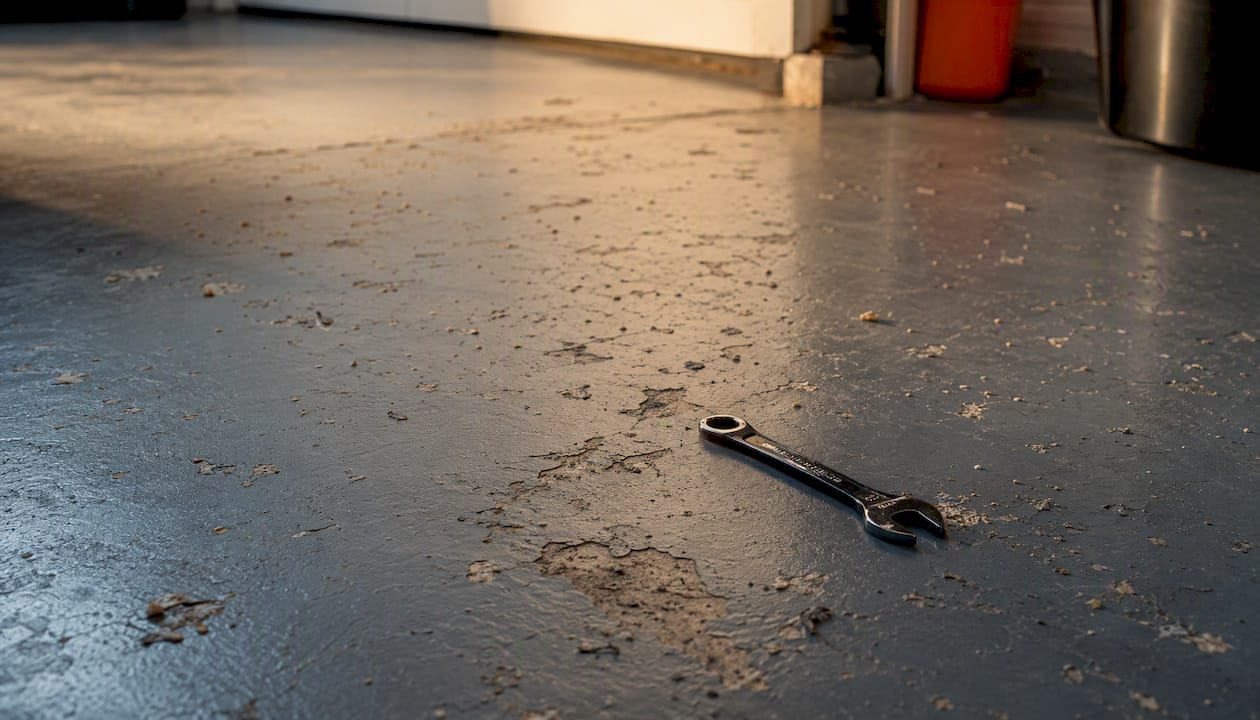
High-solids epoxy and polyaspartic both outperform paint or thin sealers by a wide margin. Epoxy's failure mode in a garage is usually surface chipping from dropped tools or heavy impacts, and delamination when moisture vapor pushes up through the slab. Polyaspartic's slight flexibility means it absorbs impact better and is less prone to chipping. For a two-car garage with daily use, polyaspartic holds its surface finish noticeably longer.
UV stability and yellowing
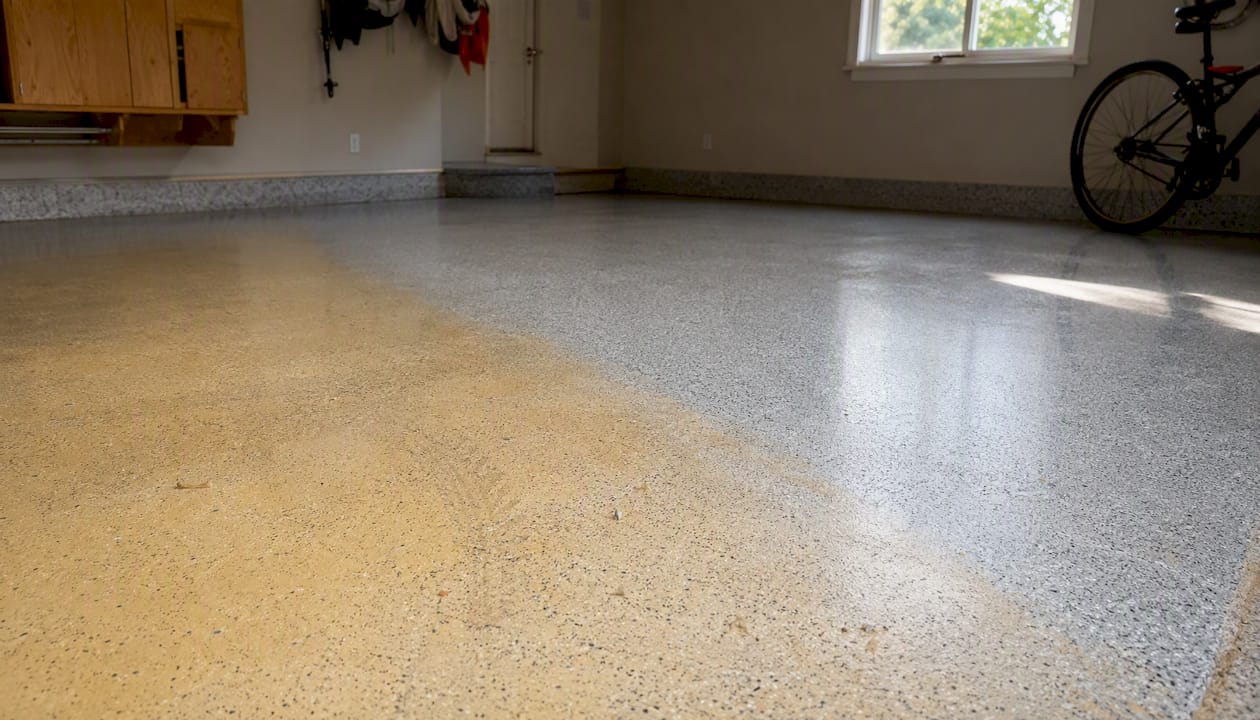
Standard epoxy is aromatic, meaning its chemical structure breaks down under UV light and turns yellow or amber over time. This is not a cosmetic issue you can ignore. In a Florida garage where the door stays open most of the day, an epoxy-only floor can show visible yellowing within a year or two. NOAA UV index data shows that Central Florida receives some of the highest sustained UV exposure in the continental United States, which accelerates that degradation significantly. Polyaspartic topcoats are aliphatic and UV-stable, holding their color and gloss for years under the same conditions. If your garage gets any direct or reflected sunlight, a polyaspartic topcoat is not optional.
Chemical and oil resistance
Both materials resist motor oil well. The difference shows up with gasoline, brake fluid, and transmission fluid, which are more aggressive solvents. Polyaspartic holds up better against those chemicals over repeated exposure. For cleanup, both surfaces wipe clean with a pH-neutral cleaner; you do not need harsh solvents on either.
Hot-tire pickup
Hot-tire pickup happens when a car parks on a coated floor and the heat from the tires softens the coating enough to bond to the rubber. When the car pulls out, it lifts patches of the coating with it. This is one of the most common failure complaints with lower-quality or improperly applied epoxy floors. Polyaspartic topcoats have a higher heat-deflection threshold and are far more resistant to this specific failure mode.
Adhesion, moisture, and vapor drive
University research consistently identifies moisture vapor transmission through concrete slabs as the leading cause of coating delamination. Concrete is porous, and water vapor moves upward through the slab constantly. If a coating is applied without testing and addressing that vapor drive, it will eventually bubble, peel, or delaminate, regardless of whether it is epoxy or polyaspartic.
Before any coating goes down, a qualified installer should perform a calcium chloride test or an in-situ relative humidity test on the slab. HUD guidance on slab remediation recommends moisture mitigation measures when test results exceed acceptable thresholds. Diamond grinding to a CSP-3 (Concrete Surface Profile 3) surface profile opens the concrete's pores and gives the coating a mechanical anchor. Acid etching, which some budget installers use instead, produces a much shallower profile and is a known predictor of early failure.
Temperature and humidity during application
Epoxy has a narrower application window: most formulas require slab and air temperatures between 50°F and 90°F, with relative humidity below 85%. Applying epoxy outside those parameters changes the cure chemistry and weakens the final film. Polyaspartic formulas are generally more tolerant of temperature variation, and some products are specifically formulated for high-humidity environments, which matters in Florida's summer months.
Slip resistance and safety
Both coatings produce a smooth, potentially slippery surface when wet. Reputable installers add aluminum oxide or shark-grip additives to the topcoat to create texture. This is especially worth requesting in a garage where you wash vehicles or live in a rainy climate. The additive is mixed into the final coat and does not affect appearance significantly.
Pro Tip: Ask any installer for the specific moisture test results from your slab before they apply a single coat. A written moisture reading, not just a verbal assurance, is the mark of a professional who will stand behind their warranty.
OSHA guidelines require adequate ventilation and appropriate respiratory protection during coating application. If you are present during installation or doing any DIY work, a half-face respirator with organic vapor cartridges is the minimum protection for solvent-based coatings.
What does the installation process look like, and how long will your garage be out of commission?
Cure windows and garage downtime
| Stage | Epoxy system | Polyaspartic system |
|---|---|---|
| Walk-on | 24 hours | 2–6 hours |
| Light foot traffic | 24 hours | a few hours |
| Drive-on (vehicle) | 3–7 days | 24 hours |
| Full chemical cure | 7–30 days | 24 hours |
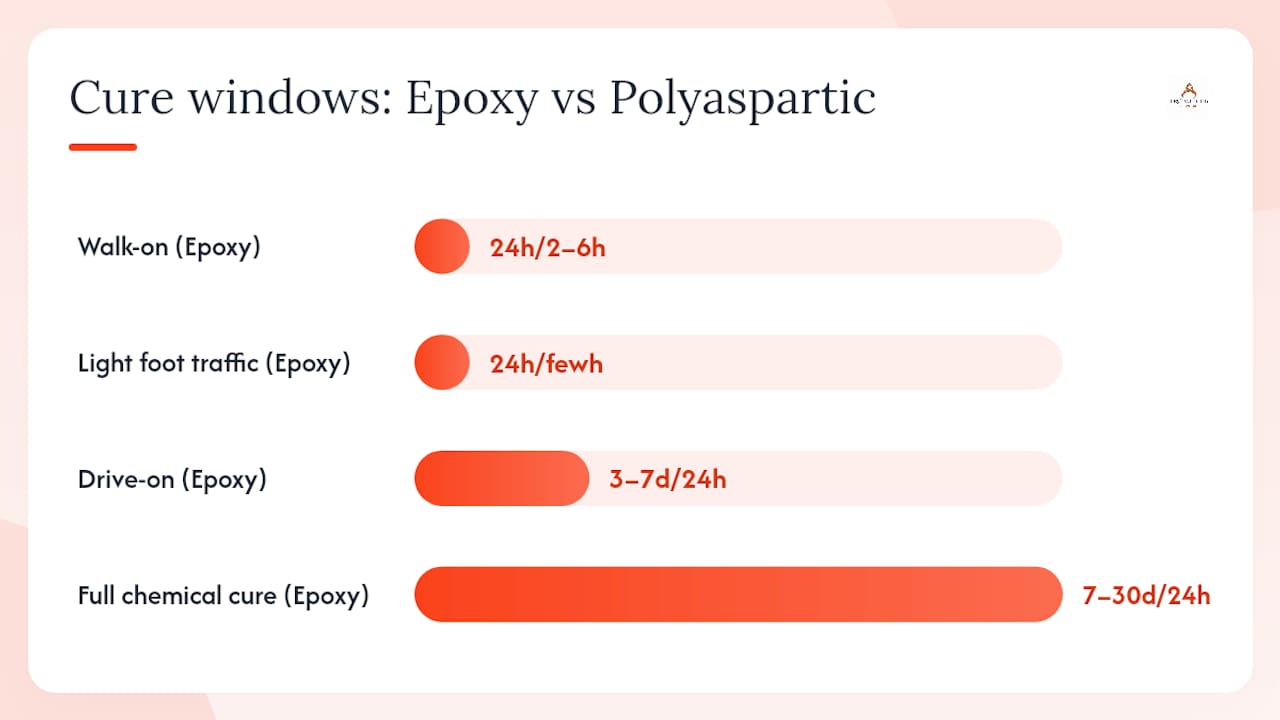
Temperature and humidity directly affect those windows. In Florida's summer heat, epoxy can cure faster on the surface but remain chemically incomplete underneath, which is why drive-on windows should not be shortened based on surface feel alone. Polyaspartic's faster cure is more consistent across temperature ranges.
Installers who skip diamond grinding and use acid etching instead typically see delamination within 1–3 years. The floor may look fine initially, but the shallow surface profile created by acid etching does not provide enough mechanical grip for a long-term bond, especially under vehicle traffic and thermal cycling.
- Plan for at least one full day without garage access for a polyaspartic system.
- Plan for 5–7 days of limited access for a full epoxy system.
- Avoid parking on a new floor during temperature extremes for the first week, regardless of system.
Should you DIY or hire a professional?
The honest answer depends on which system you are considering and what your slab looks like.
When DIY is reasonable
Box-store water-based epoxy kits are genuinely DIY-accessible. They come with instructions, require minimal equipment, and produce a decent result on a clean, sound slab. The trade-offs are real: lower solids content means a thinner film, shorter lifespan, and higher susceptibility to hot-tire pickup and UV yellowing. For a low-traffic garage, a secondary space, or a homeowner who wants to try coating without a large investment, a DIY epoxy kit is a fair starting point.
Red flags to avoid in any installer
- No diamond grinding; proposes acid etching only.
- Cannot provide written moisture test results.
- Vague or verbal-only warranty with no written documentation.
- Does not ask about the slab's history (previous coatings, moisture issues, age).
- Quotes a price that seems too low to cover proper prep.
OSHA standards for solvent handling and ventilation also apply to professional installers. A reputable contractor will arrive with proper PPE and ventilate the space during application. If an installer dismisses safety precautions, that is a signal about their overall standards.
The EPA's guidance on VOCs is relevant here too. High-solids coatings generally emit fewer VOCs per applied volume than diluted formulas, but proper ventilation is still required during application regardless of the product. Low-VOC options exist and are worth asking about, especially for enclosed spaces.
Questions to ask any installer before signing
- What moisture test will you perform, and what reading is acceptable for your system?
- What surface profile (CSP) will you achieve, and how will you verify it?
- What are the product names and solids content of each coat?
- What does your warranty cover, and for how long?
- What are the walk-on and drive-on cure windows for the specific products you are using?
- What happens if the floor fails within the warranty period?
Pro Tip: Ask the installer to show you the product data sheet for each coat before work starts. A professional who uses quality materials will have those sheets on hand and will not hesitate to share them. If they cannot produce them, that tells you something important.
Red flags in a written quote: no mention of diamond grinding, no moisture test line item, no product names listed, and a warranty that is shorter than the installer's claimed lifespan for the floor.
Pros and cons at a glance
Epoxy
Pros:
- Strong mechanical bond to properly prepared concrete
- Lower upfront cost than polyaspartic systems
- DIY-accessible in water-based formulas
- Excellent basecoat for multi-layer systems
- Wide range of decorative options
Cons:
- Yellows with UV exposure; not suitable as a topcoat in sun-exposed garages
- Susceptible to hot-tire pickup without a polyaspartic topcoat
- Long cure time before vehicle traffic is allowed
- Narrow application temperature and humidity window
- Shorter lifespan in high-traffic or UV-exposed conditions
Polyaspartic
Pros:
- UV-stable; holds color and gloss long-term
- Fast cure time; garage back in service within 24 hours
- Superior hot-tire and chemical resistance
- Longer lifespan under real garage conditions
- Wider application temperature range
Cons:
- Higher upfront cost
- Short pot life requires professional application
- Less forgiving of prep shortcuts
- DIY application is not recommended for most homeowners
The bottom line mirrors the opening verdict: for most residential garages, a polyaspartic topcoat, whether over an epoxy base or as a standalone system, delivers better long-term value than epoxy alone.
A contractor's honest take on what actually works in Florida garages
There is a version of this debate that gets argued endlessly online, and it usually centers on which chemistry is theoretically superior. What gets less attention is the part that actually determines whether a garage floor lasts: the prep work underneath the coating.
We have seen beautiful polyaspartic floors fail in two years because the installer skipped moisture testing. We have also seen modest epoxy systems hold up for a decade because the slab was ground properly and the moisture numbers were right before the first coat went down. The coating choice matters, but it is the second decision. The first decision is whether your installer is going to do the prep correctly.
For Lake County and Central Florida garages specifically, the UV argument for polyaspartic topcoats is not subtle. The sun here is aggressive, and a standard epoxy topcoat will show yellowing faster than most homeowners expect. We default to polyaspartic topcoats on virtually every garage floor we coat in this region, not because it is the more expensive option, but because it is the one that still looks good five years later when a client calls us about another project.
Our three-tier service packages let homeowners choose the level of prep, materials, and warranty that fits their situation. Every tier includes diamond grinding and a written moisture test, because those are not optional steps for us. The difference between tiers is the coating system, the number of coats, and the warranty duration. Project photos and details about what each package includes are available when you reach out for an estimate.
Trupainting LLC handles the whole job, from prep to topcoat
Spending hours researching coatings is useful, but the real difference between a floor that lasts and one that peels in two years comes down to who does the work and how they do it. Trupainting LLC brings diamond grinding, moisture testing, and professional-grade polyaspartic and epoxy systems to Lake County and Central Florida homeowners as part of a complete specialty coatings service.
Every estimate includes an on-site slab inspection, a written moisture test result, and a clear scope of work that spells out the prep method, product names, and warranty terms before anything is signed. You will know exactly what is going into your floor and what it is backed by. Our residential interior services cover specialty coatings alongside painting and refinishing, so one contractor handles the full project.
Ready to get a floor that holds up to daily use, Florida sun, and hot tires? Contact Trupainting LLC to schedule your free on-site estimate and moisture assessment.
Sources and further reading
Homeowners who want to verify the claims in this article or dig deeper into standards and safety guidance can consult the following authoritative sources.
This article provides general information about garage floor coating materials and is not a substitute for a professional on-site assessment. Coating performance, moisture conditions, and slab requirements vary by property. Consult a qualified installer and verify current product specifications before making a final decision.