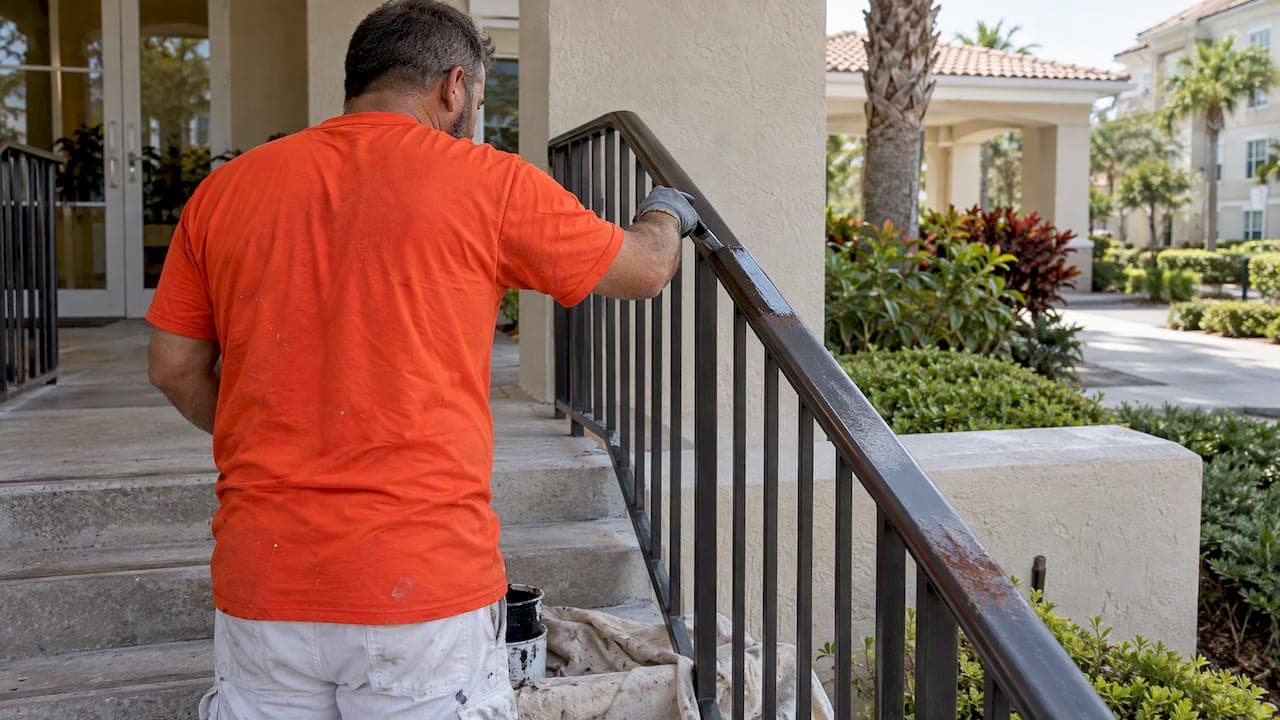
For Florida outdoor metal railings, hire a pro who performs full prep (mechanical rust removal plus passivation), uses a marine-grade primer and a UV-resistant topcoat. That combination gives you the best shot at a finish that actually survives the coast. Before you sign anything, make sure the written estimate spells out prep scope, primer system, topcoat and coat count, and containment practices if the property is older.
TL;DR:
- Salt exposure and high humidity in Florida accelerate rust and coating deterioration, requiring deeper prep and corrosion-resistant primer systems.
- Mechanical rust removal and chemical passivation are essential steps, as skipping them leads to blistering and pinholes within 12 to 18 months.
- Coastal properties need inspection and maintenance every one to two years due to aggressive salt and UV effects, while inland properties can often extend that interval.
- Proper job estimates must specify prep procedures, primer type, coating system, and coats to ensure long-lasting paint performance.
- Lead paint regulations apply to properties built before 1978, demanding certified containment, cleanup, and clearance procedures for safety and compliance.
Table of Contents
- What a professional metal railing painting job includes
- Why Florida's climate changes the paint specification
- What metal railing painting typically costs in Florida
- Lead paint and EPA RRP: what Florida property owners should know
- How to choose a metal railing painting contractor in Florida
- Why thorough prep usually matters more than the paint brand
- Tru Painting: metal railing care built for Florida conditions
- FAQ
- Sources
What a professional metal railing painting job includes
A quality metal railing restoration follows a sequence, and skipping steps is exactly where cheap jobs fail early. Here is what should happen, in order:
- Inspection first. A contractor checks fasteners, welds, and attachment points for structural issues before touching a brush.
- Mechanical rust removal. Wire wheels, grinders, or sandblasting strip rust and failing paint down to sound metal.
- Chemical passivation when needed. On heavily pitted or salt-damaged rail sections, a passivating treatment stabilizes any rust that mechanical work cannot fully remove.
- Cleaning and degreasing. The surface gets washed and profiled so the primer actually bonds instead of sitting on top of contaminants.
- Masking and containment. Plastic sheeting, drop cloths, and tape protect stucco, concrete, landscaping, and glass from overspray and debris.
- Priming. Epoxy or zinc-rich primers go on for corrosion resistance, chosen based on the metal type and exposure level.
- Topcoat application. UV-stable acrylic enamels, polyurethanes, or electrostatic powder-style finishes go on in at least two coats for even coverage and long-term durability.
Any contractor who jumps from "clean it" to "paint it" without mentioning rust removal or primer type is skipping the part of the job that determines how long the finish lasts. For a deeper look at the inspection phase specifically, see what a professional painter inspects before starting.
Why Florida's climate changes the paint specification
Inland painting rules do not fully apply once you are dealing with salt aerosol, year-round humidity, and intense UV exposure. Coastal air carries salt that settles on metal surfaces and works its way under coatings faster than in drier climates, which is why a spec that works in Ohio can fail in two years on a Clermont lanai or a Daytona balcony.
- Salt and humidity accelerate corrosion and undercut coatings faster near the coast than inland.
- Prep depth matters more in salt-exposed areas: feathering old paint instead of stripping to bare metal leaves hidden corrosion that spreads under the new coat.
- Primers with corrosion inhibitors and topcoats rated for UV stability resist chalking, fading, and cracking from Florida's sun.
- Flexible topcoat formulations handle the expansion and contraction metal goes through during Florida's daily heat swings.
Practitioners report that painting directly over visible rust, without removing it or using approved passivation plus an epoxy primer, commonly leads to failure within 12 to 18 months in coastal Florida. Well Built Florida That failure shows up as blistering and pinholes where the trapped rust keeps working under the paint film.
Coastal properties generally need inspection every one to two years, while inland properties in Central Florida can often stretch that cadence longer, depending on sun exposure and railing material. For more on coating selection for Florida exteriors, see our guide on low maintenance exterior paint.
What metal railing painting typically costs in Florida
Pricing usually comes in one of three forms: per linear foot, hourly, or a flat per-project quote. For a straightforward 100-foot railing with moderate prep and a two-coat system, practitioner pricing guidance puts the total cost in a mid-range estimate. Well Built Florida
Several factors push that number up or down:
- Total linear feet of railing, since most contractors price by length.
- Corrosion severity, because heavy rust means more mechanical removal time and possibly passivation.
- Access and height, since second-story balconies or hard-to-reach sections take longer to stage.
- Coating specification, where premium epoxy primers and polyurethane topcoats cost more than basic acrylic systems.
- Safety and containment needs, which add labor hours on older properties.
Well Built Florida That is why the cheapest bid is often the one that cuts corners on rust removal. Homeowners can manage cost by bundling railing work with other exterior projects, scheduling during a contractor's slower season, or choosing a mid-tier primer system where corrosion exposure is lower.
Lead paint and EPA RRP: what Florida property owners should know
If your property was built before 1978, disturbing old paint on metal railings can trigger EPA's Renovation, Repair, and Painting (RRP) rule. EPA RRP guidance This is not optional paperwork. It governs how the job gets done and what has to happen afterward.
- Check property age first. RRP applies to most exterior work on pre-1978 housing unless a minor repair exemption applies.
- Confirm containment distance. EPA guidance calls for plastic sheeting extending at least 10 feet from the work area on exterior jobs, with more distance or vertical containment needed near property lines or in windy conditions. EPA RRP guidance
- Require HEPA cleanup. Dust and debris containing lead must be captured with HEPA vacuums, not swept or blown.
- Ask for clearance documentation. A certified renovator should provide a pre-job pamphlet, a written work plan, and proof of clearance after the job.
Property managers in particular should request proof of a certified renovator before work starts, since these obligations can turn a simple railing repaint into a regulated job with real cost and schedule impacts. For more on disclosure responsibilities tied to older properties, see this property manager's guide to lead paint disclosure. For safe cleanup verification methods, this resource on cleaning lead dust safely is a useful reference.
Pro Tip: Ask every contractor whether the property's age requires RRP compliance, even if the railing itself looks newly installed.

How to choose a metal railing painting contractor in Florida
The quote itself tells you most of what you need to know. Look for these elements before signing anything:
- A detailed prep scope that names mechanical rust removal, passivation where needed, and surface cleaning.
- A specified primer and topcoat system, named by type, not just "quality paint."
- The number of coats written out, not left vague.
- A workmanship warranty covering the finish for a defined period.
- A realistic timeline that accounts for Florida weather and drying conditions.
Ask contractors about their experience with coastal projects, request photos of past railing work, and confirm RRP certification if the property is older. Ask about insurance limits too, since railing work often involves ladders or elevated access.
Red flags include vague descriptions like "we'll clean it up and paint it," no written coating brand or system, bids dramatically lower than competitors, and reluctance to share references. Contractors who offer tiered service packages, documented before-and-after photos, and local references tend to be more transparent about what you are actually paying for.
Why thorough prep usually matters more than the paint brand
After years in this industry, the pattern is consistent: the paint brand gets too much credit and the prep work gets too little. A premium topcoat over rust that was never fully removed will blister within a season or two in coastal air. Well Built Florida That is where the money and the time actually go, and it is where quality separates from shortcuts.
— Kyle
Tru Painting: metal railing care built for Florida conditions
A professional painting contractor serving Florida builds every exterior metalwork job around the prep-first approach this guide describes. Estimates spell out the specifics: rust removal method, primer system, topcoat type, and number of coats, so clients know what they are paying for before work begins.
What you get with a Tru Painting estimate:
- A detailed written scope covering prep, priming, and topcoat specification.
- A workmanship warranty backing the finish we apply.
- Flexible service tiers, from a Cosmetic Refresh to Maximum Prep & Protection, so you choose the level of durability that fits your budget.
- Local crews familiar with Central Florida's sun and humidity demands.
If your railings are showing rust, chalking, or peeling paint, request a site inspection and written estimate through our main services page. We will walk the property with you and show you exactly what the job involves before any work starts.
FAQ
How much should I expect to pay to paint a metal railing?
Pricing typically runs by linear foot, by hour, or as a flat project quote, with a 100-foot railing job often landing around $900 to $1,400 for moderate prep and a two-coat system. Well Built Florida Heavier rust, taller access, or premium coatings push that total higher.
What are Florida's code requirements for balcony railings?
Florida building codes govern railing height and structural requirements rather than paint finish, so code compliance for painting itself centers on safety practices like EPA RRP when lead paint may be present. EPA RRP guidance Check with your local building department for structural railing code specifics tied to your property.
What do painters in Florida typically charge per hour?
Hourly rates vary by region and experience, and the Bureau of Labor Statistics tracks wage data for painters and related occupations in Florida that helps explain typical regional cost structures. BLS occupational data Most residential railing jobs are quoted as a flat project price rather than billed purely by the hour.
Can I paint my own metal railing instead of hiring a pro?
You can, but without mechanical rust removal, proper primer, and a UV-stable topcoat, a DIY paint job over Florida's salt air and sun often fails within a year or two. Well Built Florida If the property was built before 1978, EPA RRP rules may also apply to the work.
Is powder coating or electrostatic refinishing an option for aluminum railings?
Yes, electrostatic refinishing can restore aluminum railings in place when the metal is structurally sound, giving a near-factory finish without full replacement. Florida's Choice Contracting It is often a lower-cost alternative to tearing out and replacing railings entirely.
Sources
- LEAD SAFE Renovation, Repair and Painting
- Cost to Paint Metal Railings: Prices, Factors, and Savings 2026 – Well Built Florida
- Painting, Coating, and Decorating Workers
- Glass & Aluminum Railing Systems | Florida's Choice Contracting