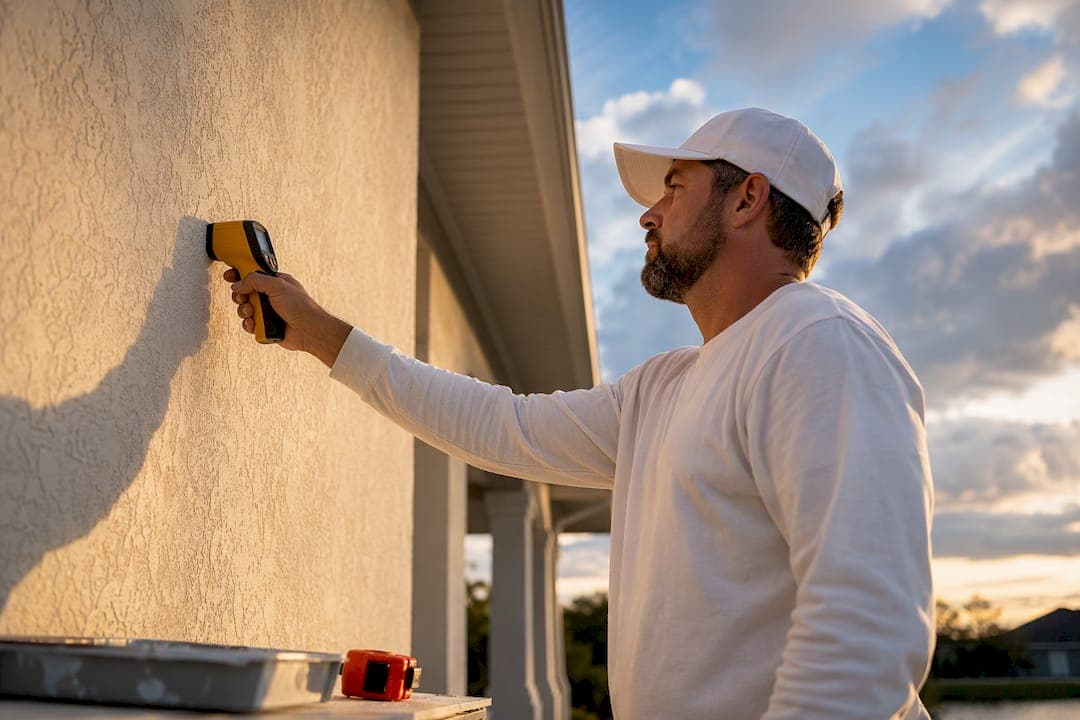
The best window for exterior painting in Florida generally runs from the start of the dry season through the cooler months, when humidity and rain are typically lower, creating better curing conditions. South Florida often gets reliable stretches in March or October and November, while Central and North Florida do best from October through March. Interior painting is different: you can usually schedule it any month of the year as long as you control humidity and ventilation indoors.
TL;DR:
- Exterior painting in Florida should be scheduled between October and April to avoid high humidity, rain, and storm delays that can compromise the quality.
- Surface temperature and dew point are critical; paint must be applied when surfaces are at least 5°F above the dew point and no rain or wind is forecasted for several hours.
- Interior painting is flexible year-round but requires humidity control to prevent peeling and mold growth, especially if moisture issues are present.
- Address moisture problems like leaks or mold before painting, as surface damage or ongoing water intrusion can cause early paint failure.
- Contractors should verify their products' temperature and dew point limits on-site and build schedules with buffer days to accommodate weather disruptions.
Table of Contents
- 1. Best seasonal windows for exterior painting by region
- 2. Does your day pass the paint manufacturer's weather test?
- 3. Interior painting works on almost any schedule
- 4. Fixing moisture problems before you repaint
- 5. Building a realistic project timeline with your contractor
- 6. What Central Florida painters check before starting a job
- How Tru Painting handles Florida's painting season
- Where to check the details yourself
- Sources
- FAQ
1. Best seasonal windows for exterior painting by region
Florida's weather splits into two clear seasons, and knowing the boundaries helps you plan a project that actually holds up. According to seasonal data from the National Weather Service in Melbourne, the wet season typically begins in late May and the dry season typically begins in mid-October, with median onset dates for the east-central region landing around May 27 to 30 for wet season and around October 15 for dry season. Those dates shift a little every year depending on broader weather patterns, so treat them as a planning benchmark rather than a fixed calendar.
Once the dry season sets in, mornings get less humid, afternoon thunderstorms fade out, and paint gets the stretch of dry hours it needs to cure properly. That's why October through April is the window most Central Florida contractors point to first.
Regional timing varies enough to matter:
- South Florida: Look at March or the October to November stretch, since summer humidity lingers longer near the coast.
- Central Florida: October through March tends to deliver the most consistent dry runs.
- North Florida: Similar to Central Florida, with slightly cooler winter mornings to watch for dew.
Hurricane season, which runs alongside the wet season from June through November, adds another reason to lean on fall and winter scheduling. Storms bring wind, driving rain, and unpredictable delays that can strand a half-finished exterior job. For more detail on building a schedule around storm risk, our guide to painting on U.S. coasts walks through the contingency planning worth doing before you commit to a start date.
2. Does your day pass the paint manufacturer's weather test?
Calendar season gets you close, but the paint can decides the final answer. Modern waterborne exterior paints, including Sherwin-Williams SuperPaint, can go on and cure at temperatures as low as 35°F, but only when air, surface, and material temperatures all meet that minimum and the surface stays at least 5°F above the dew point.

Dew point is the number Florida homeowners tend to overlook. A warm, sunny afternoon can look perfect and still set you up for failure if the surface cools below the dew point overnight, causing moisture to form on paint that hasn't finished curing. Sherwin-Williams' painting application guidance flags the first 48 hours after application as the most critical stretch, since unstable temperatures or humidity during that window can compromise the finish before it ever fully hardens.
Before you or your crew pick up a roller, run through this checklist:
- Confirm the surface temperature meets the paint's minimum, not just the air temperature.
- Check that the surface is at least 5°F above the current dew point.
- Verify no rain is forecast for the next 2 to 3 hours, or whatever window the product data sheet specifies.
- Rule out wind or lightning that would make ladder work or spraying unsafe.
- Make sure the surface has fully dried from any recent rain before you start.
A surface less than 5°F above the dew point risks moisture forming on fresh paint before it cures, which can cause blistering, dull spots, or poor adhesion. That single number matters more on a Florida morning than the daytime high ever will.
3. Interior painting works on almost any schedule
Interior projects sidestep most of the seasonal guesswork because you control the climate. The EPA's guidance on indoor moisture recommends keeping relative humidity below 60%, ideally between 30% and 50%, to avoid the kind of moisture buildup that leads to peeling paint or mold growth. Run your HVAC system or a dehumidifier during the job, and you've handled most of the risk regardless of the month.
A few practical steps make interior painting go smoothly:
- Run the air conditioner or a dehumidifier throughout the project and for a day or two afterward.
- Ventilate the work area with open windows or fans to help fumes and moisture clear.
- Isolate the room from the rest of the house with plastic sheeting if occupants are sensitive to odors.
- Schedule around your household's tolerance for paint smell, especially with kids, pets, or home offices in the mix.
Hold off on interior painting if you have an active leak, visible mold, or unusually high indoor humidity. Painting over any of those problems just traps them under fresh color.
4. Fixing moisture problems before you repaint
A fresh coat only lasts as long as the surface underneath is sound. Leaking gutters, damaged flashing, wind-driven rain intrusion, and slow plumbing leaks all push moisture into walls and siding, and painting over that moisture almost guarantees early peeling or blistering. The EPA's moisture control guidance treats these as building problems first, paint problems second, and recommends diagnosing and correcting the source before any topcoat goes on.
Before repainting, work through this list:
- Clean off mildew and algae so new paint bonds to a healthy surface, not a biofilm.
- Scrape and sand any loose or peeling paint back to a stable edge.
- Confirm stucco has cured fully if it's new or recently patched, since manufacturer guidance often calls for cure times of one to four weeks depending on the system.
- Prime bare substrate appropriately for the material, whether it's stucco, wood, or CMU block.
Pro Tip: If you spot a recurring stain or bubbling paint in the same spot every year, chase down the water source before you buy another gallon of paint.
Bring in a professional for anything beyond surface cleaning, particularly major stucco repair, flashing replacement, or signs of structural moisture. Those jobs need the right materials and cure times to hold up, and getting them wrong undoes any painting work that follows.

5. Building a realistic project timeline with your contractor
Give any exterior project buffer days beyond the estimate, since a single rain delay or a run of dewy mornings can push a schedule by several days. Multi-coat systems need each layer to get its full drying window, so a tight schedule with no slack is asking for trouble.
When you're vetting a contractor, ask these questions:
- Which paint brand and product will they use, and have they reviewed its technical data sheet for temperature and dew point limits?
- How do they check surface temperature and dew point on site, rather than relying on a phone weather app?
- What's their policy for rescheduling around storms or unexpected rain?
- What warranty terms cover the workmanship once the job is finished?
If your exterior window closes because of a stretch of wet weather, ask whether the crew can shift to interior work or repairs in the meantime rather than leaving the job half done. Our breakdown of how weather affects exterior painting covers more on building that flexibility into a contract.
6. What Central Florida painters check before starting a job
Experienced crews in Central Florida care less about the forecast high and more about overnight lows and dew point, since those numbers determine whether a coat cures cleanly before moisture returns. They look for multi-day dry stretches, not just a single clear afternoon, especially on jobs that call for more than one coat. When a run of wet weather closes the exterior window, the smart move is shifting the crew to interior scopes or prep work rather than forcing an exterior start that won't hold up.
— Kyle
How Tru Painting handles Florida's painting season
A local painting contractor serves homeowners and businesses across Lake County and Central Florida with residential and commercial exterior and interior painting, stucco repair, pressure washing, and cabinet refinishing.

When you request an estimate, expect a full inspection, a check for moisture issues before any color goes on the wall, a product recommendation suited to your surface, and a schedule built around a real dry window rather than a guess. Our three-tier service packages, Cosmetic Refresh, Enhanced Prep & Durability, and Maximum Prep & Protection, let you choose the level of preparation and protection that fits your budget. Get in touch through our main site to schedule your estimate and get a project timeline that works with Florida's weather, not against it.
Where to check the details yourself
For product-specific limits, read the technical data sheet for your chosen paint, Sherwin-Williams' EPA moisture guidance, and current NWS seasonal outlooks for Florida.
Sources
- SuperPaint Exterior Latex product data sheet (Sherwin‑Williams)
- Florida rain machine / wet and dry season discussion (NWS Melbourne)
- Mold course chapter 2 — EPA
FAQ
What is the best month to paint a house in Florida?
There's no single best month for the whole state, but October and November tend to offer reliable dry stretches across Central and North Florida, based on seasonal onset data from the National Weather Service. South Florida homeowners often get similarly good conditions in March.
What is the hourly rate for a painter in Florida?
Tru Painting does not publish a flat hourly rate, since project pricing depends on scope, prep work, and materials. Request an estimate through our services page for pricing specific to your project.
What color house sells the fastest?
There's no verified, sourced ranking of exterior colors tied to faster home sales, so treat any specific color claim you see elsewhere with caution. Neutral, well-maintained exteriors are a safer bet for broad buyer appeal than chasing a trend color.
What is the peak tourist season in Florida?
Florida's tourist season generally overlaps with its cooler, drier months in winter and early spring, which is also when exterior painting conditions tend to be at their best. That overlap is worth factoring in if you're booking a contractor during a busy travel period.
Can you paint outdoors in Florida during the summer?
You can, but summer's wet season brings daily humidity and afternoon storms that make consistent curing harder, according to seasonal patterns tracked by the National Weather Service. Many contractors prefer to schedule big exterior jobs outside the June through November stretch when possible.