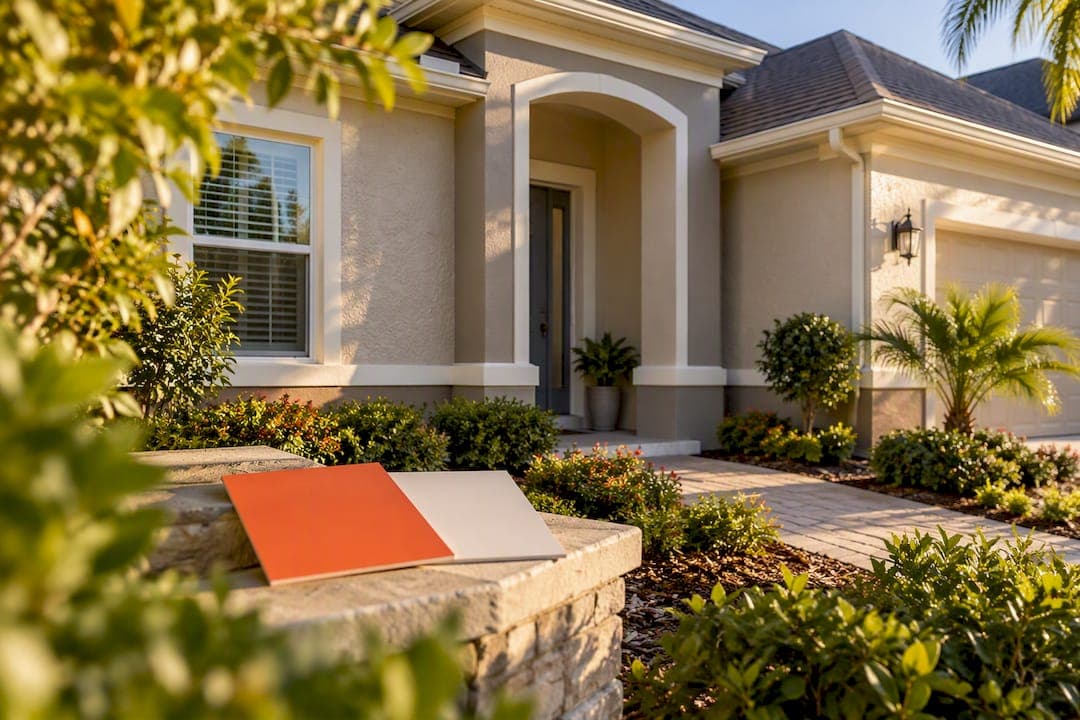
In most Villages neighborhoods, repainting your home the original construction color or a color from your district's approved palette does not require Architectural Review Committee approval. Choosing anything outside that palette does. Before you buy a single gallon, confirm your CDD district and check your current palette with Community Standards or your district's ARC manual.
TL;DR:
- Most repainting within districts does not require approval if using the original or current approved palette; approval is needed only when selecting outside colors.
- Each district maintains its own palette, making it essential to verify your specific CDD's approved colors before purchasing or applying paint.
- Approval is mandatory if changing from approved hues, mixing colors from different palettes, or drastically altering the home's exterior, including finishes or textures.
- Applying with complete documentation, including photos, color chips, and original formulas, significantly speeds up ARC approval and reduces rejection risk.
- Common mistakes include mixing palettes, skipping color verification, and not providing neighborhood context photos, all of which can be avoided with proper preparation.
Table of Contents
- What Governs Paint Rules in The Villages?
- How District Color Palettes Work (And Where to Find Yours)
- When Do You Need ARC Approval to Paint?
- Special Rules for Villas, Driveways, and Coatings
- How to Apply for ARC Approval: A Step-By-Step Checklist
- Choosing a Color That Passes Review and Looks Great
- What Happens If You Don't Follow the Rules?
- How Tru Painting Helps You Avoid Rework
- A Local Pro's Take on the Most Common Paint Mistakes
- Get Professional Help With Your Villages Repaint
- Sources
- FAQ
What Governs Paint Rules in The Villages?
Every color rule in The Villages traces back to three layers of governance: the Community Development District (CDD) that covers your neighborhood, the Architectural Review Committee (ARC) that reviews applications, and the Declaration of Restrictions that gives the ARC its authority in the first place. Each CDD maintains its own manual, and the Community Standards Department oversees the review process and deed compliance across all of them.
The guiding principle behind every rule is neighborhood harmony. Boards want colors that fit the existing "plan of development" for a section, not a single house that stands out from every home around it. Villages-News reported that CDD 9 revisited its own color palettes specifically to prevent gaudy paint jobs, a goal that shows up in nearly every district manual in some form.
That harmony standard translates into a few concrete prohibitions found across ARC manuals:
- No hot, electric, or neon colors on any exterior surface, regardless of district.
- Only solid colors that read as harmonious with surrounding homes.
- No commingling: your base, trim, and accent colors must all come from the same approved palette.
- Bottom rows of some palettes are restricted to trim and accent use only, not base coats.
That last rule trips up more homeowners than any other. A perfectly approved trim shade from Palette 2 paired with a base color from Palette 1 is still a violation, even though both colors individually appear on an approved list somewhere.
How District Color Palettes Work (And Where to Find Yours)
Color palettes are not universal across The Villages. Each CDD sets and maintains its own palette, which means a shade approved two neighborhoods over might be flatly rejected in yours. A color's hue range gets interpreted slightly differently district to district, so verify against your own CDD's manual rather than pointing to a neighbor's house as proof a color is fine.
You have two reliable ways to check a palette:
- In person: Visit the Community Standards Department office at 984 Old Mill Run, where current palettes for most districts are posted or available for review.
- In print: Pull up your district's specific ARC manual, most of which are posted as PDFs on districtgov.org, or the general House Re-Painting guidelines that explain the palette system districtwide.
If you're not sure what color your house was originally painted, the warranty or administration office for your district can look up the original formula tied to your address. That number is worth writing down and keeping somewhere permanent. It saves you a repeat trip the next time you repaint, and it's often the fastest path to an approval-free repaint since matching the original color sidesteps the ARC process entirely.
A few patterns show up repeatedly across districts. Older sections tend to have shorter, more conservative palettes with fewer options. Newer sections often carry expanded palettes with more base and accent combinations, reflecting current builder trends. Either way, the commingling rule applies the same everywhere: trim and accents must stay within the same numbered palette as your base coat.
When Do You Need ARC Approval to Paint?
Most repaints in The Villages sail through without a single form, because most homeowners simply repaint the color that's already on the house. Approval becomes necessary the moment you deviate from that baseline. Here's exactly when you need to file:
- You want a base color that isn't on your district's current approved palette. This is the single most common reason homeowners end up filing an application.
- Your home is stucco and you're changing the finish or color scheme, since stucco repaints often carry additional texture and coating considerations beyond a standard repaint.
- The color you want falls outside the approved hue range, even if it looks similar to an approved shade on a paint chip. Undertones matter more than most people expect.
- You're mixing colors from two different palettes for base, trim, or accent, which almost always triggers a denial rather than a request for more information.
- You're making a major exterior alteration alongside the paint job, such as adding architectural trim, changing shutters, or altering a facade element that wasn't part of the original construction.
When you do file, expect the ARC to ask for specifics: color chips or swatches, photographs of your home's current condition, photographs of the two or three homes immediately next to and across from you, your address, and product data if you're using a specialty coating. Reviewers weigh three things above all else: whether the color harmonizes with neighboring homes, whether it's consistent with the original plan of development for your section, and what the visual impact looks like from the street.
Special Rules for Villas, Driveways, and Coatings
Courtyard and patio villas play by a slightly different rulebook than single-family homes, largely because villa units sit closer together and share more visual continuity. If a villa community wants to expand or change its approved colors, it typically needs a petition signed by 75% of homeowners in that unit, submitted to and approved by the ARC. Once that petition is approved, individual owners choosing from the newly approved petition colors generally don't need to file a separate ARC application, which is a meaningful shortcut if your villa community has been trying to update its look for a while.

Absent an approved petition, patio and courtyard villas usually default to the same rule as everyone else: the original construction color or the current approved palette requires no separate approval, and anything else does.
Driveways, walkways, and pavers carry their own limits:
- Painted driveway or walkway designs are typically capped at a set size, often around 5 feet by 5 feet, depending on district specifics.
- Pavers are generally permitted when they sit flush and conform to district guidelines.
- Colored coatings on driveways or walkways usually require prior written approval before you apply anything.
- Bright, hot, or neon colors are prohibited on hard surfaces just as they are on house exteriors.
One clean petition beats a dozen separate ARC applications.*
How to Apply for ARC Approval: A Step-By-Step Checklist
Filing a clean application the first time is almost always faster than fixing a rejected one. Work through these steps in order:
- Confirm your CDD district. Rules and palettes are district-specific, so this is the foundation everything else builds on.
- Get your original color or your district's current palette chip. Your warranty or administration office can confirm the original formula tied to your address.
- Photograph your home from the street, along with the two or three homes immediately adjacent and across the street.
- Gather product and formula information, especially if you're using a specialty coating or a stucco-specific product.
- Complete the ARC application with your address, chosen colors identified by palette number, and supporting photos attached.
- Submit to Community Standards or your district ARC, either in person at 984 Old Mill Run or by the submission method your district specifies.
Homeowners on the Talk of The Villages forums consistently recommend calling ahead to Community Standards at 352-751-3912 before submitting anything, since a five-minute call can confirm your palette and formula before you spend money on paint.
The most frequent reasons applications get denied or bounced back for revision are commingling colors from two different palettes, submitting without context photos of neighboring homes, and villa owners skipping the petition process and applying individually for a color their community hasn't formally adopted. Avoid those three mistakes and most applications move through cleanly.
Choosing a Color That Passes Review and Looks Great
The safest strategy is also the simplest one: pick your base, trim, and accent colors from the same numbered palette every time. Cross-palette combinations are the single biggest cause of denials, and there's no workaround for it beyond staying within one palette from the start.
Once you've narrowed your options, view full-size samples in natural daylight rather than trusting a small paint chip indoors. Colors shift dramatically under Central Florida sun compared to how they look under store lighting. Hold your samples up against your actual roof color and existing landscaping, since a shade that looks neutral on a chip can clash badly against a terracotta tile roof or established greenery.
Favor subdued, weathered base tones for the majority of your exterior, and save any brighter accent shade for the small trim areas where your palette actually allows it. Skip neon or electric tones entirely. Not only are they prohibited outright, they also tend to fade unevenly in Florida's sun, which creates its own follow-up headache a few years down the road.
- Confirm palette number on every color before committing.
- Test samples in direct sun, not just under a store's fluorescent lighting.
- Match trim and accent choices to the same palette as your base.
- If you're also updating your front door, research complementary door colors before locking in your final scheme.
Pro Tip: Bring your actual palette number, not just a paint chip, when you visit a paint supplier. Suppliers can mix an exact match far faster when they know which numbered district palette a color came from.
What Happens If You Don't Follow the Rules?
Enforcement in The Villages is almost entirely complaint-driven. A neighbor, a passing board member, or a routine deed compliance inspection flags a house that looks out of step with its palette, and Community Standards opens a review from there.
Typical outcomes follow a predictable sequence rather than jumping straight to penalties:
- A notice to cure, giving you a window to correct the color or file for retroactive approval.
- A repaint order if the color truly falls outside any approved palette and no resolution is reached.
- Fines or a formal hearing in cases of repeated or ignored noncompliance, though monetary fines are rarely the first step rather than the immediate response.
If you receive a notice, you generally have three paths forward: appeal the finding if you believe your color is compliant, submit a proper ARC application with full documentation if you skipped that step originally, or repaint to bring the house back into compliance. Acting quickly after a notice almost always produces a better outcome than waiting it out.
How Tru Painting Helps You Avoid Rework
Getting the color right the first time saves you money, and Tru Painting builds that into how we work with Villages homeowners. We verify your district's current palette on-site, match new coats to original formulas when that's the goal, and document everything with the photos ARC applications typically require.
Beyond paperwork, our residential exterior painting work focuses on the prep that makes a color last in Central Florida's heat and humidity, backed by workmanship warranties. That combination reduces the odds of a rejected application and cuts down on repaint headaches down the road.
A Local Pro's Take on the Most Common Paint Mistakes
The mistakes I see repeat themselves house after house: homeowners mixing trim from one palette with a base from another without realizing it's a violation, skipping the step of confirming their original color before assuming they need approval at all, and submitting applications without photos of the neighboring homes for context.
Every one of these is avoidable in an afternoon. Call the warranty office, confirm your original formula, bring that number to your paint supplier, and photograph your street before you file anything. If you're even slightly unsure which palette governs your section, call Community Standards before you buy paint, not after.
— Kyle
Get Professional Help With Your Villages Repaint
Professional painting services can help Villages homeowners avoid common issues with ARC applications by verifying palette numbers, matching formulas, and documenting street photos as part of their process, ensuring the colors used comply with district requirements.
Our residential exterior painting service covers color verification, prep, and application, with three service tiers, Cosmetic Refresh, Enhanced Prep & Durability, and Maximum Prep & Protection, so you can match the level of protection to your home and budget. If your cabinets or interior trim need attention while you're at it, we also handle cabinet refinishing. Reach out through Trupaintingllcfl to request a color consultation or an on-site estimate before your next repaint.
FAQ
Do I Need ARC Approval to Repaint My House the Same Color?
No. If you're repainting your home the exact original construction color, or any color already on your district's current approved palette, you generally don't need ARC approval. Approval is required only when you choose a color outside that palette or its hue range.
What Is the 80/20 Rule in The Villages?
This term doesn't refer to an official paint or architectural rule published by the CDDs or Community Standards. If you've heard it in a different context around The Villages, it's worth confirming directly with Community Standards rather than relying on secondhand descriptions.
Why Are Some Homeowners Leaving The Villages?
Reasons vary widely by household and aren't governed by paint or architectural rules specifically. Community Standards and ARC guidelines focus narrowly on maintaining consistent exterior appearance, not on broader lifestyle or cost factors that might influence a resident's decision to relocate.
What's a Common Downside Homeowners Mention About Paint Rules?
The most frequent complaint centers on commingling palettes: a homeowner picks a trim or accent color that's technically approved somewhere in the district, only to have an application denied because it doesn't share a palette with their chosen base color. Verifying your full color scheme against a single palette number before applying avoids this entirely.
How Long Does ARC Approval Take for a Paint Color Change?
Timelines vary by district and by how complete the initial application is, but incomplete submissions, especially those missing neighboring-home photos, are the most common cause of delay. Submitting full documentation the first time, including photos, color chips, and your palette number, gives you the fastest realistic path to a decision.