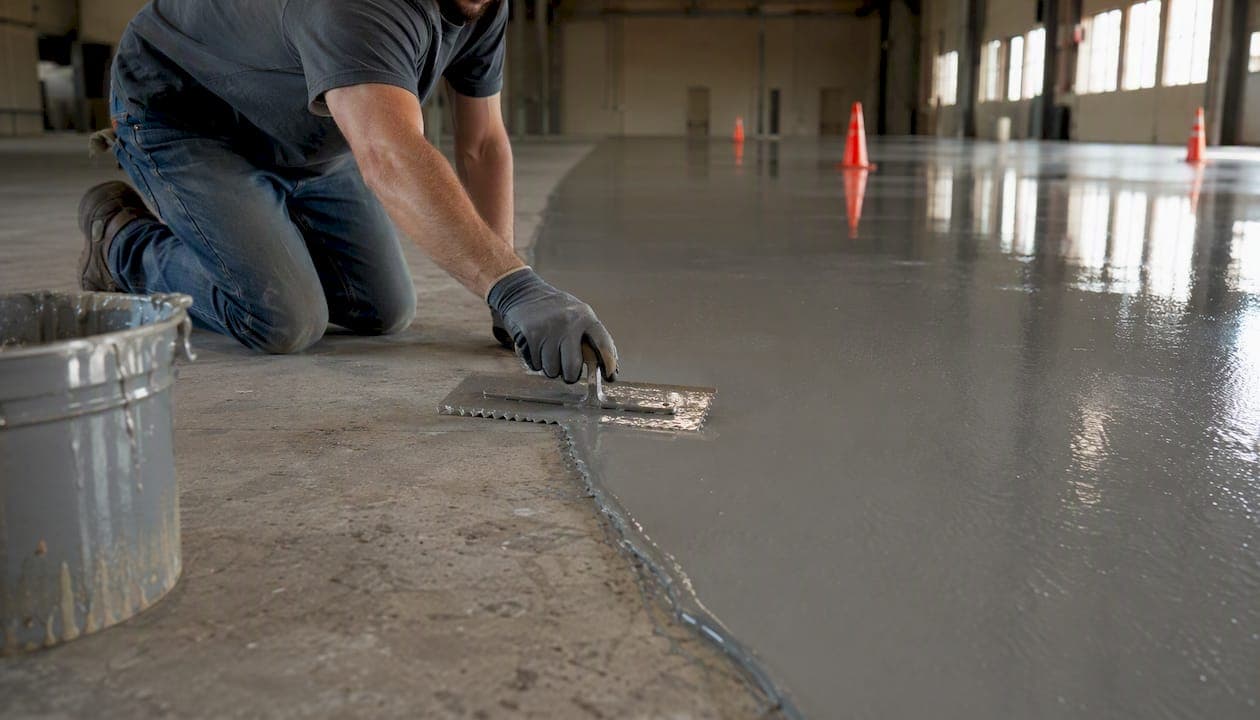
For main forklift aisles, polished or densified concrete and self-leveling epoxy handle daily traffic best. Washdown zones and hot food processing call for polyurethane cement, which tolerates steam and continuous heat near 120–150°C. Chemical storage and battery-charging areas need epoxy or novolac systems built for spills. Fast-turnaround retrofits favor polyaspartic or MMA, which cure in hours instead of days. Here is the quick reference:
- Forklift aisles, dry logistics: Polished/densified concrete or high-build self-leveling epoxy. Both resist abrasion without a thin film that eventually wears through.
- Chemical and battery rooms: Epoxy or novolac epoxy. Sealed, non-porous, and chemically inert against acids and electrolytes.
- Washdown and hot food zones: Polyurethane cement (like Sika's Ucrete). It matches concrete's thermal expansion and shrugs off steam cleaning.
- Fast-turnaround retrofits: Polyaspartic or MMA. Return-to-service in hours, not days, at a premium price.
- Budget-conscious, high-durability floors: Grind-and-seal or polished concrete, often the cheapest option per square foot over a 10-year horizon.
Key Takeaways
Matching coating chemistry to each duty zone, rather than installing one floor system everywhere, is what determines whether a warehouse floor lasts 5 years or 15.
| Point | Details |
|---|---|
| Zone before you spec | Match polished concrete, epoxy, or PU cement to each area's specific wear and chemical exposure. |
| Prep drives lifespan | ICRI CSP surface profile and ASTM moisture testing matter more than the coating brand you pick. |
| Match thermal limits to use | Epoxy softens near 50–60°C; polyurethane cement holds up to 120–150°C for washdown areas. |
| Weigh downtime against cost | Polyaspartic and MMA cost more per square foot but return floors to service in hours, not days. |
| Get professional prep help | Trupainting LLC coordinates slab inspection, moisture testing, and coating installation for Central Florida facilities. |
Table of Contents
- Warehouse Floor Coating Options: The Main Families Explained
- How Do The Main Coating Systems Compare?
- How Do You Choose The Right Coating For Your Facility?
- Why Does Surface Prep Determine How Long A Coating Lasts?
- What Maintenance Keeps A Warehouse Floor Lasting Longer?
- What Do Facility Managers Get Wrong About Coating Selection?
- Ready To Spec Your Warehouse Floor The Right Way?
- Frequently Asked Questions
- Sources
Warehouse Floor Coating Options: The Main Families Explained
Every warehouse floor decision comes down to matching a chemistry and a build thickness to a wear mechanism. Get that match wrong, and you're recoating in three years instead of twelve. Get it right, and the floor outlasts the racking systems above it.
Epoxy systems remain the default recommendation for general industrial flooring, and for good reason. Roller-applied epoxy runs 0.1 to 1 mm thick and works for light-traffic areas needing a quick, economical seal. Self-leveling epoxy steps up to 1.5 to 3 mm, giving a smoother, more durable film for forklift and pallet-jack traffic. Epoxy mortar or screed systems build to 4 to 9 mm and add real impact resistance for heavier loads. Brands like Sherwin-Williams and Mapei both offer tiered epoxy product lines that mirror this thickness progression, from thin sealers to trowel-applied mortars.
The catch: epoxy is rigid and can soften near 50 to 60°C. That's a problem in kitchens, steam-clean bays, or anywhere hot water hits the floor regularly. Epoxy also chips at sharp impact points rather than flexing, which shows up as cracking around dock plates and machine bases within a few years if the build was too thin for the load.
Polyurethane cement (PU cement) solves the thermal problem. Systems from manufacturers like BASF's MasterTop line and Tremco's industrial resin systems run 6 to 9 mm thick and tolerate continuous service up to roughly 120 to 150°C. Its thermal expansion rate is closer to concrete's than epoxy's, so it doesn't delaminate under thermal cycling. This is the floor you specify for washdown areas, commercial kitchens, and any process involving steam or hot-water cleaning. Flowcrete's Flowfresh system, built specifically for food and beverage environments, falls into this category and adds antimicrobial additives for hygiene-sensitive zones.
Polyaspartic and polyurea coatings cure in a fraction of the time epoxy needs. Where epoxy might need 24 to 72 hours before light traffic, polyaspartic and MMA systems can often return a floor to service the same day. That speed costs more per square foot, but it pays for itself fast when a distribution center can't afford a weekend of downtime, let alone a week.
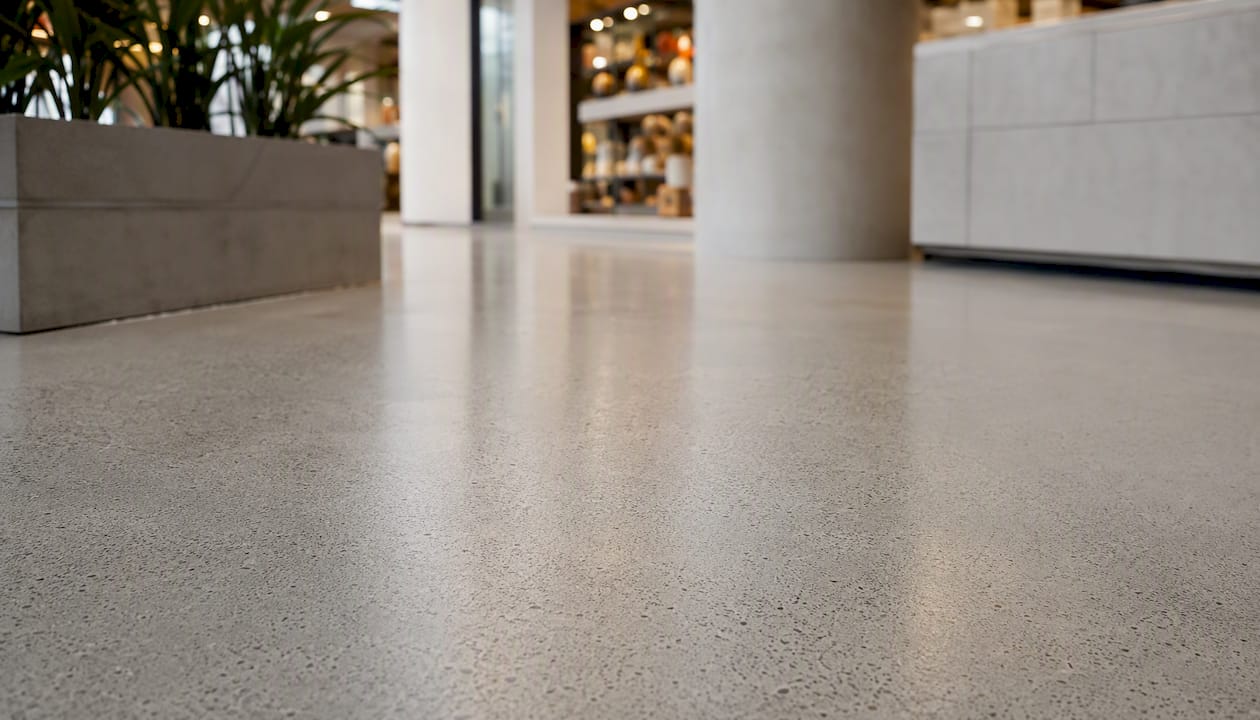
Polished and densified concrete is the floor with no separate film to wear through. Instead of coating the slab, you densify and grind it, exposing aggregate and hardening the surface chemically. Polished concrete is often the lowest-cost, longest-life option for straight forklift traffic in dry environments, running roughly $3 to $8 per square foot. There's nothing to peel or delaminate, though it offers no chemical barrier and can't handle acid spills or oil saturation the way a sealed resin system can.
Dry-shake hardeners get broadcast into wet concrete during the pour, producing a hardened wear surface baked into the slab itself. This works well for new construction where you're pouring fresh concrete anyway, but it's not retrofit-friendly on existing floors.
Anti-slip performance matters across every family. Broadcasted aggregate, crushed glass, and textured urethane topcoats all add traction, and the right choice depends on the achievable slip resistance class you need for wet versus dry operations. Surface prep shortcomings cause a large share of premature coating failures, regardless of which chemistry you pick.
Pro Tip: Don't pick a coating based on what the sales rep says works "everywhere." Ask specifically what happens to that system at your facility's peak operating temperature and worst-case chemical spill. If the answer is vague, that's your red flag.
ESD and conductive flooring deserve a special mention for electronics assembly or areas with sensitive equipment. Both epoxy and PU cement systems come in conductive or static-dissipative formulations, typically achieved by embedding carbon or metallic grid layers beneath the topcoat.
How Do The Main Coating Systems Compare?
| System | Best for | Thickness | Service temp | Chemical resistance | Cure/return-to-service |
|---|---|---|---|---|---|
| Self-leveling epoxy | Forklift aisles, general industrial | 1.5–3 mm | Up to ~50–60°C | Good | 24–72 hours |
| Polyurethane cement | Washdown, hot food, steam cleaning | 6–9 mm | ~120–150°C | Excellent | 3–7 days |
| Polished concrete | Dry logistics, long-life aisles | Slab surface | High (no film limit) | Low to moderate | Immediate |
| Polyaspartic/polyurea | Fast retrofits, downtime-sensitive | 0.1 to 1 mm | Moderate to high | Good | Hours to 1 day |
| Dry-shake hardener | New-pour construction | Slab surface | High | Moderate | Standard concrete cure |
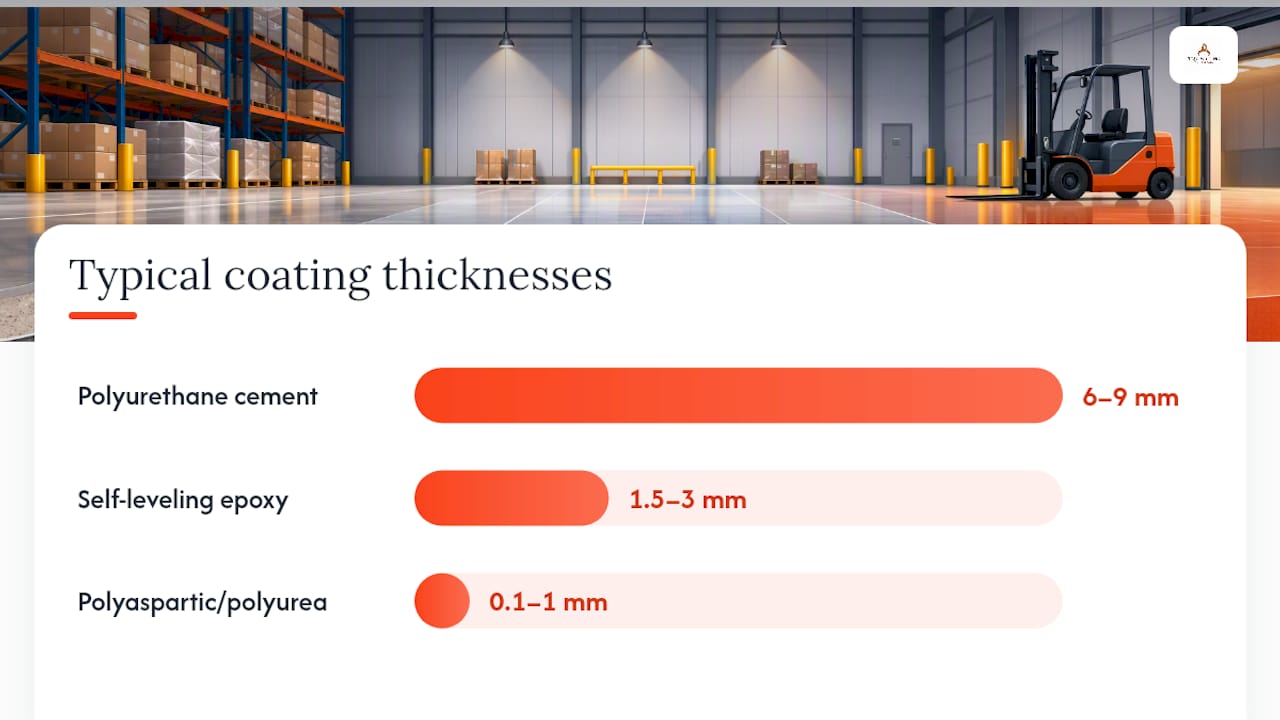
The trade-off that matters most: polyurethane cement wins on chemical and thermal tolerance but demands the longest cure window, while polyaspartic wins on turnaround but costs more per square foot installed.
How Do You Choose The Right Coating For Your Facility?
Work through this checklist before you call a contractor for bids:
- Define the duty and traffic. Count forklift passes per day, note load weights, and identify chemical or thermal exposures by zone.
- Map chemical and thermal risks. Battery acid, cleaning chemicals, and steam washdown each rule out different systems.
- Set your downtime tolerance. A distribution center running three shifts can't absorb a five-day cure the way a seasonal warehouse can.
- Decide on lifespan and maintenance cadence. A 5-year budget system costs less upfront but means recoating sooner.
- Set slip-resistance and hygiene targets. Food-adjacent zones need seamless, coved transitions; dry storage doesn't.
- Check slab condition and moisture vapor emission (MVE). This determines whether you need a mitigation primer before anything else goes down.
When you're gathering bids, ask contractors these questions:
- What surface profile (ICRI CSP rating) are you targeting, and how will you achieve it?
- Will you run ASTM moisture testing before installation, and what's the mitigation plan if levels are high?
- What warranty backs the installation, and what does it actually exclude?
- Can you show reference projects in a similar-duty environment?
- What's the realistic cure time, not the marketing brochure number?
Red flags include contractors who skip moisture testing entirely, quote a surface prep that seems too fast for the square footage, or promise full cure times that contradict the manufacturer's own datasheet. Insist on written specs covering dry film thickness (DFT), the MVE threshold and mitigation method, and coving requirements for any wet zone. A painting contractor selection checklist built for exterior work applies the same due-diligence logic here: verify credentials, get it in writing, and don't skip the reference calls.
Why Does Surface Prep Determine How Long A Coating Lasts?
The coating is only as good as what's underneath it. Shotblasting to an ICRI CSP 3 profile is standard for most resin systems, while diamond grinding suits polished concrete or lower-build applications. Solvent cleaning removes oils and contaminants that would otherwise prevent adhesion. Skipping any of these steps is the single fastest way to void a warranty and shorten service life.
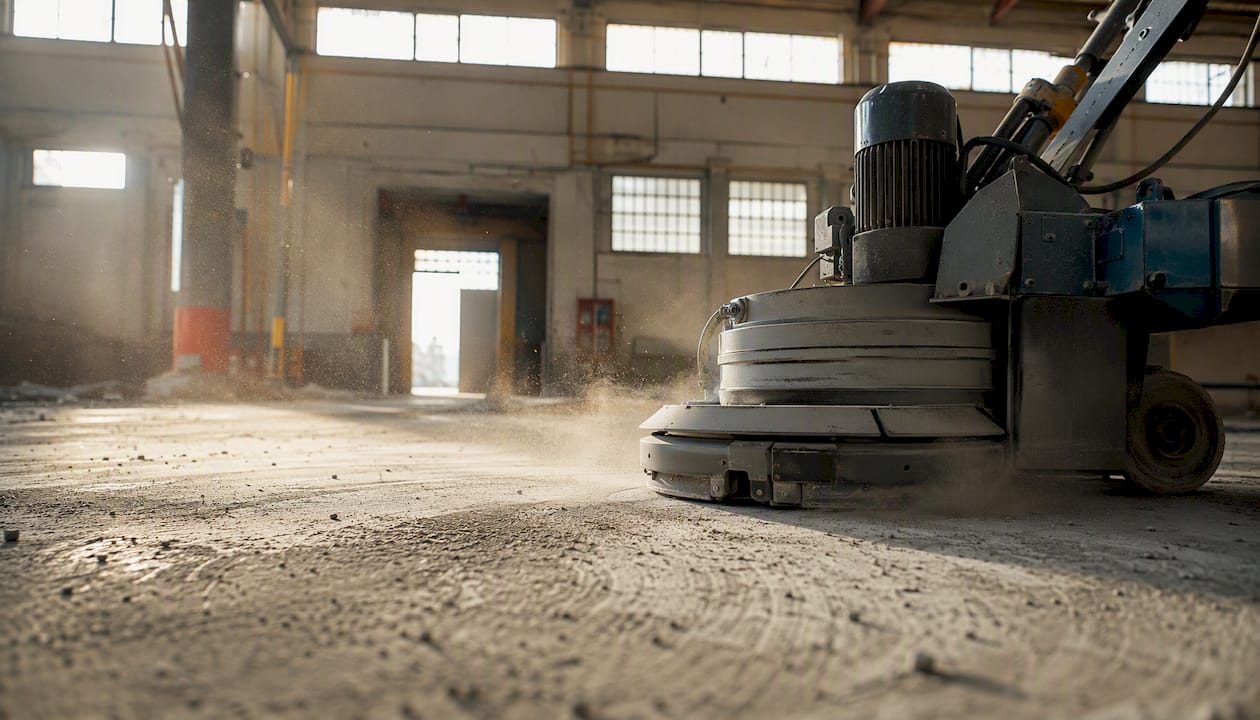
ASTM F1869 moisture testing checks vapor emission from the slab before anything gets applied. If levels exceed the coating manufacturer's threshold, an MVE barrier primer goes down first to prevent delamination months later. Attention to this kind of detail mirrors what we emphasize in exterior paint preparation: the prep work nobody sees is what makes the finish nobody complains about.
Realistic timelines vary by scale and system. A small mezzanine or office-adjacent zone might take two to three days start to finish. A mid-sized warehouse floor running self-leveling epoxy often needs five to seven days including prep, application, and cure. Full-scale distribution centers switching to polyurethane cement should plan for one to two weeks, factoring in moisture mitigation if the slab tests high.
| System | Foot traffic ready | Forklift ready | Full chemical service |
|---|---|---|---|
| Self-leveling epoxy | 24 hours | 72 hours | 5–7 days |
| Polyurethane cement | 24 hours | 3–5 days | 7 days |
| Polyaspartic | 2–6 hours | 12–24 hours | 24 to 72 hours |
Site readiness checklist before the crew arrives: clear the area of racking and equipment, confirm HVAC or ventilation for odor control, schedule around any planned shipments, and have slab moisture test results in hand before quoting begins.
What Maintenance Keeps A Warehouse Floor Lasting Longer?
Daily sweeping and weekly wet-mopping or scrubbing keep grit from acting like sandpaper under forklift wheels. Most facilities schedule a deeper scrub or recoat inspection quarterly, checking for wear at high-traffic transition points and dock areas first, since that's where failure typically starts.
Service life ranges by tier: budget single-coat systems often last 3 to 5 years under light traffic, mid-tier two-coat systems run 7 to 10 years, and premium high-build systems can reach 12 to 15 years or more under sustained forklift use. Prep quality dominates that range far more than the brand on the bucket.
Spot repairs on seamless resin floors involve grinding out the damaged area and re-troweling a patch, feathered to blend with the surrounding film. Polished concrete repairs mean regrinding and re-densifying a section, which is harder to blend invisibly. Either way, catching damage early is cheaper than letting water or chemicals wick underneath a compromised patch. Our guide on protecting painted surfaces long term covers similar principles for exterior coatings, and the logic transfers directly: proactive maintenance beats reactive replacement every time.
What Do Facility Managers Get Wrong About Coating Selection?
The most expensive mistakes rarely come from picking a "bad" coating. They come from picking the wrong family for the environment, like installing rigid epoxy in a kitchen that gets steam-washed daily. The floor looks fine on installation day and starts delaminating within eighteen months.
Zone the facility instead of treating it as one floor. Forklift aisles, battery rooms, and washdown areas each have a different wear mechanism, and no single product handles all three equally well.
Many large facilities now combine systems by zone: polished concrete for main aisles, chemical-resistant epoxy in battery rooms, and polyurethane cement wherever steam or hot water is part of daily operations.
Pro Tip: Before you approve any bid, ask the contractor to walk the floor zone by zone and justify the system for each area separately. If they recommend the same product for the loading dock and the wash bay, get a second opinion.
A note from the field
We've seen too many warehouses install one floor system everywhere and pay for it later. Zoning by duty and investing in real slab prep upfront beats chasing a cheaper universal coating.
Ready To Spec Your Warehouse Floor The Right Way?
Trupainting LLC brings the same prep discipline we apply to residential and commercial exterior work to industrial flooring evaluation, which means no guessing on slab moisture or surface profile before a coating goes down.

We handle professional slab inspection and moisture testing, coordinate shotblasting or diamond grinding to the right CSP profile, and manage specialty coating installation for warehouses and commercial facilities across Lake County and Central Florida. If your floor is due for recoating, showing chemical damage, or you're planning a new build, our team can walk the site, identify the zones that need different systems, and put together a clear specification before you collect contractor bids. Get in touch through our commercial interior painting services page to schedule a site survey and quote.
Frequently Asked Questions
What's the best warehouse floor coating option for heavy forklift traffic? Polished or densified concrete and high-build self-leveling epoxy both perform well under sustained forklift traffic. Polished concrete tends to last longer since there's no film to wear through.
Is epoxy or polyurethane flooring better for warehouses? It depends on the environment. Epoxy handles general industrial traffic and chemical exposure well but softens near 50 to 60°C, while polyurethane cement tolerates steam and hot washdown up to roughly 120 to 150°C.
How long does a warehouse floor coating installation take? A mid-sized warehouse installing self-leveling epoxy typically needs five to seven days including prep and cure. Polyaspartic systems can return to service in hours, while polyurethane cement often needs a week or more.
How often does a warehouse floor coating need to be replaced? Budget single-coat systems often last 3 to 5 years, mid-tier systems run 7 to 10 years, and premium high-build systems can reach 12 to 15 years or longer, largely depending on surface prep quality.
Do I need different coatings for different areas of the same warehouse? Often, yes. Many facilities zone their floors, using polished concrete for main aisles, chemical-resistant epoxy in battery or chemical storage rooms, and polyurethane cement in washdown or food-processing areas.
Sources
- Industrial Flooring Guide — Types, Specs, Selection | SpecForge
- Warehouse Flooring: Options, Cost & Forklift Durability | Stellar Surfaces
- Epoxy Floor Coatings for Warehouses: Specifier's Guide (2026) — CompositePaint
- Types of anti-slip coatings for your warehouse floor — ISHN
Always verify EN 13813 or ASTM datasheet values against the exact product grade your contractor plans to install, since figures vary by manufacturer formulation.