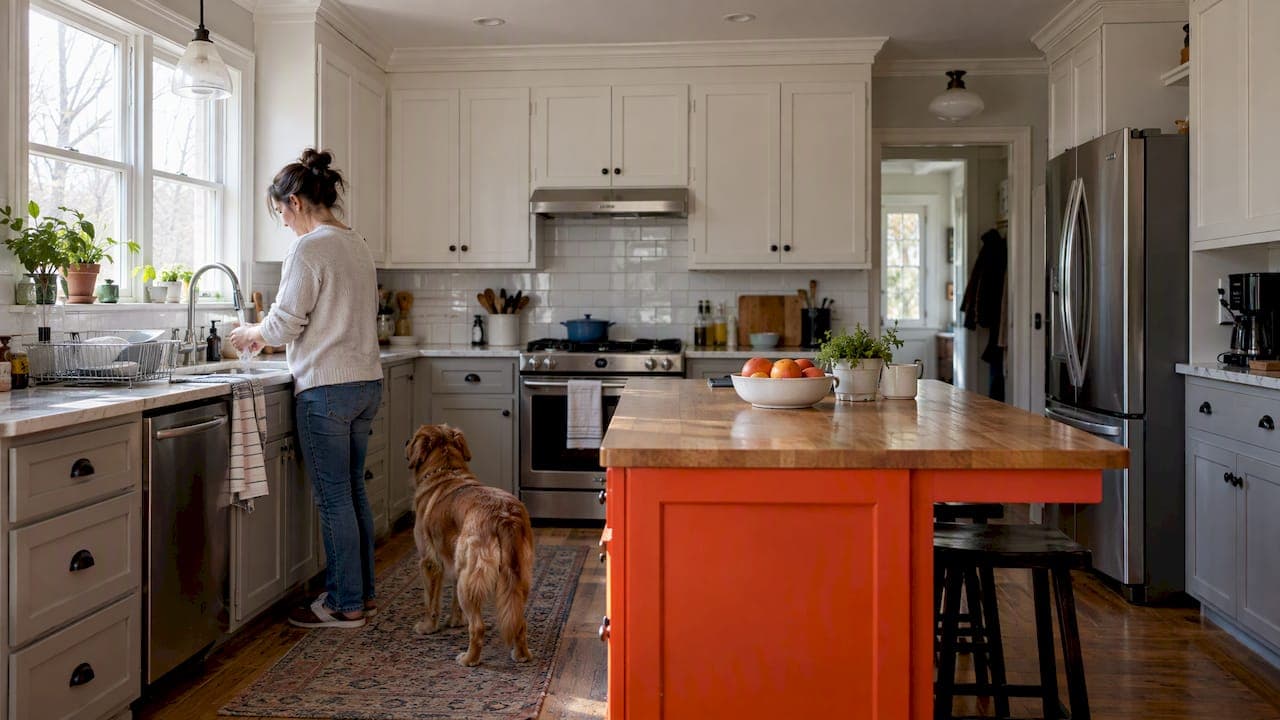
For most kitchens, the answer is satin or eggshell on the walls, semi-gloss on trim and cabinets, and flat on the ceiling. Kitchens take grease, steam, splashes and constant wiping, so the sheen you pick decides how the room looks in year one and how it holds up in year five. Below, we walk through each surface, explain the trade-offs, and show where a pro's prep makes the finish last.
TL;DR
- Walls: satin is the safe pick for most kitchens. Eggshell is fine if your walls are less than perfect and you cook lightly. Semi-gloss makes sense near the stove and sink.
- Trim, doors and cabinets: semi-gloss is the standard choice because it scrubs clean. Satin gives a softer look but shows less of the toughness.
- Ceilings: flat hides flaws and keeps glare down.
- The trade-off: more gloss means easier cleaning and stain resistance, but it also shows every dent, roller mark and patch.
- Always test: sheen names differ by brand, so brush out a sample in your own light.
Table of Contents
- Why the finish matters more in a kitchen
- The sheens at a glance
- Kitchen walls: satin, eggshell or semi-gloss?
- Kitchen ceiling paint finish
- Trim, doors and cabinets
- Light, moisture and flaws: three things that change the answer
- Test before you commit
- Our perspective: prep decides how the finish looks
- Get your kitchen painted by Lake County pros
- FAQ
- Sources
Why the finish matters more in a kitchen
Sheen is how much light a dried paint film reflects. Flat reflects almost none. High gloss reflects a lot. That one property changes three things you care about in a kitchen: how easily the surface cleans, how well it hides flaws, and how the color looks under your lights.
One paint manufacturer's guide puts it plainly: higher gloss improves washability and stain resistance, but it highlights surface defects. That is the whole decision in one sentence. A kitchen needs washability, but few kitchen walls are perfectly smooth. Your job is to find the highest sheen your surface can carry.
The sheens at a glance
Names vary by brand, so treat this as a general map, not a rulebook. One manufacturer notes that finish names vary by brand, so one company's eggshell may look like another's satin.
| Finish | Shine | Cleaning and stain resistance | Hides flaws | Best kitchen use |
|---|---|---|---|---|
| Flat | None | Lowest; stains are hard to remove | Best | Ceilings |
| Matte | Nearly none | Better than flat | Very good | Low-traffic walls, ceilings |
| Eggshell | Soft glow | Good | Good | Walls in lightly used kitchens |
| Satin | Gentle sheen | High | Fair | Walls in most kitchens |
| Semi-gloss | Noticeable shine | Excellent | Poor | Trim, doors, cabinets, splash zones |
| Gloss | High shine | Excellent | Poorest | Accent pieces, some cabinets |
The cleaning and flaw-hiding columns follow what the paint makers say. Flat paint hides imperfections well but its stains are harder to remove, and repeated cleaning can burnish it. Satin has good hide plus high stain and scrub resistance, and semi-gloss offers excellent scrub resistance but reveals more surface imperfections.
Kitchen walls: satin, eggshell or semi-gloss?
This is the question behind most searches, and the honest answer is that all three can work. Here is how we sort it out.
Satin: our default for kitchen walls
Satin sits in the sweet spot. Sherwin-Williams describes satin and eggshell as a balance of durability and elegance that is washable and suited to high-traffic rooms. Valspar specifically recommends satin for kitchens, bathrooms, laundry rooms and hallways. It wipes down well, and it does not look like plastic on the wall.
The catch is that satin shows roller marks and patched areas if the wall was not prepared well. A smooth, properly primed wall is what makes satin look flawless.
Eggshell: softer, more forgiving
Eggshell has less shine than satin. Sherwin-Williams notes that flat or eggshell finishes are the best at hiding imperfections. If your kitchen walls are older, textured, or have a few repairs, eggshell can look better than satin even though it is a little less scrubbable. It suits households that cook lightly or have a good range hood.
Semi-gloss: tougher, but unforgiving
Some manufacturers, including Rodda-Miller, recommend semi-gloss for kitchens outright. Better Homes & Gardens also suggests semi-gloss or gloss for kitchen walls because glossy surfaces tolerate frequent wiping. That is sound advice for a busy family kitchen with young kids or heavy frying.
The cost is visibility. Every bump, drywall seam and sanding scratch will catch the light. We usually suggest semi-gloss only where the surface is smooth, or in small zones.
Using two sheens on one wall
You do not have to choose just one. The Spruce points out that eggshell, satin or semi-gloss all work on kitchen walls, with semi-gloss or high-gloss especially useful near backsplashes where walls are scrubbed most. A common approach is satin on the main walls and semi-gloss on a short wall section behind the stove or around the sink, with a clean break at a corner or trim line. Keep the color identical and only the sheen changes.
Kitchen ceiling paint finish
Use flat. Benjamin Moore calls flat paint an ideal choice for ceilings because it masks imperfections. Ceilings sit under direct light, and even small roller lines or drywall tape ridges show up when light rakes across a shinier surface.
Two kitchen-specific notes:
- Over the stove: grease and steam collect on the ceiling just as they do on the walls. If you cook a lot, a washable matte made for kitchens and baths is a smart step up from builder flat. Benjamin Moore says matte is nearly shine-free and more durable than flat, and names a bath and spa matte designed for high humidity and mildew resistance.
- Stained ceilings: a water or grease stain needs to be cleaned and sealed with the right primer before any finish coat. Paint alone will not hide it for long.
Trim, doors and cabinets
Trim and cabinets are touched, bumped and scrubbed more than anything else. The Spruce states that semi-gloss or gloss is typical for kitchen cabinets and woodwork, while higher gloss makes brush marks more visible. Sherwin-Williams also recommends semi-gloss for kitchens and trim.
Semi-gloss is the practical choice for most painted cabinets. It cleans easily and hides more than full gloss does.
Satin gives a softer, more modern look and still cleans well. It is a good pick when the cabinet doors are flat-front and you want a subtle finish.
Gloss gives a lacquer-like, high-shine look, but it is demanding. Any flaw in the surface is magnified, so it only makes sense on very well-prepared doors.
For cabinets, the finish is only half of it. The primer has to suit the material underneath, which is why we wrote about choosing primers for cabinets matched to the substrate. If your cabinets are thermofoil, check for peeling before you commit to painting. And if you are picking colors as well as sheen, our guide to testing, matching and finishing kitchen cabinet colors will save you a few mistakes.
If your kitchen has original or stained wood trim you want to keep, you will want to blend painted surfaces with it. This guide on matching stain on old trim without stripping sound finishes is useful when the painted walls and the existing woodwork have to look like one scheme.

Light, moisture and flaws: three things that change the answer
Lighting
Sheen changes color. Sherwin-Williams says sheen can make colors appear lighter or darker, and Better Homes & Gardens notes that higher reflection can make colors such as white look brighter. A kitchen with big windows or under-cabinet lights will exaggerate that. Glossier paint under strong side light also shows wall flaws more.
Moisture and steam
Kitchens are damp places: boiling pots, dishwashers, open sinks. In humid climates like Central Florida, that moisture adds up fast. Pick a paint formulated for kitchens and baths in a washable sheen, and make sure the room is ventilated. Sherwin-Williams advises weighing the room's function, moisture exposure and durability when you choose a finish. The finish helps, but a range hood that actually vents outside helps more.
Wall condition
Be honest about your walls. Older drywall, textured patches, nail pops and uneven repairs all argue for eggshell or a well-prepped satin. Smooth, newly skim-coated walls can take satin or semi-gloss. If you want the shinier look on imperfect walls, the fix is prep, not more coats. Our interior wall prep checklist covers the basics, and our post on picking an interior finish for every room looks at the rest of the house.
Test before you commit
Because brands name their sheens differently, a quick test beats guessing. Better Homes & Gardens recommends testing samples because sheen varies by brand.
- Paint a large patch, at least two feet square, on the wall you will use most.
- Do two patches side by side in different sheens, same color.
- Look at them in morning light, afternoon light and with the kitchen lights on.
- Let them cure fully, then rub a damp cloth over each to see how they behave.
- Pick the highest sheen whose flaw-showing you can live with.
If you have just cleaned painted walls, do the same trick on a hidden patch first. Our post on cleaning painted walls without damaging the sheen explains why.
Our perspective: prep decides how the finish looks
People come to us asking which sheen to choose, and we are happy to help with that. But after painting many kitchens, our honest view is that the sheen is only part of the result. A semi-gloss on poorly prepared walls looks worse than an eggshell on walls that were cleaned, patched, sanded and primed properly.

Kitchen surfaces carry a film of cooking grease you cannot always see. If it is not degreased, the paint can fail to bond. Cabinet doors need the right cleaning, sanding and primer for their material. Drywall repairs need to be smooth enough for the sheen you picked. That is why we put so much weight on preparation, and why we offer three service levels, from a cosmetic refresh to maximum prep and protection, so you can match the investment to the condition of your kitchen.
We do not try to be the cheapest. We try to give you a finish that still looks good years from now. If you are unsure between two sheens, tell us how you cook and how your walls look, and we will give you a straight recommendation.
— Kyle
Get your kitchen painted by Lake County pros
If you would rather skip the sample pots and the prep work, we handle kitchen walls, ceilings, trim and cabinets for homeowners across Lake County and Central Florida. We start with a walk-through, explain which sheen suits each surface, and scope the prep the job really needs.

See our three service packages, learn about residential interior painting, or look at cabinet refinishing. When you are ready, schedule your appointment and we will come take a look. If cabinets are on your list, our post on what cabinet painting costs and what to ask is a good place to start.
FAQ
What is the best finish of paint for a kitchen?
For most kitchens, satin on the walls and semi-gloss on trim and cabinets is the best combination. Both clean easily and resist stains. Use flat on the ceiling to hide flaws, and choose eggshell instead of satin if your walls are uneven.
Should kitchen paint be eggshell or satin?
Satin is more washable, so it suits busy kitchens where you cook often. Eggshell has a softer look and hides wall imperfections better, so it works in lightly used kitchens or on older walls. Both are washable and suited to high-traffic rooms, so the choice is mostly about how your walls look and how much you cook.
Should kitchens be satin or semi-gloss?
Satin is the better wall finish for most homes because it has a gentler look and hides more. Semi-gloss is the better finish for trim, doors and cabinets, and can be used on walls near the stove if they are very smooth. Semi-gloss gives the toughest cleaning performance, but it shows every flaw.
What finish should I use on a kitchen ceiling?
Flat is the usual answer, because it hides roller marks and drywall flaws. If you cook heavily and want a surface you can wipe, a washable matte made for kitchens and baths is a good upgrade. Seal any stains with primer first.
What are the five types of paint finishes?
The common sheens, from least to most shine, are flat, matte, eggshell, satin, semi-gloss and gloss. Some brands combine or rename them, so always check the sample. Kitchens mostly use satin, semi-gloss and flat.
Sources
- Interior Guide, Rodda-Miller Paint
- How to Choose Paint Finishes, Sherwin-Williams
- How to Choose a Paint Finish, Benjamin Moore
- How to Choose a Paint Sheen or Finish, Valspar
- Best Paint Finish For Kitchen Walls and Cabinets, The Spruce
- Types of Paint: A Guide to Paint Finishes and Surfaces, Better Homes & Gardens