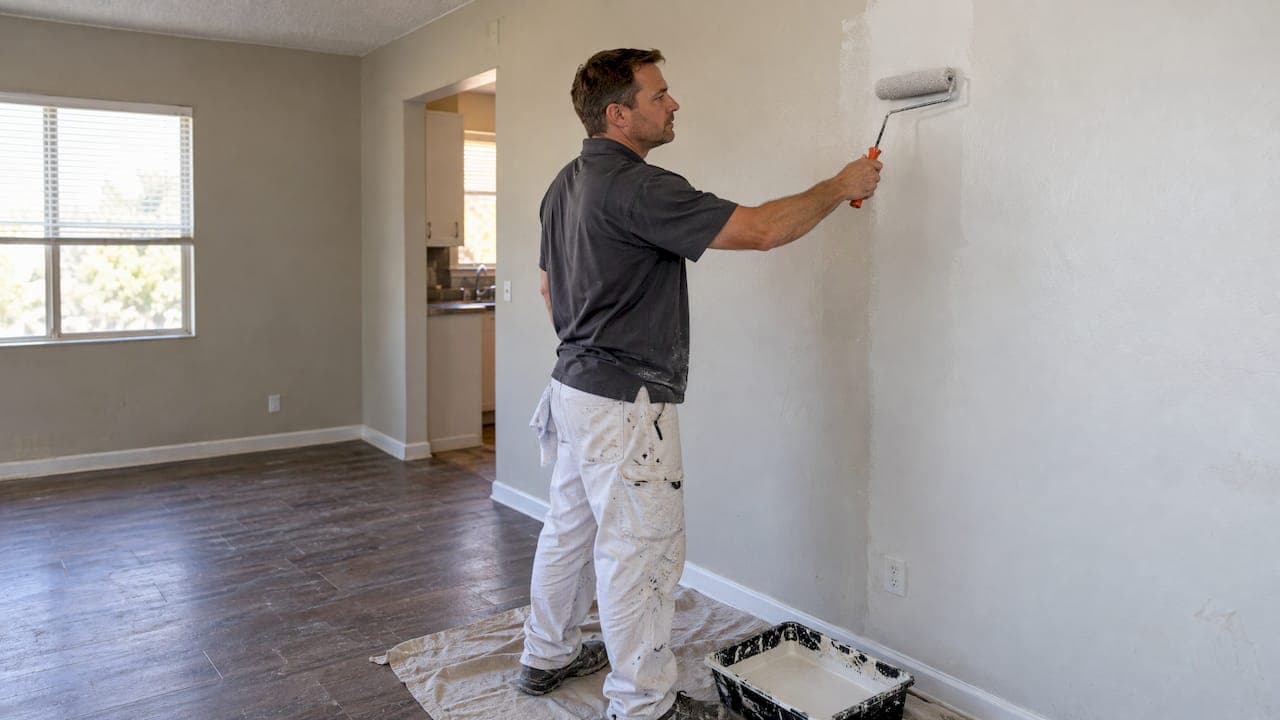
Apartment turnover painting is the repaint, patching and touch-up work done in a vacant unit between one tenant leaving and the next moving in. A good turn fills and sands the damage, primes stains, rolls fresh paint on the walls (and usually the trim and doors), and hands back a clean unit that photographs well and holds up for the next lease. The goal is a repeatable finish, done in the right order, without leaving a unit empty longer than it has to be.
We are Tru Painting, a locally owned painting contractor serving Lake County and Central Florida. Below is how we think about scoping a turn, what to expect on price, and how to keep the schedule tight.
TL;DR
- A turn usually covers a condition walk, patching and sanding, stain-blocking primer, fresh paint on walls and often trim and doors, then cleanup.
- Touch-up works when the paint is in good shape and the color stays the same. Repaint when there are stains, damage, color changes or heavy wear.
- Repairs come first, then paint, then flooring and final cleaning. Painting before repairs means doing it twice.
- Published estimating guides put per-unit prices from roughly $500 for a studio to $2,500 for a large three-bedroom, and volume work is typically priced lower.
- Pre-1978 buildings carry federal lead-safe rules for work that disturbs paint.
Table of Contents
- What apartment turnover painting includes
- Touch-up or full repaint?
- Prep that keeps the paint job from failing
- Paint, sheen, color and coats
- The step-by-step order for painting between tenants
- How long does it take, and what causes delays?
- What apartment turnover painting costs
- Choosing a painter for turnovers
- Our perspective
- Plan your next turn with Tru Painting
- FAQ
- Sources
What apartment turnover painting includes
A turnover scope should be written down before the first unit starts, so every unit is treated the same way. A typical multifamily make-ready paint scope includes a condition walk with photographs, wall hardware removal, filling and sanding holes, caulking small cracks, stain-blocking primer, protection of floors and fixtures, painting and cleanup. That is a sensible baseline for any turn.
Here is how we would break it down:
- Walk and document. Note scuffs, nail holes, water stains, cracked caulk, damaged doors and any smoke or pet odor. Photos protect you in deposit disputes and keep the bid honest.
- Prep. Pull outlet covers and hardware, patch, sand, spot-prime and mask.
- Paint. Walls first in most cases, then trim, doors and closets. Ceilings are often optional and priced separately when they are clean.
- Reset and clean. Reinstall covers and hardware, remove masking, wipe up drips and haul debris.
The items most often treated as add-ons are texture and sheetrock repairs, color changes and accent walls, and ceiling painting. Spell these out in the scope so nobody is surprised by a change order. If your property has a mix of residential and commercial spaces, such as a leasing office or clubhouse, we also handle commercial interior painting.
Touch-up or full repaint?
This is the decision that drives both cost and schedule. A simple way to decide is to walk the unit in good light and sort the walls into three groups.
| Condition | What you see | Usual call |
|---|---|---|
| Light wear | A few scuffs, small nail holes, same color going back on | Spot patch and touch-up, or one fresh coat on the worst walls |
| Moderate wear | Scuffs across many walls, patched areas that flash, faded or yellowed paint | Full wall repaint, spot-priming patches |
| Heavy wear | Water or smoke stains, grease, crayon, large damage, dark colors, a color change | Prime, then two coats, with drywall repair first |
Touch-ups are tempting, but they only work when the sheen and color match what is already on the wall. Old paint fades and ages, so a fresh patch on a three-year-old wall can show as a halo under raking light. When several walls need patching, rolling the whole wall from corner to corner usually looks better than dabbing spots. Some owners do a full repaint on every turn after a set tenancy length, which keeps the standard consistent and makes budgeting easier.
One more note: cleaning can sometimes save a wall. Before you decide a scuffed wall needs paint, our guide to cleaning painted walls without harming the sheen shows how to test a hidden patch first.
Prep that keeps the paint job from failing
Prep is where turns are won or lost. Skipped prep shows up as peeling patches, flashing and callbacks.
The basic sequence, following Sherwin-Williams repair guidance: scrape loose, bubbling or flaking paint and sand it smooth; fill small holes and cracks with spackling or patching compound, let it dry, then sand smooth; lightly sand glossy trim to a dull finish and wipe it clean.

Cleaning matters just as much. Remove dust and loose debris, cut grease and oils with a degreaser or warm water and mild dish soap, rinse, and use TSP for stubborn buildup. Kitchen walls, areas around stoves and bathroom walls tend to need the most attention. For a deeper walkthrough, see our wall prep checklist.
Water damage and larger repairs
A stain that keeps coming back through primer is not a paint problem. If a ceiling stain or soft drywall points to a leak or moisture, the source needs fixing first. For that kind of work, a specialist in water damage and drywall restoration can assess and repair before we paint. Painting over an active problem only hides it for a few weeks.
Lead-safe rules for older buildings
If a building was built before 1978, federal rules apply. Under EPA's Renovation, Repair and Painting program, compensated contractors and property managers must give tenants the EPA lead pamphlet, firms must be certified, workers trained, and lead-safe practices followed when work disturbs painted surfaces. The same guide lists prohibited practices, including open-flame burning and using high-speed paint-removal machines without shrouds or containment and a HEPA vacuum attachment, and calls for cleaning the work area until no dust, debris or residue remains. Sanding a few nail-hole patches is one thing, but scraping or sanding larger areas in an older unit calls for a certified firm. Ask any painter you hire about their certification before they start.
EPA's own guidance also notes that repainting lead-painted surfaces can last 4 to 10 years when the cause of paint deterioration is repaired first, which is another reason to fix moisture problems before painting.
Paint, sheen, color and coats
Rental paint has a different job than paint in an owner-occupied home. It has to cover well, scrub reasonably, and be easy to match next time.
Color. A standard palette is the single biggest time saver. Estimating guidance for multi-unit work points out that turnovers often use the same two or three neutral colors, which can be pre-mixed or ordered in bulk. One wall color, one trim color and one ceiling white mean fewer questions, easier touch-ups and fewer mismatched batches.
Product. Contractor-grade lines are built for this work. The same guide mentions Sherwin-Williams ProMar 200 and Benjamin Moore Ultra Spec as options with good coverage at an affordable price. On projects where we want a more durable finish, such as a premium unit or a model, we step up. For drywall, Sherwin-Williams specifies two coats of Cashmere interior latex over primer, and notes that a primer coat can improve hiding when the color change is drastic.
Sheen. Flat or matte hides wall flaws, while eggshell or satin cleans more easily. Many owners choose a low-sheen finish for walls and semi-gloss for trim and doors. Whichever you choose, keep it the same across the property.
How many coats? It depends on the starting point. The Spruce recommends primer for patched or new drywall, stains, unfinished wood and major color or sheen changes. One coat suits similar colors over a surface in good condition, two suit new drywall or a drastic color change, and a third may be needed for poor coverage, uneven surfaces or major stains. As a general painting rule, a second coat may be needed for full coverage and a vibrant finish. For a refresh going from a clean white to a similar white, one coat can be enough. For a dark accent wall going neutral, plan on primer and two coats.
The step-by-step order for painting between tenants
The efficient order is the one that avoids rework:
- Inspect and scope the unit, with photos.
- Make repairs. Drywall, doors, caulk, plumbing leaks and anything that creates dust or mess goes before paint. Painting before repairs creates rework.
- Prep and prime patches and stains.
- Paint ceilings first if included, then walls, then trim and doors.
- Let it cure before the next trade walks in. Our property manager painting checklist explains why we enforce a 24 to 72 hour dry window before heavy contact.
- Flooring, if it is being replaced or refinished.
- Final cleaning, then a punch walk and sign-off.
If you have not mapped out the painting steps inside a room, our interior painting sequence guide covers cutting in, rolling and trim order.
Two habits help with multiple units. First, pre-pack a supply kit for each unit type. Second, track actual time per unit. Estimating guidance suggests that after 10 to 20 turnovers you will have reliable production data for estimating. That data is how you stop guessing on bids and schedules.
How long does it take, and what causes delays?
Painting itself is usually the short part of a turn. A one-bedroom with minor patching can often be painted in a day or two by a small crew, while heavy repairs, big color changes or damaged trim stretch it out. The calendar time is usually longer because painting has to fit between maintenance, flooring, cleaning and inspection.
The delays we see most often are predictable:
- Repairs not finished. The painter arrives and the drywall patch is still wet or not started.
- Scope creep. A unit scoped as touch-up turns out to need full repainting after the first walk.
- Color changes. Dark or saturated colors need primer and extra coats.
- Dry time and humidity. Central Florida humidity can slow drying, so rushing the next trade onto fresh paint risks scuffs and smudges. We give that cure time room in the schedule.
- Access and keys. Units that are still occupied, or without working keys or utilities, cost crews hours.
- Unit-by-unit changes. Different scopes in each unit mean no rhythm. A fixed scope for each unit type is faster.
The cleanest fix is communication. Tell your painter the move-out date, the move-in date and who else is working in the unit, and ask them to confirm the sequence in writing.
What apartment turnover painting costs

Prices vary by region, unit size, condition and how much prep is involved. As a reference point, one multi-unit estimating guide lists standard turnover prices of $500 to $900 for a studio, $700 to $1,200 for a one-bedroom, $900 to $1,800 for a two-bedroom and $1,200 to $2,500 for a three-bedroom. Those figures include two coats on walls and ceilings, basic prep and cleanup. Trim and doors are additional, and volume contracts are typically 10 to 20 percent below individual rates.
Treat those as ranges to sanity-check a bid, not as quotes. We do not publish a flat price list, because a lightly worn unit and a heavily damaged one are different jobs. What moves the price:
- Square footage and ceiling height.
- Prep level. Patching, stain blocking, caulking and scraping take labor.
- Surfaces. Ceilings, trim, doors, closets and cabinets each add time.
- Color change. A drastic change adds primer and coats.
- Volume. More units with a consistent scope allow a better rate.
- Access. Occupied units, multiple floors or phased schedules add complexity.
To see where paint sits in your wider budget, a benchmark of multifamily operating expenses per unit helps you compare turn costs against the rest of your property spending. For commercial or mixed-use properties, our piece on budgeting repaints with line-item bids shows how to compare quotes fairly.
Choosing a painter for turnovers
The cheapest per-unit number is rarely the cheapest outcome. A rushed single coat over unprimed stains returns as a callback or a deposit dispute. When you compare bids, look at:
- A written scope per unit type, naming what is and is not included.
- Prep detail. Who patches, who primes, and what happens with stains.
- Lead-safe certification for pre-1978 buildings.
- Insurance and warranty on workmanship.
- Communication. A named contact, quick confirmations and daily status on the units in progress.
Our contractor selection checklist goes through questions to ask before you sign.
Our perspective
We have seen a lot of units where the paint looked fine for a month and then started to show through. Almost every time, the cause was the same: patches left unprimed, glossy trim not scuffed, or a stain painted over before the source was fixed.
Our approach is built around preparation first. That is why we offer three service levels: a Cosmetic Refresh for units in good shape, Enhanced Prep & Durability for units that need more repair and protection, and Maximum Prep & Protection for the most demanding jobs. You choose the level that fits the unit and the budget, and the scope stays in writing.
We do not try to be the cheapest painter in Lake County. We try to be the one you do not have to call back. Premium products, careful prep, clear communication and a warranty on our workmanship are how we aim to make a turn something you can stop worrying about.
Kyle
Plan your next turn with Tru Painting
We paint residential and commercial interiors across Lake County and Central Florida, including rental units, retirement communities and mixed-use properties. Tell us the unit count, sizes and your target dates, and we will scope it with you and match the right service level to each unit. See our residential interior painting and service packages for details.

Ready to get a scope and bid? Visit Tru Painting and schedule your appointment.
FAQ
Do I need to repaint the whole unit at every turnover?
Not always. If the paint is in good condition and the color is staying the same, spot patching and touch-ups may be enough. If walls show scuffs, stains, flashing patches or fading, a full repaint looks better and avoids a patchwork result. Many owners set a standard, such as a full repaint after a certain tenancy length.
How many coats does a turnover usually need?
One coat can work over clean walls in a similar color. Two coats are the norm for new drywall, patched areas or a noticeable color change, and stains or dark colors may need primer plus extra coats. Your painter should confirm the coat count when scoping each unit.
Can we paint before the repairs are finished?
It is better not to. Drywall, caulk and plumbing repairs create dust and patches that need paint, so painting first means doing it twice. Schedule repairs, then paint, then flooring and final cleaning.
Do lead-safe rules apply to apartment turnovers?
They can. In housing built before 1978, EPA rules apply to paid work that disturbs painted surfaces, including certified firms, trained workers and required tenant notification. If your building is that old, confirm your painter's certification before the work starts and check the EPA guide for the current requirements.
Sources
- Multifamily Interior Paint Standards
- How to Repair Walls, Sherwin-Williams
- Surface Preparation, National Association of Finishing Contractors
- Small Entity Compliance Guide to Renovate Right, EPA
- Lead In Your Home: A Parent's Reference Guide, EPA
- Multi-Unit Painting Estimating Guide for Contractors
- Cashmere Low Lustre product data sheet, Sherwin-Williams
- How Many Coats of Primer Do You Need?
- How To Paint a Room Like a Pro, This Old House
- Multifamily Operating Expenses per Unit
- Mold, Water and Fire Restoration, Lake Mary