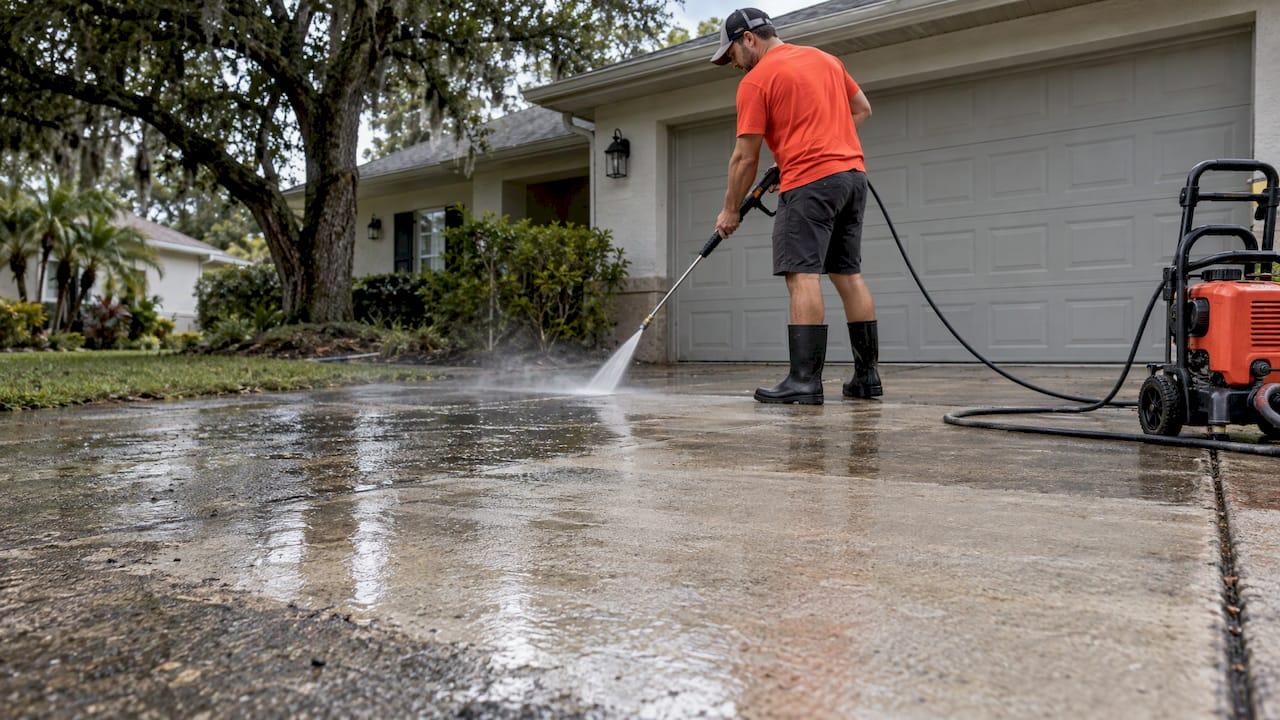
Driveway pressure washing works best with a 2,500 to 3,000 PSI machine, a 25-degree nozzle or a surface cleaner, a concrete-safe detergent and a steady, overlapping pass from the high point down to the street. Do those four things and a gray, streaked driveway can look new again. Get them wrong and you can etch the concrete, hurt yourself or send dirty water into the storm drain. Below, we walk through the equipment, the prep, the technique, the stain fixes and what to do afterward, with notes from our work in Lake County and Central Florida, where algae and humidity make driveways a regular project.
TL;DR
- Use a pressure washer in the 2,500 to 3,000 PSI range with a 25-degree nozzle or a surface cleaner. Never use a 0-degree red tip.
- Sweep, pretreat stains and apply a concrete-safe cleaner (alkaline degreaser or peroxide-based, no acids) before you blast.
- Work from the highest point toward the street, hold the wand 12 to 18 inches away and keep wash water out of storm drains.
- Let the concrete dry at least 24 hours before sealing. Humid Florida weather can stretch that to 48 or 72 hours.
- Protect your eyes and skin. Pressure washer injuries are serious and send thousands of people to emergency rooms.
Table of Contents
- What driveway pressure washing actually does
- Gear: PSI, nozzle and cleaner
- Prep before you spray
- Step-by-step: how to pressure wash a driveway
- Removing the stains that won't budge
- Safety: the part that can't wait
- Pressure washing a driveway before sealing
- How often should you wash a Florida driveway?
- Our perspective
- Let us handle the washing
- FAQ
- Sources
What driveway pressure washing actually does
A pressure washer pushes water through a narrow nozzle fast enough to lift dirt, algae, mildew, tire marks and surface grime out of the pores of concrete. Detergent does the chemistry, and the water does the rinsing. Together they restore the color of the slab without any coating.
In Central Florida, driveways take a beating from sun, afternoon storms, shade from oaks and constant moisture. That is why green and black streaking shows up so quickly. A clean driveway is also the best starting point for a sealer, a coating or a fresh coat of paint on the house, because the whole front of the property reads as one finish.
Gear: PSI, nozzle and cleaner
How much pressure you need
For plain concrete, aim for a machine rated at about 2,500 to 3,000 PSI. Bob Vila says you need at least 2,000 PSI to blast dirt off concrete and recommends staying at or under 3,000 PSI to avoid etching the surface. More is not better. Etched concrete holds dirt faster, so the driveway re-stains sooner.
Nozzle or surface cleaner
The nozzle controls how that pressure hits the slab. A 25-degree tip handles most driveway cleaning. Wide tips spread the force and protect the surface, while narrow ones concentrate it and can cut into concrete.
Consumer Reports advises throwing away any 0-degree (red) nozzle, because its pinpoint blast can cause severe damage. Higher-degree nozzles can do the job.
For a big, flat driveway, a surface cleaner is the better tool. Bob Vila describes it as a disk-shaped attachment with spinning wands under a 12- to 16-inch deck. The smaller 12-inch models typically run on 1,500 to 2,300 PSI at 1.4 to 2.0 GPM, and the 15- and 16-inch models need 2,000 to 3,000 PSI at 2.5 to 3.0 GPM. The Spruce notes that a wheeled surface cleaner speeds up the job and leaves a more even finish than a wand alone. Those tiger stripes you see on DIY driveways come from wand work at uneven distances.

Which cleaner to use
Match the cleaner to the mess:
- Oil, grease and vehicle fluids: an alkaline-based degreaser.
- Dirt, mud and organic stains: a peroxide-based cleaner.
- Avoid acids such as muriatic or hydrochloric acid, per Bob Vila.
One more caution from Family Handyman: do not pour bleach or other chemicals into the pressure washer's soap tank. Use a detergent made for the machine and for concrete.
| Item | What to use | Why |
|---|---|---|
| Pressure | 2,500 to 3,000 PSI | Cleans concrete without etching |
| Nozzle | 25-degree tip, or a surface cleaner | Wide spray protects the surface |
| Soap nozzle | 65-degree | Low-pressure detergent application |
| Rinse nozzle | 40-degree | Gentle, wide rinse |
| Cleaner | Alkaline degreaser or peroxide-based | Safe for concrete, targets the stain type |
| Distance | 12 to 18 inches | Even results, less risk of damage |
Prep before you spray
Good prep decides how the driveway looks when it dries. Here is the order we follow.
- Clear the area. Move cars, planters, toys and hoses. Remove loose dirt and debris with a leaf blower or a stiff-bristle push broom, as Bob Vila suggests.
- Walk the slab and mark stains. Oil spots, rust and old paint drips need pretreatment, not extra pressure.
- Protect the landscaping. Wet nearby plants, shrubs and grass with fresh water before you apply any cleaner. Our guide to plant-safe pressure washing covers how to keep beds and lawns healthy while you clean.
- Check the finish. If the concrete is stamped or colored, test the cleaner in a hidden spot first.
- Plan where the water goes. More on that in the next section.
Keep wash water out of storm drains
This is the step most homeowners miss. Pinellas County's pressure washing best practices say never to dispose of wash water into streets, storm drains, drainage ditches or streams. They advise protecting nearby storm drains and containing the water with berms, rubber mats or tarps. Florida's stormwater systems flow to lakes and springs without treatment, so the same common sense applies in Lake County. Rinse toward grass or gravel where the water can soak in, and keep detergent off the street.
Step-by-step: how to pressure wash a driveway
1. Treat the stains first
Soak oil stains with a degreaser and scrub with a stiff-bristle brush. For algae and mildew, apply an algaecide or a peroxide cleaner. Let each product work for the time listed on the label.
2. Apply detergent from the low side up
Fill the soap dispenser with a concrete-safe cleaner and fit the 65-degree soap nozzle. Bob Vila advises applying it from the driveway's lowest point upward, with the wand 12 to 18 inches from the surface, then letting it soak for about 10 minutes. Do not let it dry on the concrete. In Florida sun, work in sections, or wash in the morning or evening.
3. Switch to the wash nozzle
Swap to the 25-degree tip, or set the surface cleaner on the slab. Hold the wand at about a 45-degree angle, 12 to 18 inches from the concrete, and keep that distance steady. Start at the highest point so gravity carries dirty water away from the finished area, a tip Home Depot also gives.
4. Work in overlapping strokes
Take small sections and overlap each pass slightly. Do not stop in one spot with the trigger down, because that is how gouges and light patches appear. Keep the stream moving at the same pace along the whole slab. Avoid the high-pressure nozzle on brick pavers or brick edging, which Home Depot specifically warns against. For brick surfaces, see our guide to pressure washing a brick house for safe PSI.
5. Rinse thoroughly
Use a wide 40-degree nozzle to remove dirt and leftover detergent, per Bob Vila. Rinse the edges, the apron at the street and any expansion joints, where grime hides.
6. Let it dry, then treat for regrowth
Once the slab is dry, Bob Vila recommends applying a chlorine-based algaecide to slow regrowth. Keep it off your plants and follow the label.
Removing the stains that won't budge
Pressure alone rarely lifts oil or rust. Lowe's suggests the following:
- Fresh oil: blot with paper towels or rags, cover with cat litter or baking soda to absorb, then scrub with dish soap and a stiff brush and rinse.
- Older oil: try TSP or WD-40, then scrub and rinse.
- Rust: lemon juice, vinegar, CLR or oxalic acid, then scrub and rinse.
One first-time driveway washer reported in Family Handyman that concrete detergent made a big difference compared with water alone, and that paint stains cleaned up quickly while oil and rust took longer. Plan for a second pass on deep stains rather than turning up the pressure.
Safety: the part that can't wait
A pressure washer is not a garden hose. Bob Vila notes that machines can exceed 3,000 PSI, enough to cause serious eye injuries and puncture skin. Consumer Reports estimated that about 6,057 people went to an emergency room with pressure washer injuries in 2014, and warns that spray entering the skin can push fluid deep into tissue and cause bacterial infection.
Safe habits:
- Wear splash-resistant goggles, long pants, a long-sleeved shirt, closed-toe shoes and chemical-resistant gloves, as Lowe's recommends.
- Grip the wand with two hands and never aim it at people or pets.
- Keep children away from the work area.
- If the spray breaks your skin, even if it looks minor, see a doctor or urgent care promptly. Home Depot advises having any pressure washer injury checked by a medical professional as quickly as possible.
Avoid ladders and wet slopes while you work, since a wand's kickback can throw you off balance.
Pressure washing a driveway before sealing
If you plan to seal, the wash is only half the job. The slab has to dry completely first.
Eagle Federal VOC says concrete needs 24 hours to dry fully after pressure washing, and longer in humid conditions, with surface and air temperatures between 50°F and 95°F for best application. In Central Florida summers, humidity regularly stretches drying time, so be patient.
Guidance summarized by Power Washing Authority puts drying at 24 hours in warm, low-humidity weather, 48 hours in moderate conditions and 72 hours or more in cool or humid weather. It also says that sealing concrete that still holds moisture can cause whitening, poor adhesion and early peeling, and suggests a water-bead test to check readiness: if water soaks in and darkens the slab, wait longer.
After sealing, Sherwin-Williams recommends waiting at least 24 hours before walking on the driveway and 48 hours before driving on it, and not sealing if rain is forecast within 48 hours. Florida's pop-up storms make that forecast check essential.
Not sure whether your surface needs a sealer at all? This explainer on when to seal pavers walks through the signs, and it helps with paver drives and walkways too. For other concrete surfaces such as patios and pool decks, our guide to concrete patio coating options explains prep and what lasts.

How often should you wash a Florida driveway?
There is no single schedule. Shade, irrigation overspray, nearby trees and humidity all change how fast algae returns. Fixing the moisture sources, such as sprinklers that hit the slab, speeds up your results more than washing more often. Our article on pressure washing frequency in Florida goes into how moisture and landscaping change your cleaning cycle.
A driveway wash also pairs well with house washing. If you are repainting soon, read when to pressure wash before painting. Stucco homes need a gentler touch, covered in how to pressure wash stucco, and when you are choosing between methods, soft wash vs pressure wash helps.
Our perspective
Most of the driveways we see in Lake County are not damaged by dirt. They are damaged by the wrong tool in the wrong hands: a narrow tip, too close, in one spot too long. That is why we treat preparation as the real work and the spray as the finishing step.
We built our approach around thorough prep, premium products, skilled craftsmanship and clear communication. We would rather explain what a surface needs than quote the cheapest option and leave you with streaks or etched concrete. A clean driveway also sets up everything else on the property, from the paint on your exterior walls to the finish you choose for a patio.
That is also why our service packages come in three levels: Cosmetic Refresh, Enhanced Prep & Durability, and Maximum Prep & Protection. You pick the level of protection and investment that fits your home and budget, and we tell you plainly what each one covers.
Kyle
Let us handle the washing
If you would rather spend your weekend elsewhere, we offer pressure washing as part of our work for homes, retirement communities and businesses across Lake County and Central Florida. We scope each job, explain what we will do and keep you informed from the first visit to the final rinse.

Want the driveway cleaned along with an exterior repaint? See our residential exterior painting services or compare our three service packages. Business owners can look at our commercial exterior painting in Clermont. Schedule your appointment on our website and we will take it from there.
FAQ
Is it worth it to pressure wash a driveway?
Yes, for most homes. Washing removes algae, mildew and grime that make a driveway look older than it is, and it prepares the slab for sealing or coating. Done with a wide tip and the right cleaner, it restores the concrete without harming it.
What should I spray on my driveway before pressure washing?
Use a concrete-safe cleaner matched to the stain: an alkaline degreaser for oil and vehicle fluids, or a peroxide-based cleaner for dirt, mud and organic growth. Avoid acids such as muriatic acid, and do not pour bleach into the machine's soap tank, per the sources above. Apply low pressure and let it soak about 10 minutes.
What PSI should I use on a concrete driveway?
Stay between 2,500 and 3,000 PSI with a 25-degree nozzle or a surface cleaner. Going above 3,000 PSI risks etching the surface. Use a fan tip, never a 0-degree red tip.
How long should a driveway dry before sealing?
Allow at least 24 hours, and expect 48 to 72 hours in cool or humid weather. Check that the surface is dry and that no rain is forecast for 48 hours after application. A drop of water that beads on the surface instead of soaking in is a good sign it is ready.
Where should the wash water go?
Away from storm drains, streets and ditches. Direct it toward grass or gravel where it can soak in, and use berms, mats or tarps to contain it, as Pinellas County guidance advises.
Sources
- How to Pressure Wash a Driveway, Bob Vila
- Pressure Washer Safety Alert, Consumer Reports
- How to Pressure Wash a Driveway Like a Pro in 30 Minutes, The Spruce
- How to Pressure Wash a Driveway for the First Time, Family Handyman
- Best Management Practices for Pressure Washing, Pinellas County
- How to Pressure Wash Your Driveway, The Home Depot
- How to Clean and Seal a Concrete Driveway, Lowe's
- Penetrating Sealers, Eagle Federal VOC
- Concrete Sealing After Powerwashing, Power Washing Authority
- How to Seal Your Driveway, Sherwin-Williams
- When to Seal Pavers