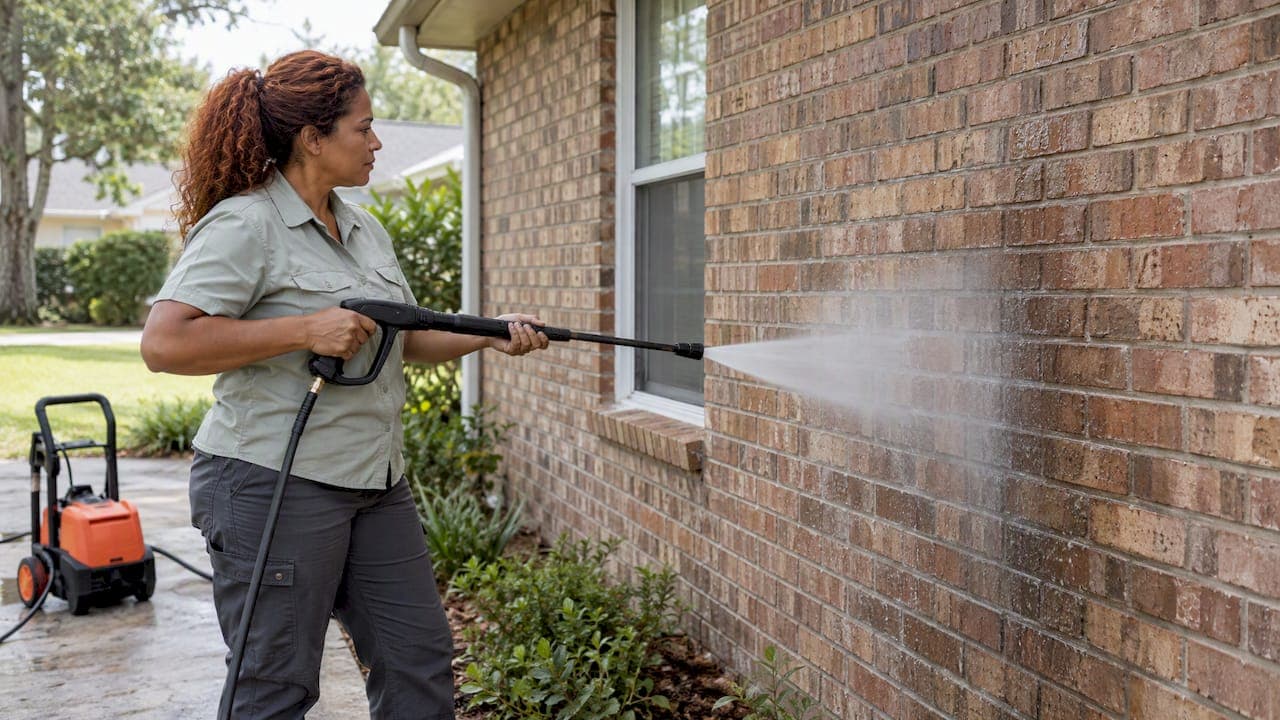
Yes, you can pressure wash a brick house, but only gently. Brick is hard on the surface and surprisingly soft underneath, and the mortar between the bricks is softer still. Too much pressure, a nozzle held too close or the wrong spray tip can strip the face of the brick and wash out the joints. Done right, a low-pressure wash lifts dirt, algae and grime and leaves the wall looking years younger.
Below, we cover what pressure to use, how to wash from top to bottom, how long brick needs to dry, and how to clean brick before painting it. We also tell you when it is smarter to hand the job to a professional.
TL;DR
- Brick can be pressure washed, but start low. The National Park Service advises beginning at 100 PSI or below and raising pressure only if needed.
- Use a wide spray pattern, keep the nozzle moving, and work from the top of the wall down.
- Never wash in freezing weather, and give the wall time to dry afterward. A masonry wall can take more than a week.
- Before painting brick, clean it gently, repair damaged mortar and let it dry at least 14 days.
- Old, soft or already-painted brick is the riskiest case. Test a hidden spot first or call a professional.
Table of Contents
- Is it a good idea to pressure wash a brick house?
- What PSI is safe for brick?
- How to pressure wash a brick house, step by step
- Weather and drying time
- How to clean brick before painting
- Soft washing: the gentler alternative
- How often should you wash brick in Florida?
- Our perspective: gentle first, prep always
- When to call a professional
- FAQ
- Sources
Is it a good idea to pressure wash a brick house?
It can be, when the brick is sound and the method is gentle. Dirt, algae and mildew build up on brick, especially on shaded and north-facing walls, and a careful wash is the quickest way to remove them. The trouble is that most damage comes from enthusiasm, not neglect.
The National Park Service explains that excessive pressure, a nozzle held too close, an unsuitable nozzle or too much flow can abrade brick. It also notes that grains of stone or sand in the runoff are a sign your pressure is too high. If you see sand washing off the wall, stop.
The damage is not only cosmetic. Brick manufacturer technical guidance warns that high-pressure water can remove mortar and damage the texture of the brick, leaving the wall more exposed to water getting in and to frost damage. That guidance comes from the UK, but the physics of water and masonry is the same here.
So the honest answer: yes if the wall is in good shape, you control the pressure, and you are willing to go slowly. Think twice if:
- the brick is old, soft or crumbling
- the mortar joints are sunken, cracked or sandy
- the wall is already painted and the paint is flaking
- you are not comfortable working from a ladder
What PSI is safe for brick?
This is where advice disagrees, and it is worth knowing why.
A big-box retailer's how-to says that a brick house generally calls for 1,500 to 2,000 PSI with a 25-degree tip, and a wider 40-degree pattern for painted brick. The same guide also tells you to use the lowest effective pressure and the widest effective spray pattern. That is the part to hold on to.
Preservation guidance is far more conservative. The National Park Service recommends starting at 100 PSI or below, even with a garden hose, and increasing only as necessary, generally to no more than 300 to 400 PSI for historic masonry. Historic-masonry guidance from an academic preservation resource suggests low-pressure washing at 600 to 1,000 PSI with detergent and natural-bristle brushes for unpainted masonry, and warns against high-pressure water and abrasive methods.
| Situation | Where to start | Notes |
|---|---|---|
| Old or historic brick | 100 PSI or below, garden hose first | Rarely above 300 to 400 PSI |
| Sound unpainted brick | Low pressure, in the 600 to 1,000 PSI range | Detergent and a soft brush do most of the work |
| Newer, hard, well-pointed brick | Lowest pressure that cleans | Retail guidance goes to 1,500 to 2,000 PSI, which is the ceiling, not the goal |
| Painted brick | Wide 40-degree pattern, low pressure | Aggressive washing strips sound paint and can drive water behind it |
Our advice is to treat the top of that range as a limit you probably never reach. If a wall comes clean at lower pressure, you have lost nothing and protected the mortar.
How to pressure wash a brick house, step by step

1. Check the wall first
Walk the whole house. Look for cracked or recessed mortar joints and loose bricks. Retail guidance suggests you repair damaged joints and let the patches dry for at least a week before washing, so water does not get driven into open joints. Check windows, door seals and any gaps where water could get inside.
2. Protect what is around the wall
Close windows and doors, cover outlets and light fixtures, and move furniture. Wet down nearby plants beforehand and keep cleaners off them. If landscaping is a concern, our guide to plant-safe pressure washing walks through how to clean without harming your beds.
3. Test a hidden spot
Pick an inconspicuous area, such as behind a shrub or low near the foundation. Start with a garden hose and a soft brush. The National Park Service says cleaning should begin with the gentlest method, use test areas and progress only if necessary, and that natural or synthetic bristle brushes are preferred over metal ones. Wire brushes leave scratches and rust marks on brick.
4. Pre-wet and apply cleaner if needed
Wet the brick with a gentle, low-pressure spray first. Damp brick absorbs less dirty water and cleaner. For algae or mildew, a masonry-safe cleaner applied with a pump sprayer and a soft brush often does the job. Always follow the product label.
5. Wash from the top down
Use the widest tip that cleans, hold the nozzle a good distance back, and keep it moving in even, overlapping passes. Work from the top of the wall down so dirty water never runs over a section you have already rinsed. Do not aim straight at mortar joints, and do not tilt the wand upward under siding, soffits or window frames.
6. Rinse and inspect
Rinse thoroughly, then step back and look. Check the runoff for sand or grit, and look at the joints. If mortar is eroding, you were using too much pressure or standing too close.

What about the roof and nearby surfaces?
Keep the wand off shingles. High pressure strips protective granules and is a well-known way to shorten a roof's life, which is covered in detail in this explanation of why pressure washing harms shingles. Rinse the lower edge of the roof from the ground with a gentle spray at most.
Weather and drying time
Timing matters as much as pressure. The National Park Service says water cleaning should not be done in freezing weather, because water trapped in masonry can freeze and cause spalling or cracking. In Central Florida freezes are rare, but a cold snap in winter is not unheard of, so check the forecast.
How long does brick take to dry? Longer than most people expect. The same National Park Service brief says a masonry wall may take more than one week to dry after cleaning. The surface looks dry within hours, but the brick holds moisture deeper in. Humid weather slows it down further.
If painting is the next step, that drying time is not optional. Moisture trapped behind paint is a leading cause of bubbling and peeling. Our articles on diagnosing peeling paint in Florida humidity and fixing paint bubbling explain what that looks like and how to prevent it.
How to clean brick before painting
Homeowners who search for how to prep brick for paint are usually weighing a bigger project, and the cleaning step decides how long the new finish lasts.
- Wash gently. Historic-masonry guidance advises cleaning dirty brick with a low-pressure wash, testing the method first, and removing only damaged or deteriorated paint. Avoid high-pressure and abrasive methods. A home-and-garden painting guide likewise recommends keeping pressure under 1,500 PSI to avoid mortar damage.
- Repair first. Fix cracked mortar and loose bricks before painting, and let repairs cure.
- Let it dry fully. The academic guidance says to allow masonry to dry at least 14 days before repainting. The painting guide is more relaxed, suggesting several days at minimum, so treat two weeks as the safer target, especially in humid weather.
- Use a masonry primer. Brick is porous. A compatible masonry primer and paint system keeps the finish bonded and lets the wall manage moisture.
If the old paint is chalky, a quick check will tell you whether it needs special handling. Our 30-second rag test for chalking paint shows how. For the broader question of timing between washing and painting, see our guide to pressure washing before painting.
Soft washing: the gentler alternative
For many brick homes, the best choice is not pressure at all. Soft washing uses low pressure and a cleaning solution to loosen algae, mildew and grime, then rinses it away. It is especially useful for old brick, painted brick, and walls with weak mortar. We compare the two methods in soft wash vs. pressure wash.
If your home also has stucco sections, the same caution applies, with its own twists. See how to pressure wash stucco without damaging it.
How often should you wash brick in Florida?
Florida's heat, rain and humidity feed algae and mildew, so brick that stays damp turns green and dark faster. Washing more often is not the answer, because every wash adds wear. The better fix is to reduce moisture at the source: redirect sprinklers, trim plants back from the wall and fix gutters that overflow. We lay this out in cutting pressure washing in Florida by fixing moisture and landscaping. Painting is easier to schedule well when you know the season, too. Our Florida painting season and dew point checklist covers it.
Our perspective: gentle first, prep always
We are a locally owned painting contractor serving Lake County and Central Florida, and we see brick, block and stucco homes in every condition. Our view is simple: the wash is part of the preparation, not a separate chore. A wall that is cleaned too aggressively will not hold paint well, and a wall painted before it is dry will fail early.
That is why thorough prep is the center of how we work, and why our service packages are built around it. We would rather tell you a wall needs a softer approach, a repair or another week of drying than rush to a finish that will not last. Brick is forgiving for decades and unforgiving in minutes, and a damaged joint cannot be undone with a second coat.
If you are unsure what your brick can take, test a small area first, go slower than feels necessary, and ask someone who handles this work every week.
— Kyle
When to call a professional
Hire help if the brick is old or soft, the mortar is failing, the wall is two stories or more, or you plan to repaint afterward and want washing, repairs and paint handled as one job so the timing works. A pro also saves you the cost of a repair if a wash goes wrong.
We offer exterior painting for homes and businesses across Lake County, with three service packages: Cosmetic Refresh, Enhanced Prep & Durability and Maximum Prep & Protection. They let you choose the level of preparation and protection that fits your house and budget. Learn more about our residential exterior painting or compare the packages, then schedule your appointment and we will look at your brick in person.
FAQ
Can pressure washing damage brick?
Yes. Too much pressure, the wrong nozzle or standing too close can wear away the brick face and wash out mortar. Damaged brick and joints let water in, which can lead to cracking in cold weather. Start at the lowest pressure and test a hidden area first.
How long does brick take to dry after pressure washing?
The surface can look dry in hours, but the National Park Service says a masonry wall may need more than a week to dry fully. Humid weather lengthens that. If you plan to paint, wait at least two weeks to be safe.
Can I pressure wash painted brick?
Yes, with extra care. Use a wide spray pattern and low pressure, and expect loose paint to come off. Remove only failing paint, then repair and repaint. If paint is flaking widely, a professional assessment is worth it.
What is the best way to clean the outside of a brick house?
Start with a garden hose, a soft natural-bristle brush and a masonry-safe cleaner, working top to bottom. Move to low-pressure washing only if that does not work, and keep the nozzle moving. Soft washing is a good option for older or painted brick.
Sources
- Preservation Brief 1: Assessing Cleaning and Water-Repellent Treatments for Historic Masonry Buildings, National Park Service
- Materials, historic masonry guidance
- How to Pressure Wash a House, Lowe's
- Site practice and troubleshooting: water pressure washers and brickwork, Ibstock
- How to Paint a Brick House, The Spruce
- Pressure Washing Shingles: Why It Damages Your Roof