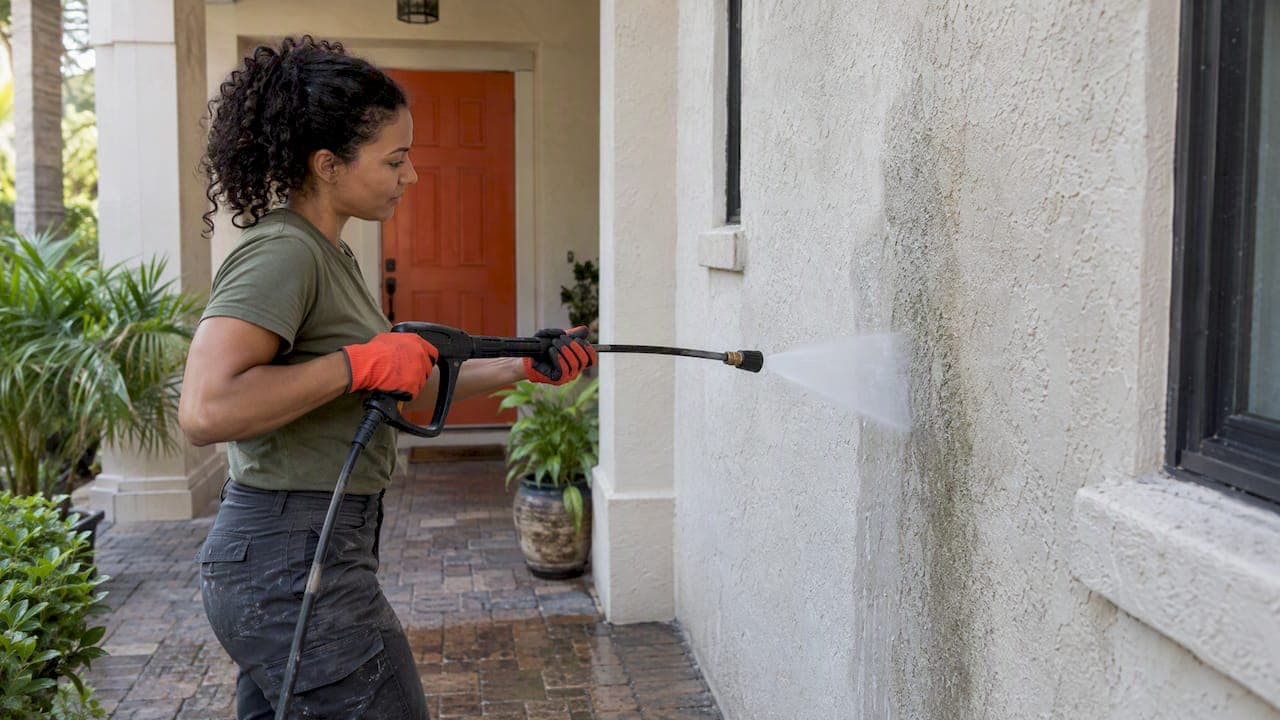
Yes, you can pressure wash stucco, but only with the pressure turned way down and the right technique. Stucco is porous and can crack, chip or soak up water if it is blasted. Most of the cleaning should come from a detergent solution and patience, not force. If your Central Florida home has green streaks, black mildew or chalky dirt, this guide explains what is safe, what to avoid, and when to call a pro.
TL;DR
- Keep pressure low: 200 to 500 PSI is the range stucco manufacturers point to for routine maintenance. Never aim a high-pressure stream directly at the wall.
- Soft washing (low pressure plus a cleaning solution that sits on the wall) usually cleans algae and mildew better than force does.
- Test a small, hidden area first, and never spray upward under laps, trim or around windows.
- Wash water should not run into storm drains. Ask any contractor how they contain it.
- Planning to repaint? Let the wall dry fully, repair cracks, then prime and paint. Washing and painting work best as one planned job.
Table of Contents
- Can you pressure wash stucco?
- What PSI is safe for stucco?
- Soft washing vs. pressure washing stucco
- How a careful stucco wash goes, step by step
- Wash water and Florida rules
- What does it cost to pressure wash a stucco house?
- Washing before you paint stucco
- Our perspective: clean gently, prep thoroughly
- Should you do it yourself or hire a pro?
- Wash and repaint your stucco with Tru Painting
- FAQ
- Sources
Can you pressure wash stucco?
You can, with limits. Stucco is a cement-based finish, and its surface is full of tiny pores. That is why it breathes, and it is also why it is vulnerable. Too much pressure can destroy the porous texture and cause chipping or cracking, and forcing water in can leave moisture behind the finish.
The type of stucco matters too:
- Traditional cement stucco is hard but can have hairline cracks you can't see from the ground.
- Synthetic stucco (EIFS) has a thin finish over foam insulation board. It is much more delicate, so low pressure is the rule.
- Painted or elastomeric-coated stucco has a film on top. High pressure can lift that film, especially where it is already chalking or peeling.
If you don't know which one you have, assume the more delicate option. A quick look at old repair work, or a pro's opinion, can settle it.
What PSI is safe for stucco?
For routine cleaning, stay at the 200 to 500 PSI range that soft washing uses. That is far below what many consumer machines put out at full tilt, so the setup matters as much as the number.
Some contractors go higher on sound, unpainted cement stucco. We don't recommend it for homes in our area, because you can't always tell what's hiding under the surface. Pressure above roughly 1,500 to 2,000 PSI aimed straight at stucco is where real damage happens.
A few practical habits keep the pressure effective but gentle:
- Use a wide-angle fan tip, never a zero-degree or narrow tip.
- Hold the nozzle a few feet from the wall and keep it moving.
- Spray down, not up, so water doesn't get behind the surface.
- Rinse from the top of the wall to the bottom.
The Lowe's stucco cleaning guide also describes washing from top to bottom, and says to set the washer to low pressure if you use one.
Soft washing vs. pressure washing stucco
People say "pressure wash" for everything, but professionals separate two methods.
| Pressure washing | Soft washing | |
|---|---|---|
| Pressure | High, concentrated | Low, under about 500 PSI |
| Cleaning action | Mechanical force | Detergent that breaks down growth |
| Best for | Concrete, driveways, walkways | Stucco, painted walls, roofs, EIFS |
| Risk to stucco | Cracks, gouges, water intrusion | Low when done correctly |
| Algae and mildew | Can leave roots behind | Treats the growth itself |
Professionals avoid blasting stucco and soft wash instead, pairing low pressure with solutions that chemically break down organic growth. That gives a deeper clean than water alone, with less risk to the finish.
Patience is the key. Experts describe applying a cleaning solution and letting it dwell 10 to 15 minutes so it can loosen algae and mildew before rinsing. Blasting harder to make up for skipping that step is how walls get damaged.

How a careful stucco wash goes, step by step
This is the order we would expect from any contractor working on your walls.
- Inspect first. Look for cracks, loose patches, failing caulk and bare spots. Water finds every one of them.
- Protect what's nearby. Cover or wet down plants, close windows, and shield outlets and light fixtures.
- Test a small area. Professionals always test a small area first to confirm the cleaner and technique won't discolor or degrade the finish, whether traditional, acrylic or elastomeric.
- Pre-wet the wall with plain water, working top to bottom.
- Apply the cleaning solution at low pressure and let it dwell. Don't let it dry on the wall.
- Rinse thoroughly, again from top to bottom, until no residue is left.
- Let the wall dry before judging the result or doing any painting.
On a Florida home, expect the shaded north side and areas near sprinklers to need extra attention. Those stay damp longest and grow the most algae.
Wash water and Florida rules
What comes off your walls doesn't disappear. Detergent, mildew and sediment end up in the runoff. A Pinellas County guide on best management practices for pressure washing explains that wash water should be kept out of storm drains, which lead to local waterways. That brochure is county-specific, and rules vary by city and county, so ask your contractor which ones apply to your property.
There is a common misunderstanding here. Even biodegradable, phosphate-free cleaners can harm aquatic life quickly if they reach a storm drain. "Eco-friendly" on the label is not permission to rinse into the street.
When you interview a contractor, ask:
- How do you keep wash water out of storm drains?
- Where does the water go instead, such as landscaped areas or a sanitary drain?
- Do you pre-test the cleaner on my wall?
A confident, specific answer is a good sign. A shrug is not.
What does it cost to pressure wash a stucco house?
Nationally, professionals typically charge $200 to $450 to pressure wash a house. For a 2,000 sq ft home, the same source shows a range of $200 to $1,000, depending on complexity, access and the number of stories. Stucco often needs slower, more careful work, so expect it to land higher in the range rather than lower.
For a deeper look at how bids are built, this breakdown of pressure washing cost estimates is a good place to compare line items. These figures are national averages. We don't publish prices for our own services, because every home is scoped and bid individually.
Price differences usually come from:
- Home size and number of stories
- Mildew or algae severity
- Access, landscaping and fencing
- Add-ons such as deep cleaning or sealing
- Containment and cleanup requirements
Washing before you paint stucco
A clean wall is the first step in any repaint, and stucco is no exception. Paint over dirt, chalk or mildew and it won't bond. We cover this in detail in our guide on pressure washing before painting, including how long to wait.
A few points specific to stucco:
- Dry time matters. Moisture trapped in stucco can cause blistering and poor adhesion. We explain our approach in our piece on curing and bid specs for Florida stucco.
- Check surface pH. One painting specification says surface pH should be between 6 and 9 before applying new coatings, and that the surface must be clean and fully dry. Synthetic stucco can be painted under those conditions.
- Fix cracks first. Painting over cracks hides them for a season at best. See repairing stucco cracks before painting.
- Look for white powder. Efflorescence points to moisture moving through the wall. Read our notes on efflorescence on stucco before you coat it.
- Check the old paint. If your hand comes away chalky, the old coating needs attention. Our chalking paint rag test shows how.
Once the wall is clean, dry and repaired, the coating can go on. Our stucco painting process covers spraying and back-rolling, and our elastomeric paint checklist helps you decide whether that coating suits your home.
Our perspective: clean gently, prep thoroughly
We are a locally owned painting contractor serving Lake County and Central Florida, and we see what happens when stucco is washed too hard. The wall looks bright for a week. Then hairline cracks open, paint peels near windows, or moisture shows up inside.
That is why our approach starts with preparation. Cleaning is not a separate chore for us. It is the first stage of a finish that should last. We would rather spend extra time on a gentle wash, a dry-time check and proper repairs than rush to the paint.
Here is how we think about it:
- Gentle beats strong. If low pressure and a good cleaner don't get it clean, higher pressure is rarely the right fix.
- Washing and painting belong together. When a wash is the first step toward a repaint, one contractor planning both avoids gaps in moisture, timing and responsibility.
- Prep depth should match the home. That is why our work comes in three tiers: Cosmetic Refresh, Enhanced Prep & Durability, and Maximum Prep & Protection. A newer, sound wall needs less than an older one with repairs and moisture history.
- Clear communication. You should know what we're doing to your walls, in plain words, before we do it.
We don't compete on being cheapest. We compete on finishes you'll be glad you paid for years later.
— Kyle
Should you do it yourself or hire a pro?
A light rinse of a small, single-story wall with a garden hose and a mild cleaner is within reach for many homeowners. Beyond that, the risks go up fast.
Consider hiring a pro if:
- Your home is two stories or has hard-to-reach walls.
- You see cracks, soft spots or peeling paint.
- You have EIFS or aren't sure what type of stucco you have.
- You plan to repaint soon.
- You live in an HOA or retirement community with rules on wash water, noise or appearance.
- Your walls have heavy algae or mildew that a rinse won't touch.
Don't climb a ladder with a pressure washer. The kickback and the height are a real fall risk.
Wash and repaint your stucco with Tru Painting
If your stucco needs more than a rinse, we can help. We handle residential exterior painting, stucco painting, drywall repair and pressure washing across Lake County and Central Florida. Our three service packages let you choose the level of prep and protection that fits your home and budget. Want a straight answer on what your walls need? Visit our site to schedule your appointment.
For more on how we prepare surfaces, see our guide to prepping exterior walls before painting.
FAQ
Can you power wash stucco?
Yes, but keep the pressure low, generally 200 to 500 PSI, and use a wide fan tip held a few feet from the wall. Higher pressure can chip, crack or gouge the surface. A soft wash with a cleaning solution is usually safer and works better on algae.
Can you paint synthetic stucco?
Yes. The surface has to be clean and fully dry, and a pH between 6 and 9 is the target before coating. Have a professional check compatibility and moisture content first, since synthetic stucco is more delicate than cement stucco.
How often should stucco be cleaned?
There is no single schedule. In Florida's humidity, shaded and damp walls grow algae faster, so check them each year and wash when you see staining. Regular gentle cleaning is easier on the finish than occasional heavy cleaning.
Is 3,000 PSI too much for stucco?
Yes. That is far above the range manufacturers recommend for stucco maintenance. Even with a wide tip, a stream at that level can damage the surface. Reduce the pressure, or use a soft wash method instead.
Sources
- Stucco Repair and Maintenance, Sto Corp
- Sto Specification RC100: Cleaning Wall Surfaces
- How to Clean Stucco Siding Step by Step, Angi
- How Much Does It Cost to Pressure Wash a House?, Angi
- Best Management Practices for Pressure Washing, Pinellas County
- How to Clean Stucco, Lowe's
- Paint specifications, Bishop State
- How to soft wash stucco, Dirt Killer