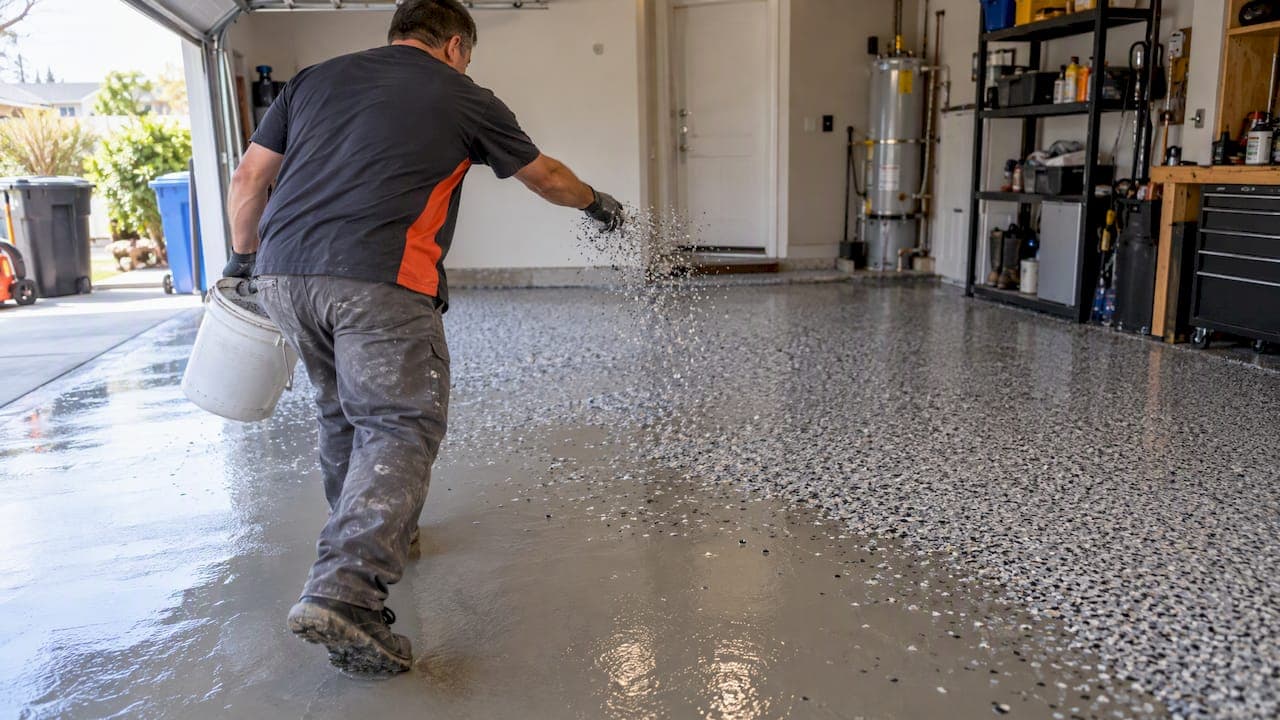
A flake epoxy floor is a seamless coating made of a pigmented epoxy base, colored vinyl chips broadcast into it while it is wet, and a clear topcoat sealed over the top. Professionally installed, it typically runs $5 to $9 per square foot, and the result hides dirt, adds grip and covers the flaws a slab already has. Below, we walk through how the system is built, what drives the price, where these floors fail, and what to ask a contractor before you sign.
TL;DR
- Flake epoxy is a three-part system: a pigmented base coat, broadcast vinyl chips, and a clear topcoat.
- Expect roughly $5 to $9 per square foot installed, depending mostly on full or partial broadcast and the condition of your concrete.
- Most failures come from poor surface prep, not from the flakes. Ask how the slab will be ground.
- A polyaspartic topcoat can cut downtime and improve UV stability, which matters on sunny Florida garages.
- Choose one or two topcoats based on whether you want more traction or an easier-to-clean surface.
Table of Contents
- What a flake epoxy floor is made of
- Why homeowners choose flakes over a solid color
- What a flake epoxy floor costs
- Full broadcast vs. partial broadcast
- Surface prep decides how long the floor lasts
- Epoxy vs. polyaspartic topcoat
- One topcoat or two?
- Common problems and how pros avoid them
- How the installation goes, step by step
- Our perspective on flake floors
- Choosing colors for a Florida garage
- Caring for the finished floor
- Planning your project with Tru Painting
- FAQ
- Sources
What a flake epoxy floor is made of
The system has three layers, and each one has a job. Miracote describes it as a pigmented epoxy receiving coat, broadcast colored vinyl chips, and a clear epoxy, polyaspartic or urethane topcoat.
- Base coat. A tinted epoxy rolled onto the ground concrete. It bonds to the slab and holds the flakes in place.
- Flakes. Small vinyl chips, often 1/4 inch, thrown by hand into the wet base. They create the speckled, blended look.
- Topcoat. A clear coating that locks the flakes down, protects against chemicals and wear, and sets the final texture and gloss.
The result is a seamless, non-porous surface. Sherwin-Williams notes that these systems resist chemical spills, bacterial growth and thermal shock, which is why you see them in everything from luxury garages to commercial kitchens and veterinary clinics.
Why homeowners choose flakes over a solid color
A solid-color epoxy floor looks sleek on day one and shows every tire mark, footprint and dust bunny by day three. Flakes solve that. According to EpoxyTimes, the chips do three things at once: they mask slab imperfections, break up slick surfaces for better grip, and hide dirt and tire marks that a solid coating can't.
That last point matters in Central Florida, where garage floors collect fine sand, pool water and lawn debris year-round. A blended flake color forgives a floor that sits a few days between sweeps.
Where flake epoxy makes sense
- Residential garages
- Basements and workshops
- Laundry rooms and utility spaces
- Showrooms, break rooms and light commercial areas
- Commercial kitchens and similar spaces where a seamless, easy-to-clean surface is needed
If you are comparing floors for a larger commercial space, our guide to warehouse floor coating options covers heavier-duty choices.
What a flake epoxy floor costs
EpoxyTimes puts professional installation at $5 to $9 per square foot. The spread comes from a handful of factors:
- Full or partial broadcast. More flake means more material and more labor.
- Slab condition. Cracks, pitting, oil stains and old coatings all add prep time.
- Topcoat choice. One coat, two coats, or a polyaspartic upgrade.
- Size and access. A two-car garage and a 5,000-square-foot showroom do not price the same way per foot.
For scale, a full broadcast on a standard two-car garage of about 480 square feet takes roughly 70 to 100 pounds of 1/4-inch flake, at about 5 to 7 square feet per pound. At the quoted range, that garage lands somewhere between $2,400 and $4,320 (480 sq. ft. times $5 and $9). That is arithmetic on a national range, not a quote. Your slab, your flake choice and your local market will move it.
We don't publish fixed prices because every floor is different. We scope each job and bid it per project. For a local look at how garage coating pricing works, read our piece on garage floor coating cost in The Villages.
Full broadcast vs. partial broadcast
This is the biggest decision after prep.
| Full broadcast (to refusal) | Partial broadcast | |
|---|---|---|
| Coverage | Flakes cover the base coat completely | Some base coat shows through |
| Dirt hiding | Best | Weaker |
| Durability | Builds thickness for hot tires and heavy use | Thinner build |
| Future scuff-coat | Easier | Limited |
| Cost | Higher | Lower |
| Flake needed (two-car garage) | About 70 to 100 lbs | Less |
Practitioners cited by EpoxyTimes call broadcast to refusal, where no more flakes stick to the wet base, the most effective route to durability on hot tires and high-use areas. A partial broadcast can be a cheaper aesthetic choice, but it leaves more base coat exposed, hides less dirt and limits your ability to scuff-coat the floor later.
For a garage that parks daily-driven vehicles, we lean toward full broadcast. For a low-traffic laundry room or a shed, a lighter broadcast can be a sensible way to save.
Surface prep decides how long the floor lasts
The flake gets the attention, but the grind does the work. The most common failure is delamination, and EpoxyTimes traces it almost always to inadequate surface preparation rather than the flake product. If the concrete is not mechanically ground to an open profile, the coating cannot bond properly, whatever the product quality.

Here is the uncomfortable part. Decorative chips can hide a lazy grind. A floor can look perfect the day it is finished and begin peeling a year later. You are really buying the crew's care, not just the materials.
Questions to ask any installer about prep
- Will the slab be mechanically ground, or just acid etched or cleaned?
- How will cracks, spalls and old control joints be repaired?
- How are oil stains and existing coatings handled?
- Is the slab tested for moisture before coating?
- What does the workmanship warranty cover, and for how long?
Those are the same questions we put at the center of every project. Thorough preparation is how we work on interiors, exteriors, cabinets and coatings, and a floor is no different.
Epoxy vs. polyaspartic topcoat
Many modern systems keep an epoxy base and swap the clear topcoat for polyaspartic. The tradeoffs are mostly about cure time and sunlight.
Product data from one manufacturer lists Shore D hardness around 65 to 75 for polyaspartic topcoats, along with low abrasion loss in Taber testing. Systems like these can often handle foot traffic within a few hours and vehicle traffic within about a day, while standard epoxy takes longer. Exact times depend on the product, temperature and humidity, so follow the data sheet for the specific system your installer uses.

Polyaspartic is also more UV stable. A plain epoxy topcoat can yellow under strong sun, which is a real consideration for garages with a big south-facing door or open driveway exposure in Florida. For a fuller comparison, see our guide to garage floor epoxy vs. polyaspartic.
Does it cost more? Usually, yes. A retail example: one manufacturer lists a 2-gallon polyaspartic topcoat kit at $194.99 as of its September 2025 listing. That is a materials price for a DIY kit, not an installed price, but it shows why a pro system costs more than a single epoxy clear.
One topcoat or two?
This is a choice most homeowners never hear about. Per Miracote, a single clear topcoat is more economical but leaves a more aggressive, slip-resistant texture that can be harder to clean. Two topcoats give a smoother, easier-to-clean surface with slightly less slip resistance.
Think about how you use the space:
- Wet or pool-adjacent garage, ramped driveway entry: favor more texture.
- Showroom, workshop, or a garage you wash often: a smoother two-coat finish is easier to maintain.
Slip resistance matters most in commercial settings. Under OSHA's walking-working surfaces rule, 29 CFR 1910.22, employers must keep workplace floors clean, orderly, sanitary and as dry as feasible. If you run a business, ask your installer how the finish handles wet conditions, and have a site-specific assessment done rather than relying on one number.
Common problems and how pros avoid them
Bald spots and uneven flake
Flakes can sink into the base coat if they are thrown too early or unevenly, leaving thin patches. Installers avoid this by checking the floor about 30 minutes after broadcasting in spiked shoes and rebroadcasting any thin areas before the base cures.
Peeling and lifting
This points back to prep, and sometimes to moisture coming up through the slab. A ground, repaired and dry slab is the foundation for everything else.
Fading and yellowing
Sunlight is the cause. UV-stable topcoats help, and so does good habit. Our article on how Florida car owners prevent paint fading explains how strong sun breaks down coatings.
Skipped cure time
Parking on a floor too early can leave tire prints or lift the coating. Follow the return-to-service times for your specific system, not a rule of thumb.
How the installation goes, step by step
Here is the sequence a careful crew follows. The step-by-step guide from Concrete Floor Supply lays out the same general order for DIYers.
- Clear the space and inspect the slab for cracks, stains and moisture.
- Diamond-grind the concrete to an open profile and vacuum the dust.
- Repair cracks and joints.
- Roll or squeegee the tinted base coat.
- Broadcast flakes by hand while the base is wet, to refusal or to the planned density.
- Let the base cure, then scrape and sweep off loose flakes.
- Apply one or two clear topcoats.
- Allow the full cure before vehicles return.
This is a job for trained crews, not a weekend experiment. Mixing ratios, pot life and temperature windows are tight. One manufacturer's data sheet lists a pot life of 10 to 15 minutes for its polyaspartic, which leaves little room for error.
Our perspective on flake floors
We are painters and coating specialists, and we hold floors to the same standard as a front door or a kitchen cabinet: the finish is only as good as the prep underneath it. Rather than competing on being the cheapest, we compete on lasting value, clear communication and finishes you can be proud of for years.
That shapes how we talk about flake epoxy. We would rather explain why a full broadcast makes sense for your garage, or why a polyaspartic topcoat is worth the upgrade in the Florida sun, than push you toward the lowest bid. A low price on a floor often means a short grind. Ask any contractor, us included, to describe the prep step by step.
We also like to match the project to the budget. Our three-tier approach, Cosmetic Refresh, Enhanced Prep & Durability and Maximum Prep & Protection, exists so you can choose the level of protection that fits your home, and we explain what changes at each level.
— Kyle
Choosing colors for a Florida garage
The color question comes down to light and dirt.
- Gray and tan blends hide dust and tire marks well and suit most garages.
- Dark blends look dramatic but can show light-colored dust and sand.
- Light blends brighten a dim garage but need a bit more sweeping.
- Multi-color flakes are the most forgiving for hiding stains and slab flaws.
Bring a sample chip to your garage and look at it in the actual light, in the morning and late afternoon. Match it to your cabinets, door and exterior trim. If you are planning a repaint at the same time, our exterior paint lifespan guide for Florida homes can help you time the work.
Caring for the finished floor
Flake floors are low maintenance, but not no maintenance.
- Sweep or dust mop weekly to keep grit from scratching the topcoat.
- Mop with a mild cleaner and water. Skip harsh solvents.
- Wipe up oil, antifreeze and brake fluid promptly.
- Use mats or pads under jack stands and heavy tool chests.
- Plan to scuff and recoat the clear topcoat eventually if the gloss wears. A full broadcast leaves you better positioned to do that.
For general upkeep ideas that apply to coated surfaces around the house, see our tips on protecting painted surfaces long term.
Planning your project with Tru Painting
If you live in Lake County or elsewhere in Central Florida and want a durable coating, we can help you scope the project. Specialty coatings are part of our work, alongside interior and exterior painting, cabinet refinishing, pressure washing and drywall repair. We bid each job per project and explain the options plainly.
See our three service packages or visit our main site to start a conversation about your project. Have a pool deck or patio in mind too? Our post on pool deck coatings for Lake County homeowners is a good next read.
FAQ
What are epoxy flakes used for?
They add color and texture to an epoxy floor. The chips hide dirt and tire marks, mask minor slab imperfections and add grip. They are also part of what builds thickness in a full broadcast system.
Can you do an epoxy floor without flakes?
Yes. A solid-color epoxy works, and it looks clean when new. It shows dirt, scuffs and slab flaws more than a flake floor and can be slicker underfoot unless a texture is added.
How long does a flake epoxy floor last?
It depends mostly on prep, product and use. A properly ground slab, a full broadcast and a quality topcoat give the floor its best chance at lasting for years. Ask your installer for the workmanship warranty terms in writing.
How soon can I drive on a new flake floor?
It depends on the system. Polyaspartic topcoat data often lists foot traffic within hours and vehicle traffic in about a day, while epoxy generally takes longer. Follow the data sheet and your installer's instructions for your specific product.
Sources
- EpoxyTimes: Flake Epoxy Floors, Cost, Full vs Partial Broadcast
- Miracote: MiraFlor CQ Epoxy Flake System
- Sherwin-Williams: Epoxy Flake and Epoxy Chip Flooring
- Concrete Floor Supply: How to Install an Epoxy Flake Floor
- PurEpoxy polyaspartic topcoat data sheet
- Pourla: UltraShield Polyaspartic Top Coat
- E2U polyaspartic technical data sheet
- OSHA: 29 CFR 1910.22, General requirements