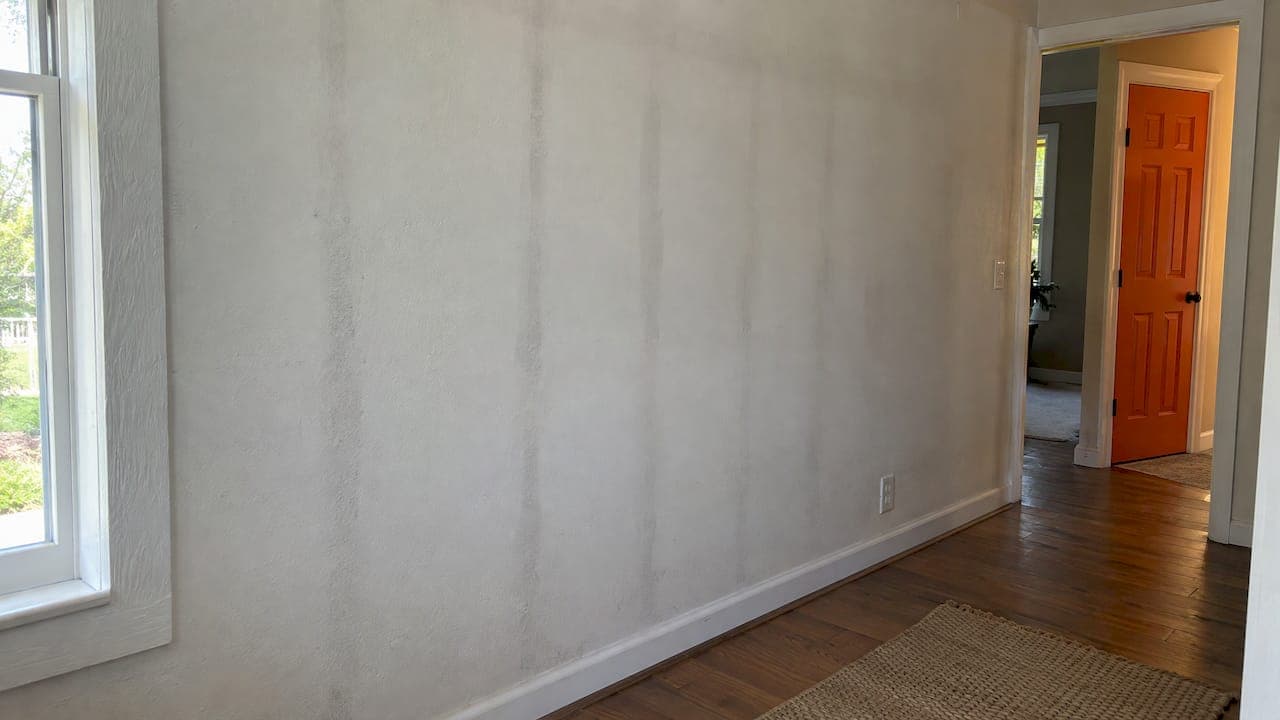
Ghosting is the dark streaking or outlining that appears on walls and ceilings where the surface is a little cooler than the rest, usually tracing studs, joists and nail heads. It is caused by airborne particles such as dust, soot and cooking residue settling on those cooler spots. It is not automatically mold, but the cause has to be found before you repaint, or the marks will come back. Here is how to read what you are seeing, clean it safely and keep it from returning.
TL;DR
- Ghosting is particle buildup, often in stripes that follow studs or in dots at nail heads. It is not automatically mold.
- The usual culprits are candle and fireplace soot, cooking residue, dust and air movement, combined with cold spots in the wall or ceiling.
- Cleaning and repainting only works long term if the source of the particles or the cold spot is addressed first.
- If streaks keep returning, smell musty, or sit on exterior walls with moisture issues, have the home evaluated before any paint goes on.
- Once the cause is handled, a proper prep and a quality coating give you a clean, even finish.
Table of Contents
- What ghosting on walls looks like
- What causes ghosting
- Ghosting or mold? How to tell
- How to clean ghosting marks safely
- Why repainting alone does not solve it
- How to keep ghosting from coming back
- When to call in professionals
- Our perspective on ghosting
- Ready for a clean, even finish?
- FAQ
- Sources
What ghosting on walls looks like
Most homeowners first notice it as a faint gray or black shadow on a freshly painted wall or ceiling. The Connecticut Department of Public Health describes ghosting as particle deposition that can appear as dark streaks or geometric patterns on studs, drywall nail heads, under doors, on carpets and plastics, and around picture frames.
The pattern is the giveaway. Common signs include:
- Vertical stripes that repeat across a wall at an even interval. A reference site on building diagnostics notes these commonly follow 16- or 24-inch stud spacing.
- Dark dots in a grid that line up with drywall nails or screws.
- Horizontal bands along the top plate, or lines on a ceiling that follow the joists.
- Outlines around frames, behind furniture, or along the edge of a door.
The marks often look dusty or sooty, and some of them wipe partway off with a dry sponge. That is a clue that you are dealing with deposited particles rather than something growing in the wall.
What causes ghosting
Two things have to be present at once: particles in the air and a reason for them to land in a specific place.
The particles
The Connecticut brief points to particles from occupant activities, combustion and mechanical systems, combined with building defects or airflow. Home inspectors at InterNACHI list soil dust, animal dander, cooking residue, fireplace soot and candle soot as typical sources. Smoking, vacuuming, traffic and construction dust can add to the load.
In plain terms, that means:
- Burning candles, especially scented or heavily sooting ones, for hours a day
- A fireplace that is not drawing well
- Gas appliances that are poorly vented or out of adjustment
- Frying and cooking without a range hood that vents outdoors
- Dust circulating through a duct system with poor filtration
The cold spot
Particles do not land evenly. The Building Science Corporation explains that ghosting happens when airborne particles plate out on colder wall areas, commonly tracing studs because framing members act as thermal bridges. A stud conducts heat differently than the insulated cavity beside it, so the paint over it sits at a slightly different temperature.
The same company describes four ways particles get deposited: filtration, electrostatic attraction, thermal deposition and impaction. You do not need to memorize those. The takeaway is that temperature, static charge and air movement all play a part, which is why the same house can show ghosting in one room and none in another.
A national laboratory guide on residential moisture control links marks on gypsum board that match the framing to cold spots and thermal bridging, particularly with highly conductive steel framing. It also stresses that gaps or penetrations in the air, thermal and moisture barriers let heat, air and moisture move through the wall, creating cold spots and condensation risk.
Why it shows up after repainting
Fresh, light paint makes a faint pattern easier to see. It also means the wall has been sealed up and cleaned, so a house that had a slow buildup for years can suddenly look streaked within a season. If you have just painted and the stripes are back, the paint almost never caused the problem. The conditions around the wall did.
Ghosting or mold? How to tell
This is the question most people have, and it is a fair one. Dark marks on a wall can mean several things, and they call for different responses.
The Connecticut brief notes that asking about moisture problems and odor can help rule mold in or out. Use these questions as a starting point:
| What you notice | Points toward ghosting | Points toward moisture or mold |
|---|---|---|
| Pattern | Repeats along studs, joists or nail heads | Random patches, spreading blotches, or a stain with a ring edge |
| Smell | None, or a faint smoky smell | Musty or earthy odor |
| Texture | Dusty or powdery, wipes partly off | Fuzzy, slimy, or the paint bubbles and peels |
| History | Candles, fireplace, cooking, new dust sources | Past leaks, plumbing issues, high humidity, water stains |
| Location | Exterior walls, ceilings, corners | Near plumbing, roof leaks, windows, bathrooms |
The table is a guide, not a diagnosis. Iowa State University Extension material says laboratory testing can determine whether streaks are soot, mold or dirt. If you are unsure, or anyone in the house has respiratory problems, a lab test or a qualified home inspector is the right next step before you scrub or paint.
If the marks look more like a brown ring or a spreading stain on a ceiling, you may be dealing with a leak instead. Our guide to water stain ceiling repair walks through that case.
How to clean ghosting marks safely
The order matters. Cleaning first and investigating later wastes a weekend. University extension guidance gives the sequence in one line: find and eliminate the source, then clean and repaint.
- Identify the likely source. Think about candles, the fireplace, gas appliances, cooking habits and the air filter. Look at where the marks are heaviest.
- Fix or reduce the source. Cut back on candle burning, use the range hood, change the HVAC filter, and have combustion appliances checked.
- Test a small hidden spot. Painted walls vary in sheen and durability. Our post on how to clean painted walls explains why a hidden patch test protects the finish.
- Dry-clean first. A soft dry sponge or a vacuum with a brush attachment lifts loose soot and dust without smearing it into the paint.
- Wash gently if needed. Use a mild cleaner and a damp cloth, rinse, and let the wall dry fully. Scrubbing hard can burnish flat paint and leave a shiny patch.
- Prime and repaint. Soot and stain residue can bleed through plain paint, so a stain-blocking primer matters.
If you have confirmed mold, the same extension guidance says to reduce moisture and clean with a bleach solution, and that severe mold growth inside the wall cavity calls for removing the wall surface. That is a job for a remediation professional, not a weekend project. Wear gloves, eye protection and a respirator rated for the work, and never mix bleach with other cleaners.
Why repainting alone does not solve it
This is the most common mistake we see described by homeowners. They scrub, roll on two coats and enjoy a clean wall for a few months. Then the stripes return.
The Los Angeles Times reported that repainting will not stop soot ghosting if the source remains, pointing to improperly vented fireplaces, furnaces and other fuel-burning fixtures as likely culprits. The paint is only the surface. The wall will keep collecting particles until the cause changes.
There is also a coating question. Once the cause is under control, how well the surface was prepared decides how clean the result looks and how long it lasts. Our checklist for how to prep walls before repainting covers cleaning, repairs, sanding and priming in the right order, and our guide to covering dark walls explains what it takes to get an even, lighter color over stained surfaces.

How to keep ghosting from coming back
Prevention comes down to three things: fewer particles, better airflow and warmer, better-sealed walls.
Reduce what goes into the air
The Connecticut brief recommends reducing sources such as candles, smoking and cooking without exhaust. Simple habits help:
- Use the range hood every time you fry or sear, and make sure it vents outside
- Burn fewer candles, and trim wicks if you do
- Keep fireplaces serviced and the damper open while burning
- Replace HVAC filters on schedule
Deal with combustion appliances
For soot-related problems, University of Illinois Extension recommends properly venting combustion appliances, providing combustion and makeup air, and venting gas dryers outdoors. It also advises avoiding unvented gas heating appliances except in emergencies. Have a licensed HVAC or gas professional check any appliance you suspect.
Address cold spots and moisture
For dirt streaks, Iowa State recommends reducing moisture in the home, warming the walls, sealing outdoor dirt entry points and filtering ventilation air. It also cautions that sealing a house can cause downdrafting problems unless new heating appliances are installed. That is a good reason to involve a professional rather than caulk everything yourself.
In a Florida home, where air conditioning runs much of the year and humidity is a constant, keeping moisture under control and the air circulating through clean filters is just as relevant as it is in a cold climate. Our post on why interior painting improves air quality at home is a useful companion when you plan the repaint.
When to call in professionals
Some cases deserve more than a sponge and a can of primer. Consider an evaluation when:
- Ghosting returns within a season of repainting
- It appears on several exterior walls or across ceiling joists in many rooms
- You notice a musty smell, peeling paint or past water damage
- Gas, oil or wood-burning appliances are involved
- Anyone at home has asthma or allergies
A Home Energy Magazine technical article recommends blower-door, duct-leakage, pressure and infrared insulation testing when the source is unclear, and advises trained professionals because improper repairs can make the problem worse. A building performance contractor or a home inspector is the right person for that. A painter's role comes after: preparing the surface, sealing and coating it so the finish is clean and durable.
Our perspective on ghosting
We get calls about ghosting after a homeowner has painted once already and watched the stripes come back. It is frustrating, and it is almost never the paint's fault.
Our approach is to treat it as a prep problem and a cause problem, in that order. We look at where the marks are, what the home burns, how it breathes, and whether anything points to moisture. If it looks like something a building specialist should check, we say so before anyone opens a paint can.
Once the cause is handled, preparation is where we put our time: careful cleaning, repairing drywall where needed, stain-blocking primer, and premium paint applied meticulously. That is why we offer three service tiers. A cosmetic refresh suits a wall with a minor, one-time mark. A home with a history of staining may call for more prep and protection, and we walk you through the difference without pressure.
Our goal is a flawless wall that stays that way, not the cheapest quick fix.
Kyle
Ready for a clean, even finish?
If you are in Lake County or Central Florida and have walls or ceilings with stubborn marks, we can look at the surfaces, talk through the likely cause and recommend the level of prep that fits. Our three packages, Cosmetic Refresh, Enhanced Prep & Durability and Maximum Prep & Protection, are described on our services page, and our residential interior painting team handles the rest, from drywall repairs to the final coat.

To get started, schedule your appointment and tell us where the marks are. We will give you a clear, honest scope.
FAQ
What is ghosting on a ceiling?
It is the same particle buildup you see on walls, but it follows ceiling joists, trusses or insulation gaps above. Those areas are cooler than the rest of the ceiling, so particles settle there first. Fix the source and the cold spot before repainting, or the lines will reappear.
Can I just paint over ghosting?
You can, but it will usually come back unless the source is addressed. Clean the surface first, then use a stain-blocking primer and quality paint. Coverage helps appearance only; it does nothing about the particles or cold spots that created the marks.
Is ghosting dangerous?
Ghosting itself is a cosmetic sign of particle deposition, but it can point to something that deserves attention, such as poorly vented combustion appliances or excess moisture. If you smell gas or smoke, or have a gas appliance you suspect is venting poorly, contact a licensed professional or your utility right away.
How do I know if the marks are mold?
Look for a musty odor, fuzzy or spreading growth, peeling paint or past leaks. Stripes that follow studs and nail heads are more typical of ghosting. When in doubt, a lab test can tell soot, mold and dirt apart.
Does the paint matter?
Yes, in the sense that prep and primer decide how well a repaint holds up. Paint does not stop the cause, but a properly prepped surface with the right primer gives you the cleanest, most durable result once the cause is handled.
Sources
- Connecticut Department of Public Health technical brief on ghosting
- InspectAPedia: Ghosting stains and thermal tracking
- InterNACHI: Ghosting
- Building Science Corporation: Black stains on carpets and ghosting of framing (PDF)
- Building Science Corporation: BSD-150 digest
- Pacific Northwest National Laboratory: Moisture control for residential buildings
- University extension: Black streaks (ghosting) on walls, AEN-174
- Los Angeles Times: Soot can cause ghosting on painted walls
- Home Energy Magazine: Black soot ghosting