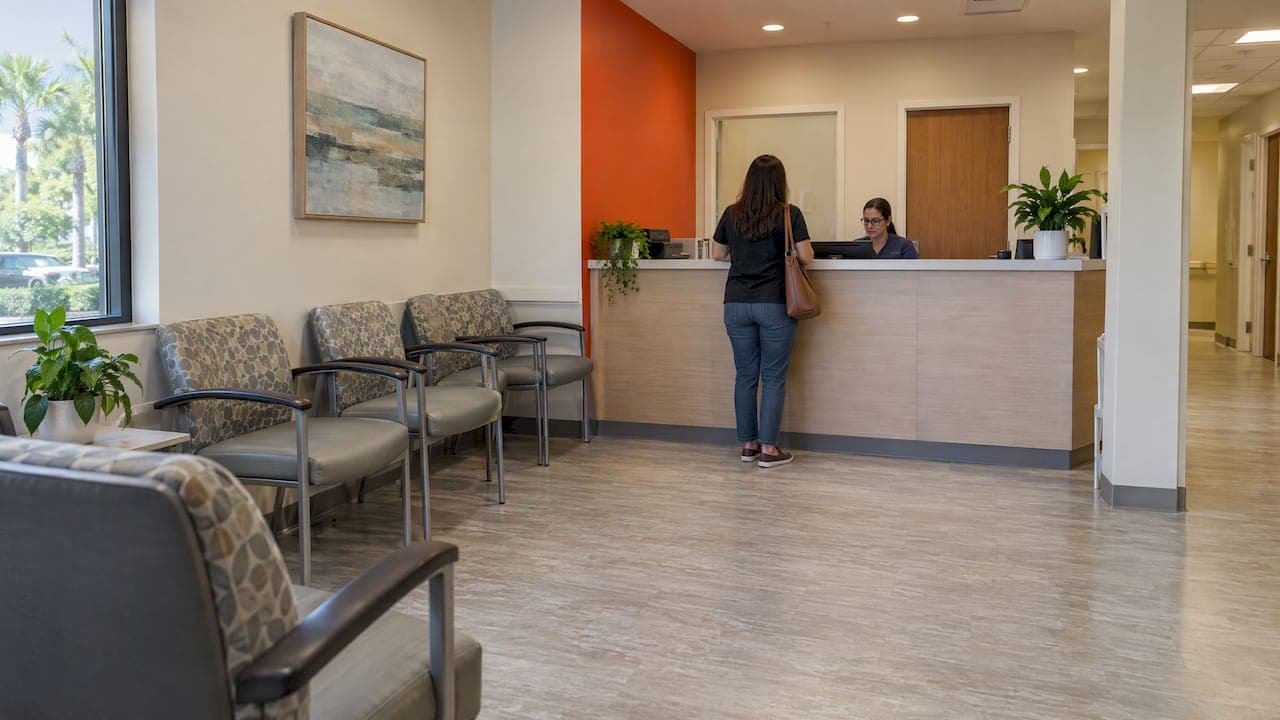
The best medical office paint colors are soft blues, muted greens and warm neutrals on most walls, with a few deeper or livelier accents where they help people find their way. Pair them with a washable, semi-gloss or eggshell finish and your office will feel calm to patients and hold up to daily cleaning. Below, we go room by room, explain what the research does and does not show, and cover the finish and lighting choices that decide whether a color still looks right in a year.
TL;DR
- Blues and greens are the most common choices for patient-facing rooms, and professional and academic sources link them to a calmer feel. Keep them soft and slightly muted.
- Use warm neutrals in waiting areas, soft pastels or yellows in pediatric spaces, and avoid large areas of red.
- Research on color and emotion is still limited, so treat color as one part of a calm room alongside lighting, layout and cleanliness.
- Choose scrubbable finishes: eggshell for general walls, semi-gloss for procedure rooms, restrooms and trim, flat for ceilings.
- Judge samples under your real lighting, and plan painting around patient hours.
Table of Contents
- What colors work best in a medical office
- Colors by room: waiting area, exam rooms and more
- Specific shades to start with
- Light changes everything
- Finishes that survive daily cleaning
- Exterior colors for a Florida medical office
- Painting around patients
- Our perspective
- Planning your medical office paint project with us
- FAQ
- Sources
What colors work best in a medical office
Start with the family of colors most practices land on: blue, green and gentle neutrals. The American Dental Association notes that blue and green tend to relax people but can feel dull on their own, and that red can add to anxiety in a dental office. It also says orange, pink and purple can add fun or sophistication but can overwhelm in large amounts.
A 2024 systematic review of color in healthcare environments reports that cool colors are linked to calming effects, while warm colors such as red, yellow and orange are tied to comfort but may raise anxiety in some patients. Soft whites and grays give a balanced backdrop, but they can read as sterile if they are all you use.
There is some direct evidence too. In a randomized trial with 190 chemotherapy patients, 20 minutes in a blue-themed room lowered anxiety scores from 57.70 to 50.03, while patients in standard white or off-white rooms showed no significant change. A 2026 study of 30 patients waiting for cataract surgery found blue light was associated with lower anxiety, while red and yellow light were more often seen as stimulating.
A realistic view of color psychology
The same 2024 review cautions that empirical evidence is still thin and that the field needs evidence-based guidelines. An earlier academic paper on color design in healthcare argues that a room does not become relaxing just because of its paint color. That is a useful way to plan. Color sets the tone, and it works best together with good lighting, clear signage, clean surfaces and a tidy finish. A well-chosen blue-green on a flawless wall does more for a patient than a perfect swatch on a scuffed one.
Colors by room: waiting area, exam rooms and more
Different rooms ask different things of a color. Patients arrive nervous in reception, want privacy and calm in exam rooms, and staff need to stay alert in back-of-house spaces. Guidance from the American Med Spa Association breaks this down in a way that maps well to a typical clinic.
| Space | Colors that tend to work | Why |
|---|---|---|
| Waiting area and reception | Warm neutrals, earth tones, a soft green or blue accent wall | Welcoming and reassuring on arrival |
| Exam and patient rooms | Soft blues, muted greens, light neutrals | Calm for patients who may be anxious |
| Treatment rooms | Calming base with a small energizing accent | Balances comfort with focus |
| Pediatric areas | Soft yellows, greens, pastel blues | Cheerful without overstimulating |
| Staff areas | Cool neutrals such as soft gray, or a bolder accent | Quiet retreat or an energizing lift |
| Corridors | Neutral base with stronger accents at key points | Helps with wayfinding |
Waiting areas and reception
A healthcare design expert quoted in Architecture Today says reception and waiting areas benefit from welcoming, reassuring palettes that ease anxiety on arrival. Warm neutrals such as greige, soft sand or warm white make a wait more comfortable, as COE Office also suggests for waiting areas. Add one calmer accent wall in sage or dusty blue and you avoid the all-beige look.
If your waiting room serves several departments, accent colors can help people find their way. A Dulux research summary suggests long corridors can be divided with strong accents to point the way or mark departments.
Exam and patient rooms
This is where soft blues and muted greens earn their place. Keep them light to mid-tone so rooms feel open and clean. The AmSpa guide describes lighter blues as creating a sense of openness and cleanliness, while darker blues feel more formal and professional. A deep navy accent behind a desk or on a single wall can add polish without making a small room feel heavy.

Pediatric spaces
Children respond to cheerful color, but the goal is comfort, not a carnival. COE Office points to soft yellows and greens as pops of color that can reduce fear and build rapport with younger patients. Architecture Today's expert adds that pediatric environments can carry more uplifting colors and playful accents while avoiding overstimulation. Paint the main walls in a soft tone and let the playful color live in a mural, a stripe or one feature wall. Painted accents are also easy to refresh later.
Staff areas
The ADA notes that bright, bold schemes may raise patient anxiety, yet may be just what staff areas need because those colors can invigorate and motivate. A break room can go either way: a deeper green for a restful pause, or a livelier accent to wake up a long shift.
Specific shades to start with
Sherwin-Williams' healthcare palette guidance has highlighted two deeper tones that pair well with lighter neutrals. Naval SW 6244 is a deep traditional navy, described by the manufacturer as calm and grounding. Rosemary SW 6187 is a bold green the manufacturer calls organically elegant and comforting.
Both are strong. Think of them as accent colors for a reception desk wall, a hallway end wall or a consultation room feature wall, set against soft white or warm gray. For the main field of the room, choose lighter versions of blue, sage or greige so the space stays bright.
What do we mean by a professional look? In our experience, it comes from restraint: two or three related colors, one accent, and crisp trim and ceilings. A basic color scheme plan for an office usually means one of three approaches:
- Monochromatic: several tints of one color, such as pale blue walls with a slightly deeper blue accent.
- Analogous: neighbors on the color wheel, such as blue, blue-green and green.
- Neutral plus accent: warm or cool neutrals with a single signature color.
For medical offices, the second and third options are the easiest to make look calm and polished.
Light changes everything
A color that looks serene in a showroom can look harsh in your hallway. Sherwin-Williams' healthcare guidance says color should be selected, reviewed and approved under the same lighting as the final space, because fluorescent light makes any color look harsher.
In practice:
- Paint large sample swatches, at least a couple of feet square, on the actual walls.
- View them in the morning, midday and evening, with the lights on and off.
- Look at them next to your flooring, cabinetry and any fixed furniture.
- Check them in the exam rooms and the lobby separately, since each gets different light.
In Central Florida, bright afternoon sun through lobby windows can wash out pale colors and make deep ones look darker, so it pays to check samples near windows too.
Finishes that survive daily cleaning
Color gets the attention, but finish decides how the walls look after a year of wiping. Clinical finishes need to be washable, cleanable and compatible with your disinfectants, and standard latex paint is not considered a healthcare interior finish according to one healthcare construction firm. The same source notes that EPA-registered antimicrobial paints exist and are widely specified.
Sheen by surface
Manufacturer schedules point in the same direction. Sherwin-Williams' healthcare interior paint schedule recommends flat for ceilings, eggshell or semi-gloss for walls, and semi-gloss for trim. UF Health's building standards for its Florida facilities use eggshell for general partitions and ceilings, with semi-gloss required in procedure rooms, toilet rooms, showers and soiled areas. A Florida county's facilities design guidelines call for at least latex semi-gloss on wall surfaces to ease cleaning, and water-based epoxy in places such as restrooms.

These are specifications for specific institutions, so treat them as good reference points rather than rules for your clinic. Your disinfectant supplier and your landlord or licensing requirements have the final word. For a plain-language rundown of sheens in any room, see our guide on how to pick interior paint finish type.
Moisture and wall prep
Finish only works on sound walls. The same healthcare construction source says standard gypsum board is not appropriate behind sinks or in splash zones, and that moisture-resistant substrates should be specified there before any finish goes on. In humid Florida, prep matters: repair drywall damage, treat stains and prime properly before color goes up.
Low-VOC choices for occupied buildings
Patients and staff are in the building, so odor matters. The EPA's indoor air quality guidance for healthcare facilities notes that very low-VOC and no-VOC paints are less widely available in dark or vibrant colors, and that low-VOC paints can be thinner and need an extra coat for full coverage. That is worth knowing if you are leaning toward a deep navy accent: plan for the coats it needs. Our article on how interior painting affects air quality explains more.
Once the walls are done, keeping them looking new is a cleaning matter too. Many practices bring in medical facility cleaning services to keep painted surfaces, floors and touch points in shape between repaints.
Exterior colors for a Florida medical office
Your exterior is the first impression. A Florida owner discussion on exterior schemes for medical offices mentions tan with teal or turquoise as a common local pairing, and the idea is sound: a warm stucco-friendly neutral with one cool accent on doors, shutters or signage. Keep the accent in the same family as your interior colors so the building feels connected.
For tips that apply to any building, our guide to exterior paint color selection covers sun exposure, surroundings and trim contrast. Stucco needs the right coating and repair work, so the substrate and prep deserve as much thought as the shade.
Painting around patients
Most practices cannot close for a week. The workable answer is phasing: paint exam rooms on a rotating schedule, do corridors and reception after hours, and use low-odor products. Our post on painting an office while occupied shows the moves facility managers use. If you are planning future cycles, a condition-based repaint plan helps you budget and spread the work, and line-item bids make comparing quotes easier.
Our perspective
We paint a lot of offices, and the color conversation usually starts with "what is the calmest shade?" We like to widen it to "what will still look great after two years of cleaning, scuffs and sunlight?"
Our view: pick a soft, muted palette, add one accent with purpose, and spend your budget where it counts, on preparation. Thorough prep, premium products and clear communication are what we build every job around. A beautiful sage on a poorly prepped wall will look tired fast. The same sage on a repaired, primed and properly finished wall looks flawless for years.
That is also why we offer three service packages, from a cosmetic refresh to maximum prep and protection. A practice with light wear can choose the refresh, while a busy clinic with heavy cleaning and high traffic may prefer more prep and durability. We would rather match the package to how your office is used than push the biggest one.
Kyle
Planning your medical office paint project with us
Tru Painting is a locally owned painting contractor serving Lake County and Central Florida. We handle commercial interior painting for offices and clinics, along with drywall repair and specialty coatings, and we back our workmanship with a warranty.

If you are ready to talk colors, finishes and scheduling around your patients, take a look at our three service packages and schedule your appointment. We will walk the space with you, help you sample colors in your real light and give you a clear scope.
FAQ
What is the best color for a medical office?
Soft blue and muted green are the most common answers, paired with warm or cool neutrals. Professional and academic sources link these colors to a calmer feel. Keep them light to mid-tone for patient areas and save deeper shades for accents.
What colors should a medical office avoid?
Avoid large areas of saturated red, which the ADA says can add to anxiety in a dental setting. Overly bright or neon tones can overstimulate, and all-white rooms can feel sterile. Small touches of warm color are fine, especially in pediatric or staff spaces.
What paint finish is best for medical office walls?
Eggshell works well for general walls, and semi-gloss suits procedure rooms, restrooms and trim because it wipes down easily. Ceilings are typically flat. Confirm that the paint is compatible with your disinfectants before you commit.
Do paint colors really affect patients?
Some studies, including a randomized trial on blue rooms, found lower anxiety. The overall evidence is still limited, though, so use color as one part of a calm environment that also includes good lighting and a clean, well-maintained finish.
Can a medical office be painted without closing?
Often yes. Work can be phased room by room or done after hours with low-odor products. A contractor experienced in occupied buildings can build a schedule around your appointments.
Sources
- Choosing a Color Scheme, American Dental Association
- The Impact of Color in Healthcare Environments: A Systematic Review
- The Effect of Color Therapy on Anxiety in Chemotherapy Patients
- Designing for calm, Frontiers in Psychology
- Color Design in Healthcare Environments: Theoretical Perspectives
- Understanding Color Psychology in Health Care Design, AmSpa
- Designing for care: specifying colour and paint in healthcare environments
- Medical Office Design, COE Office
- The psychology of colour, Building Better Healthcare
- Naval SW 6244, Sherwin-Williams
- Rosemary SW 6187, Sherwin-Williams
- Healthcare Interior Design: Color Rx, Sherwin-Williams
- Specialized finishes for medical exam rooms
- Healthcare facility interior paint schedule, Sherwin-Williams
- 09 0000 Finishes, UF Health Building Standards
- Facilities Design Guidelines, Leon County, Florida
- Indoor Air Quality: Materials Selection, Healthcare, US EPA
- Medical and dental office cleaning