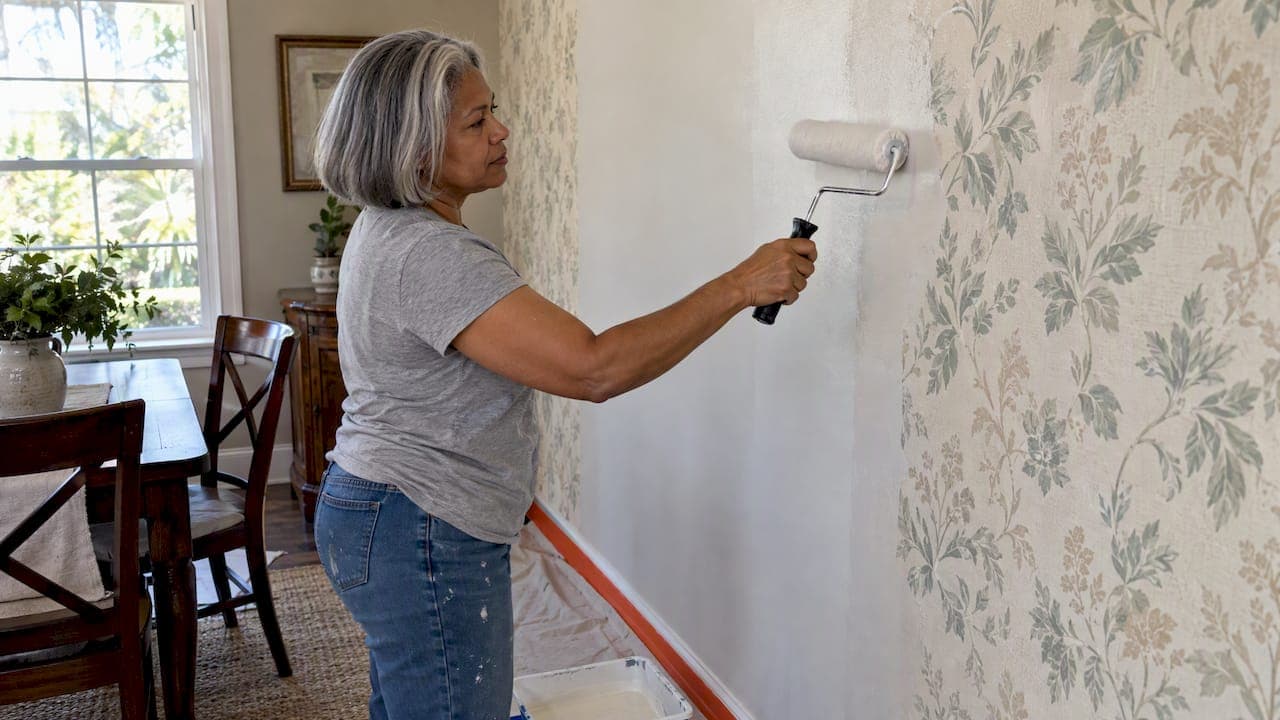
Yes, you can paint over wallpaper, but only when the paper is smooth, tight to the wall and in good shape. If it is textured, glossy, or peeling in several places, removing it first gives you a better wall. Below, we walk through how to tell which situation you have, how to prep, prime and paint, and what to expect from the finish.
TL;DR
- Smooth wallpaper that is firmly stuck down can be painted. Heavily textured, high-sheen or peeling paper is better removed.
- Clean the wall, glue down lifting seams, repair damage, and prime before any paint goes on. An oil-based primer is the common recommendation because water-based products can loosen the paper glue.
- Expect seams or patterns to show through in some cases, and expect removal to be harder later.
- If the paper keeps failing after you prime, or you want a flawless result, strip it and start with a clean wall.
Table of Contents
- Can you paint over wallpaper?
- What you should expect from the finish
- How to paint over wallpaper, step by step
- Common problems and what causes them
- Painting over wallpaper or removing it: how to decide
- Our perspective
- When to hire a pro
- Painting a brick fireplace: a related question
- What is dryfall paint?
- FAQ
- Sources
Can you paint over wallpaper?
Sometimes. Sherwin-Williams says you can paint over wallpaper, but it advises against textured paper or paper that is peeling in multiple places. Benjamin Moore goes further: it does not recommend painting over high-sheen or heavily textured wallpaper, because primer and paint may not hide the seams and the moisture can make the paper release from the wall.
Those two positions are not really in conflict. They describe a spectrum:
| Wallpaper condition | Paint over it? |
|---|---|
| Smooth, matte, tight to the wall, seams flat | Usually yes, with proper prep and primer |
| Vinyl or foil covering | Yes, but it must be primed first |
| Heavily textured or embossed | Texture will still show; removal is better |
| High-sheen or glossy | Poor adhesion risk; removal is better |
| Peeling or bubbling in many places | Remove it |
| Several layers of old paper | Depends on the wall underneath (see below) |
When painting over is the sensible choice
This Old House notes that painting over smooth paper in good condition can make sense when removal could damage unfinished drywall or plaster, or when multiple layers make stripping especially difficult. In older homes, a wall that was never sealed before the paper went up can tear apart when the paper comes off. In that case, a careful paint job over sound paper may be the lower-risk path.
When you should remove it
Remove the paper if you see any of these:
- Seams curling up along more than a few edges.
- Bubbles that do not settle flat.
- A raised pattern you can clearly feel with your hand.
- A glossy or metallic surface that water beads on.
- Damp areas, stains or mildew, which point to a moisture problem behind the paper.
In a Florida home, that last one deserves attention. Humidity gets behind wallcoverings in bathrooms, laundry rooms and exterior-facing walls. If you suspect moisture, solve it first. Our guide on fixing paint bubbling in humid homes explains how to tell a humidity issue from a surface issue.
What you should expect from the finish
Be realistic here. Paint over wallpaper rarely looks like paint over a bare wall.
- Seams may show. Benjamin Moore says seams can remain visible even under premium primer and paint, so do not assume a perfectly smooth result.
- Texture stays. This Old House points out that textured wallpaper will not look flat and even once painted.
- Removal gets harder later. The same source warns that paper that has been painted over is more difficult to strip down the road.
The upside is real too. You save the time and cost of removal, and you avoid the chance of damaging the wall underneath. For a guest room, a hallway or a rental-ready refresh, a clean, uniform color on smooth paper is often exactly what is needed.
On lighting: low, matte or eggshell sheens hide seams and uneven surfaces better than semi-gloss, and raking light from windows exaggerates every flaw. Our post on choosing an interior paint finish for each room goes through the trade-offs.
How to paint over wallpaper, step by step
The steps below follow the guidance from paint manufacturers and trade sources. Work slowly on prep. That is where nearly every failure starts.
1. Inspect every seam and corner
Run your hand along each seam, around outlets, and along the ceiling and baseboards. Mark any spot that lifts. Check for bubbles, stains and tears. A trade reference, the Paint Problem Solver, advises keeping the paper clean and stain-free and re-gluing or removing loose sections before you coat anything.
2. Clean the walls
Dust, kitchen grease and fingerprints keep primer from bonding. Sherwin-Williams recommends cleaning wallpapered walls before painting. Use a mild detergent solution and a barely damp sponge. Do not soak the paper, because water can soften the adhesive. If your paper has a delicate surface, test a small hidden patch first, the same way we suggest in our guide to cleaning painted walls without hurting the sheen.
3. Glue down seams and repair damage
Behr's guidance starts with securing loose seams with wallpaper paste so they lie flat. Press them down with a seam roller and wipe off squeezed-out paste. For tears or gouges, the Paint Problem Solver suggests spackling and sanding the repair so it blends in.

If you find a bubble that does not dry back flat, the same reference says to slit it, remove the loose paper, spackle, sand, and repaint.
4. Protect trim and floors
Tape off baseboards, window casings and outlets, and lay drop cloths. If you are painting a whole room, it helps to follow a sequence so you are not taping and re-taping. We lay that out in our interior painting sequence guide.
5. Prime, and choose the primer carefully
This is the step people skip, and it is the one that decides whether the job lasts.
Behr warns that water-based paint and primer may reactivate wallpaper glue and cause peeling, and recommends sealing the surface with an oil-based primer. The Paint Problem Solver adds that vinyl or foil wallcovering should always be primed, then topped with a latex finish coat once the primer is dry. It also says to prime if dye bleeds or the surface is stained.
Practical points:
- Oil-based (alkyd) primers seal the paper and keep moisture from reaching the paste. They have strong odor, so ventilate well and plan for longer dry times.
- Read the label on any primer you choose. Some manufacturers make stain-blocking or wallcovering-specific primers, and the label tells you whether it is meant for this use.
- Roll on a thin, even coat. A heavy, wet coat is more likely to lift seams.
- Let it dry fully before the next step.
6. Cut in, then roll the finish coats
Behr's next step is to cut in around the perimeter with a brush, starting at a top corner and working along the ceiling and baseboards. Then roll the walls with a latex paint, working in sections so the wet edge stays alive. Two coats are normal. Use a light touch near seams, and avoid going back over areas that have started to tack up.
7. Pull the tape and check in daylight
Remove the tape while the final coat is slightly soft, then step back and look at the wall in both morning and evening light. Small seam flaws are easier to touch up once the paint has cured for a day or so.
Common problems and what causes them
| Problem | Likely cause | What helps |
|---|---|---|
| Seams lifting | Adhesive reactivated by water-based product, or seam was already loose | Re-glue before priming, use oil-based primer |
| Bubbles | Moisture or trapped air | Slit, remove loose paper, spackle, sand, re-prime |
| Pattern ghosting | Texture or embossing | Often only removal fixes it |
| Stains bleeding through | Dye or water marks | Stain-blocking primer first |
| Peeling sheets of paint | Glossy surface or dirty wall | Clean, prime with a bonding product |
If seams show a hairline crack after the paint dries, that can also be the drywall underneath moving. See our note on hairline drywall seam cracks to judge whether it is cosmetic.
Painting over wallpaper or removing it: how to decide
Ask these questions in order:
- Is the paper smooth, tight and clean? If not, remove it.
- Is the wall underneath fragile? If it is unfinished drywall or old plaster that may tear, painting over may be safer than stripping.
- How perfect does the result need to be? For a showpiece living room with strong side light, removal wins. For a utility room or a quick refresh, paint can be enough.
- How long will you stay? Painted-over paper is harder to take off later, so it is a poor choice if you plan a full renovation soon.
- Is there moisture? Fix it first, then decide.
If you do remove it, finish the job properly. The Paint Problem Solver recommends a high-performance primer after removal when you are not sure the surface is clean, since leftover adhesive can cause problems with the new paint. Our interior wall prep checklist covers what to do between stripping and painting. If you plan to drop to a lighter color, see our guide to covering dark walls.
Our perspective
We get asked about wallpaper often, and our honest answer is that it depends on the wall in front of us. We do not want to promise a paint job that fails in a year, and we do not want to talk anyone into an expensive teardown they do not need.
Here is how we think about it. Preparation decides the outcome. On smooth paper in good shape, a careful clean, seam repair and a proper primer can give you a tidy, durable finish. On textured or damaged paper, we would rather tell you up front that removal is the better investment, because the texture and seams will show no matter how good the paint is.

We also encourage homeowners to think about the next owner of the room, which might be you in five years. Painting over paper now makes future removal harder, and that is a fair trade only if you know about it going in.
That approach is why our work is built around thorough prep and clear communication rather than the lowest bid. We would rather show you the options and let you choose.
— Kyle
When to hire a pro
Wallpaper jobs are slow, fiddly and unforgiving. Hire help when:
- The paper covers a stairwell, a high ceiling or a whole house.
- You suspect moisture, mold or a failing wall surface.
- You are not sure whether the paper can be painted.
- Drywall repair is needed after stripping.
We handle residential interior painting across Lake County and Central Florida, including drywall repairs and prep work. Our service packages range from a cosmetic refresh to maximum prep and protection, so you can match the level of work to the condition of your walls and your budget. You can compare them on our services page.

Want a straight answer on your wallpaper? Schedule your appointment and we will look at the paper, the seams and the wall behind it before recommending paint, removal or a mix of both.
Painting a brick fireplace: a related question
Many people who ask about wallpaper are also planning a fireplace update, so here is a short guide.
Prepare the brick
The Brick Industry Association's technical note on changing the appearance of brick recommends dry-brushing a fireplace surround with a nonmetallic stiff-bristled brush, vacuuming, cleaning with grease-cutting detergent and water, rinsing carefully and letting the brick dry. It also says the treatment should suit the masonry and its moisture behavior, and that unsuitable treatments can damage brickwork. It cautions against treating a working firebox unless the manufacturer specifically designates the product for that use. If your fireplace burns, keep paint and coatings to the surround unless the label says otherwise.
Paint, whitewash or limewash
- Paint. Better Homes & Gardens suggests a thorough cleaning, a stain-blocking primer if the brick has soot stains, and high-gloss paint for a sleek, contemporary look. Paint is hard to reverse, so decide carefully.
- Limewash. Family Handyman describes limewash as brightening and changing brick color while giving a natural, artistic finish rather than a flat coat. It keeps the variation and texture of the brick.
- Whitewash look. A thinned white wash lets some brick color show through. It is softer than solid paint, but it still needs clean, dry masonry and the right product for the brick.
If you later want paint off brick, Better Homes & Gardens warns that pressure washing and sandblasting can damage brick and mortar, and recommends gentler methods. That is one more reason to choose the finish with care.
What is dryfall paint?
Dryfall is a ceiling and wall coating made mostly for large commercial and industrial spaces. It is formulated so overspray dries to a dust before it lands on the floor, which makes cleanup quick when spraying warehouses, offices and similar buildings. For a typical home ceiling, a standard ceiling paint applied by roller is the usual choice. If you manage a commercial space and want to know whether dryfall suits it, ask your painting contractor about the ceiling type, height and the surfaces nearby.
FAQ
Can you paint over wallpaper?
Yes, if it is smooth, clean and firmly attached. Sherwin-Williams says painting over wallpaper is possible but advises against textured paper or paper peeling in multiple places. Always prime first.
What primer should I use on wallpaper?
Behr recommends an oil-based primer to seal the surface, because water-based paint and primer can reactivate the paste and cause peeling. Vinyl or foil wallcovering should always be primed, then finished with latex paint once the primer dries.
Should I remove wallpaper or paint over it?
Remove it if it is textured, glossy, peeling or damp. Paint over it when it is smooth and in good condition, especially if stripping could damage the wall underneath. Keep in mind that painted-over paper is harder to remove later.
Will the seams show through the paint?
They can. Benjamin Moore says seams may stay visible even under premium primer and paint. Matte or eggshell finishes and careful seam repair reduce the effect, but a perfectly smooth look is not guaranteed.
Can I paint a brick fireplace?
Yes, on the surround, after cleaning and drying the brick and choosing a product suited to masonry. Do not coat a working firebox unless the manufacturer designates the product for that use.
Sources
- Sherwin-Williams: Wallpapering FAQs
- Benjamin Moore: How to Remove Wallpaper in 6 Steps
- This Old House: How To Paint Over Wallpaper
- Behr: How to Paint on Wallpaper
- Paint Problem Solver (PDR Magazine)
- Brick Industry Association: Changing the Appearance of Brick Masonry
- Better Homes & Gardens: High-Impact, Low-Cost Home Improvement Ideas
- Better Homes & Gardens: How to Remove Paint from Brick
- Family Handyman: What To Know About Textured Paint