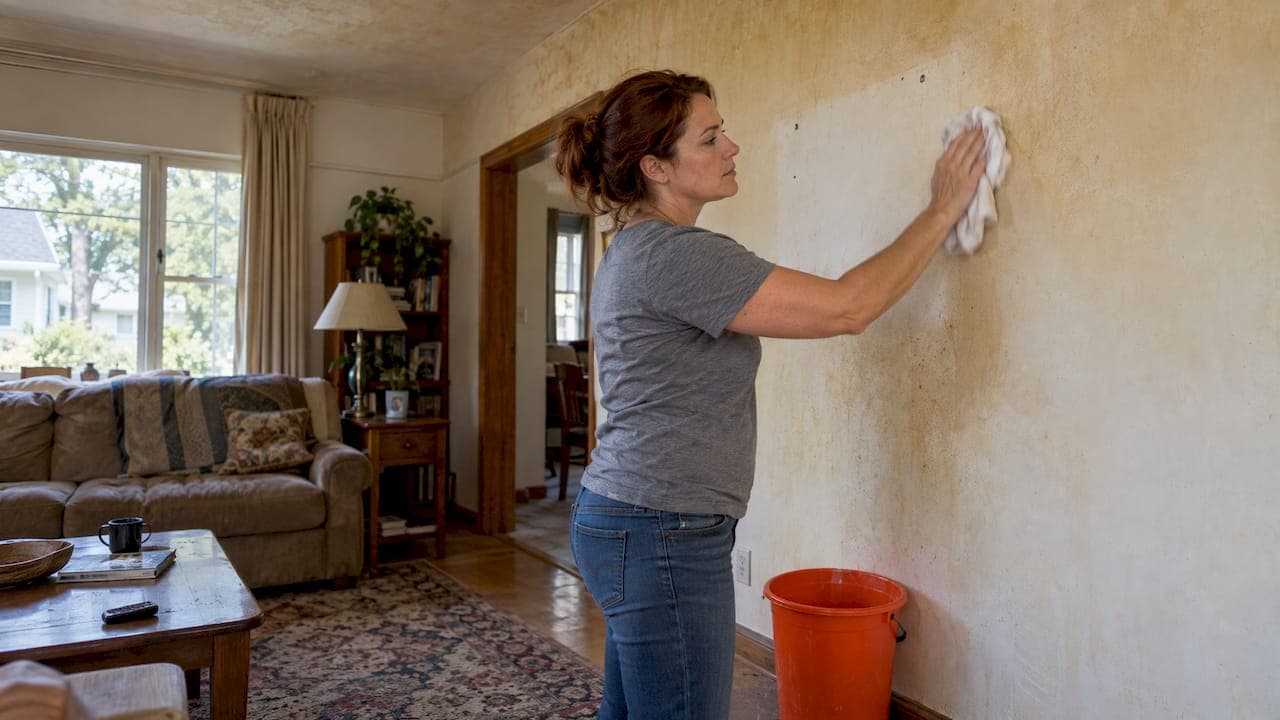
Nicotine stains on walls come back through ordinary paint, so the fix has three steps in a fixed order: clean the surface, seal it with a stain-blocking primer made for smoke residue, then apply your topcoat. Skip the middle step and the yellow-brown film usually shows through again. Below we explain why it happens, what each cleaning method can and can't do, how the sealing step works, and when it makes sense to hand the job to a professional painter.
TL;DR
- Smoke leaves a sticky yellow-brown film that soaks into walls and ceilings and can stay there for years.
- Wash first. Dish soap suits light staining, and stronger cleaners suit heavy buildup, but washing alone rarely stops bleed-through.
- Regular wall paint, even two coats, tends to let oily nicotine residue creep back. A shellac-based or similar stain-blocking primer goes on before color.
- Ventilate well and follow the label on every cleaner and primer. Shellac primers need a respirator.
- Heavily saturated drywall, or stains that follow a leak, need more than paint. A pro can tell which situation you have.
Table of Contents
- Why nicotine stains walls in the first place
- Why paint alone doesn't hide it
- Step 1: Clean the walls before anything else
- Step 2: Seal with a stain-blocking primer
- Step 3: Repaint, and manage the smell
- When to call a professional painter
- Let us handle the prep and the paint
- FAQ
- Sources
Why nicotine stains walls in the first place
Smoke doesn't just float away. The Washington State Department of Health describes thirdhand smoke as residue that settles on indoor surfaces, can turn walls sticky and yellow, and can cling for years after someone stops smoking or leaves the room.
That is why a home can look fine in the listing photos and then show a tan haze once you move furniture, hang a new light fixture or take down a picture. Residue builds up evenly on walls and ceilings, and it is often darkest on the ceiling, near vents, around windows and behind frames, where air moves and cooler surfaces collect more film.
The color deepens with time. Nicotine itself is colorless when fresh but darkens when exposed to air and light, and tar adds a brownish-yellow tint, according to one restoration company's explainer. Another source notes that the film is mildly water-soluble in the first few weeks but bonds over months and years, which makes older stains much harder to lift.

Is it really nicotine?
Brown or tan staining is consistent with tobacco residue, but it isn't the only possible cause. Building-inspection guidance describes smoke stains as uniform films, streaks or rivulets, and it also cautions that mottled brown patches can come from a leak dissolving materials inside a wall or ceiling cavity.
A quick check helps:
- Even yellowing across a whole room, strongest high on walls and on the ceiling, points to smoke.
- A patch with a ring, a soft bulge or a damp feel points to moisture. Fix the leak first. No primer will hold over an active water problem.
- A smoky smell that returns on humid days is common in Florida homes where the smoker lived for years.
In Lake County's humidity, moisture is worth ruling out before any painting plan. Our guide on paint bubbling and humidity explains what healthy indoor moisture looks like.
Why paint alone doesn't hide it
The residue is oily. When you roll standard latex paint over it, the moisture and solvents in the new coat can dissolve and pull some of the film upward. Painting over untreated smoke-stained walls often fails because the residue bleeds through the fresh paint.
The Thirdhand Smoke Resource Center puts the same idea in careful terms. Special primers, such as alcohol-based ones, are sometimes used, and painting may temporarily trap residue, but reports of bleeding suggest paint is not always a permanent solution. Heavily polluted building materials may need replacement.
In practice that means two things for you. First, the primer is not optional, and it has to be the right kind. Second, the more saturated the wall, the more important thorough prep becomes. If you have seen yellow spots reappear on a wall you already painted, our article on tannin bleed-through covers a similar mechanism and why a basic latex coat can't stop it.
Step 1: Clean the walls before anything else
Cleaning removes the loose surface film so the primer has something clean to grip. It doesn't make the wall stain-proof, and it works best when you match the cleaner to the level of staining.
Matching the cleaner to the stain
| Staining level | Typical approach | What to watch |
|---|---|---|
| Light haze, recent smoking | Dish soap and warm water | Rinse well, wipe dry |
| Light to moderate, odor | White vinegar solution | May not be strong enough for heavy staining |
| Moderate to heavy buildup | TSP or a TSP substitute | Can dull the sheen, especially flat or matte paint |
The table follows guidance from a smoke-damage restoration company, which says dish soap can work for light smoke damage, vinegar helps with light to moderate residue and odor, and TSP or a substitute is often most effective for moderate to heavy buildup. The same source warns that strong cleaners can change the sheen of flat or matte paint.
Safe washing habits
- Test a hidden spot first. A closet wall or the area behind a door shows how your paint reacts. We cover the method in our guide to cleaning painted walls and protecting the sheen.
- Work top down. Start with the ceiling, then walls, so drips land on surfaces you haven't washed yet.
- Use clean water often. Dirty rinse water just spreads the film around.
- Rinse and let everything dry fully. Primer over damp drywall is a recipe for adhesion problems.
- Ventilate. The EPA's indoor air guide recommends opening windows and running fans and following all safety labels when you clean or paint.
One caution on ammonia: use it only with proper ventilation, follow label directions, and never mix it with other chemicals or cleaners. If you use TSP, wear gloves and eye protection, and check the primer's label first. Rust-Oleum's technical sheet for Cover-Stain advises against TSP as the pre-cleaner and points to an appropriate ammoniated cleaning solution or solvent instead. Always follow the directions for the specific primer you plan to use.
For lighter, soot-like residue on porous surfaces, the general principles in this guide to candle soot removal on walls are a reasonable companion read.
What cleaning can't do
The Thirdhand Smoke Resource Center is clear that surface cleaning removes accumulated residue, but it may not remove pollutants embedded in drywall, wood products, insulation, ducts or other porous materials. It also notes that less odor does not necessarily mean the pollutants are gone. TSP, it adds, is sometimes used by professionals before priming and painting, but it is hazardous and calls for specialized tools and protective equipment.
That is the practical reason many homeowners in retirement communities and older Lake County homes ask a painter to handle the washing and prep. Our own prep checklist for repainting interior walls shows how much work happens before a color ever goes on.
Step 2: Seal with a stain-blocking primer
This is the step that decides whether the wall stays white. Shellac-based stain-blocking primers are formulated to seal nicotine residue and keep it from bleeding into the topcoat. Rust-Oleum recommends its B-I-N shellac-base primer for nicotine stains and odors. Rust-Oleum also describes its Cover-Stain oil-based primer as designed for surfaces damaged by fire, smoke or water, for interior or exterior use.
Application directions that matter
From the manufacturer's page for B-I-N:
- Substrate moisture should not exceed 12%.
- Apply in temperatures of 0 to 90°F and below 70% relative humidity.
- Provide adequate ventilation and wear a NIOSH-approved respirator.
Those numbers matter in Central Florida. A summer afternoon with the air conditioner off can push indoor humidity past the limit, so painters often schedule priming when the house is conditioned and dry.
The EPA's guidance is the same in spirit: ventilate when using paints or cleaning chemicals and follow every label. Fumes from a shellac or oil-based primer are strong, and pets, children and anyone with breathing problems should stay out of the area until it has aired out.
Heavy staining: spot prime, then prime again
On a ceiling that has darkened over decades, or around a window where a smoker sat, one pass may leave faint shadows. A common professional approach is to spot-prime the darkest areas, let them dry, then prime the full surface. Check the product label for recoat times, and stop only when no tint remains. A sealed wall should look uniform before any color goes on.

Watch for ghosting too. Uneven staining and patchy primer can leave faint outlines even after repainting, and our piece on ghosting on walls explains the causes and fixes.
Step 3: Repaint, and manage the smell
Once the primer has cured, apply your finish coats. A good-quality interior paint in the sheen you want will do the job, because the primer is now carrying the blocking work. Cut in carefully at edges and follow the order our interior painting sequence guide lays out: ceilings first, then walls, then trim.
Two smells will be in the room for a while: the primer's and the paint's. Ventilate, run fans and give it time. Our guide on how long paint odor lingers walks through ways to clear it faster, and there is a 24 to 48 hour timeline for typical rooms. If a faint tobacco smell returns after all this, the source is probably embedded in drywall, insulation or ductwork rather than the paint film. That is the point at which to talk to a contractor about what can be sealed, repaired or replaced.
When to call a professional painter
A weekend project can handle a single room with a light haze. Call a pro if:
- The whole house has years of smoke exposure, including ceilings and trim.
- You're preparing a home for sale, or a unit for a new resident, and need a uniform result.
- Stains are heavy, sticky or dark, or have come back through earlier paint.
- Drywall is damaged, patched or has areas that need repair before priming.
- You don't want to work with respirator-grade primers and strong cleaners yourself.
- You manage a commercial space or a rental where a clean turnaround matters.
A good contractor will also check for moisture and leaks before quoting, because paint over a wet problem fails whatever primer is used.
Our perspective
We see nicotine stains in older Lake County homes, retirement communities and small commercial spaces, and the lesson is always the same: the paint color is the easy part. What decides whether a wall stays clean is the prep that happens before the first coat.
That is why we don't compete on being the cheapest. We wash, repair, seal and then paint, and we explain what we're doing and why. A wall with years of smoke on it needs a different plan from a wall with a light haze, and we would rather tell you that up front than hand you a fresh coat that yellows in a few months.
Our three service packages are built around that idea. Cosmetic Refresh, Enhanced Prep & Durability and Maximum Prep & Protection let you choose the level of preparation and protection that fits your home and budget. For a smoke-stained home, we'll walk the rooms with you and recommend the tier that matches what we find.
Kyle
Let us handle the prep and the paint
We're a locally owned painting contractor serving Lake County and Central Florida. Our residential interior painting work includes drywall repairs, careful surface preparation and finishes made to last, and we offer warranties on workmanship. If you'd like a clean, even result after years of smoke, schedule your appointment and we'll look at your walls, talk through the options and explain the process.

Not sure which level of prep fits? See our three service packages to compare them. If you have cabinets that absorbed smoke film too, ask us about cabinet refinishing in the same visit.
FAQ
Will Dawn remove nicotine from walls?
Dish soap can work for light smoke damage, according to restoration guidance. For moderate to heavy buildup, TSP or a substitute is often more effective. Even after washing, residue deeper in the wall can remain, so priming is still the safer next step.
Can you paint over nicotine stains without cleaning first?
We don't recommend it. Residue left on the surface can keep new paint from bonding well, and it is the material that bleeds through. Wash the wall, let it dry, then seal it with a stain-blocking primer before color.
Does vinegar remove nicotine stains and smell?
Vinegar can help with light to moderate residue and odor, but it may not be strong enough for heavy staining. Test a hidden spot first, and don't combine it with other cleaners. For stubborn walls, plan on a stronger wash and a sealing primer.
How long does nicotine stay on walls?
The Washington State Department of Health says residue can persist on surfaces for years after smoking stops. That's why a home that was smoked in long ago can still show stains or smell when it warms up or humidity rises.
Sources
- Thirdhand Smoke, Washington State Department of Health
- Why Does Cigarette Smoke Stain Walls Yellow?
- Nicotine Stains: Removal Guide for Walls and Surfaces
- Occupant Stains & Smudges in Buildings
- How can I remove thirdhand smoke from my home? (Thirdhand Smoke Resource Center)
- How to Clean Cigarette Smoke Damaged Walls
- Cleaning cigarette smoke from walls
- Zinsser B-I-N Shellac-Base Primer, Rust-Oleum
- Cover-Stain product application, Rust-Oleum
- Care for Your Air: A Guide to Indoor Air Quality, EPA
- Candle Soot Removal: Clean Walls, Ceilings and Jars