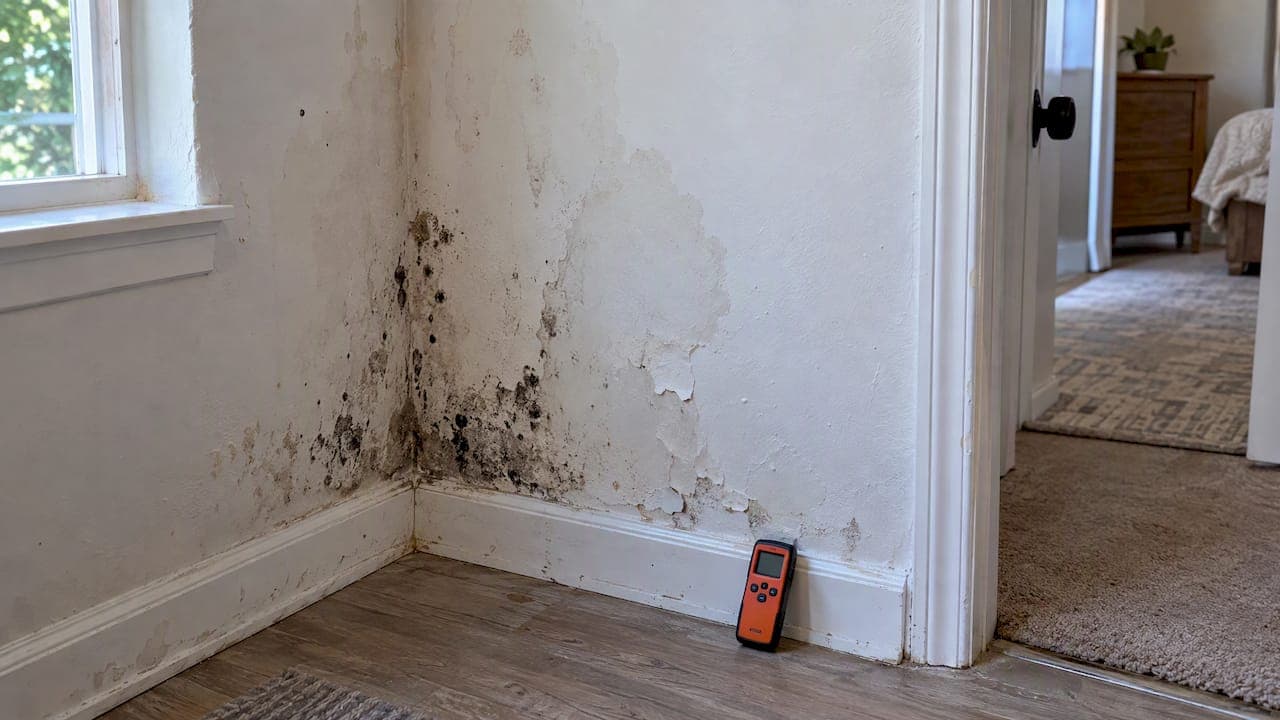
No. Paint over mold will not kill it, and it will not last. Mold is alive and keeps feeding on moisture, so it grows behind the coating, and the paint starts to peel. EPA guidance says the same: fix the moisture problem, clean the mold off, dry the surface completely, and only then paint.
We paint homes and businesses across Lake County and Central Florida, and we see this mistake often. A stain gets covered, the wall looks fine for a few months, and then the spots come back through the new finish. This guide explains why that happens, what the right order of work is, when to call a mold professional before a painter, and which mildew-resistant paints make sense once the surface is truly ready.
TL;DR
- Never paint over visible mold or mildew. Paint hides it for a while, but the growth continues underneath and the coating fails.
- Mold control is moisture control. Find and fix the leak, condensation or poor ventilation first, or the mold will return.
- Small hard-surface patches (under about 10 square feet) can be cleaned by a healthy homeowner. Larger areas, flood water, sewage, HVAC involvement or damaged drywall call for a qualified professional.
- Mold-resistant paint is protection for a clean, dry, primed surface. It is not a mold treatment.
- In Lake County's humidity, a thorough prep plan matters more than which can of paint you pick.
Table of Contents
- Why painting over mold fails
- What happens if you paint over mold anyway
- Step 1: Find and fix the moisture source
- Step 2: Decide who should clean it
- Step 3: Clean and dry the surface correctly
- Step 4: Repair, prime and paint
- Mold-resistant and mildew-resistant exterior paint: what it can and cannot do
- For retirement communities and businesses
- Our perspective: prep is the product
- Ready to repaint once the surface is sound?
- FAQ
- Sources
Why painting over mold fails
Mold needs moisture, an organic material to eat, and time. Drywall paper, wood, caulk and even dust all qualify. When you roll paint over a colony, you seal it into a warm, damp layer between the substrate and the film. The paint has nothing solid to bond to, so it blisters, flakes or shows dark spots again.
The CDC notes that mold grows wherever moisture collects, such as around leaks in roofs, windows or pipes, or after a flood. The EPA's brief guide to mold adds that mold spores cannot be eliminated from a home entirely, but they will not grow without moisture. That is the whole strategy in one idea: you are not trying to create a sterile house. You are trying to take away the water.

So a repaint is a finish, not a repair. If the leak, the condensation or the humidity problem is still there, a beautiful paint job is only a delay.
Mold or mildew: does the name matter?
Homeowners often ask whether they can paint over mildew when it is "only" surface growth. The answer is the same. Mildew is generally the term for mold growing flat on a surface, such as a bathroom ceiling or a shaded siding board. The CDC's guidance moves away from trying to identify a color or species: if you see or smell mold, remove it and correct the moisture. It also says routine home mold testing is not recommended, because the result does not tell you whether cleanup is needed.
What happens if you paint over mold anyway
Here is what we typically see when a surface was coated without cleaning:
- Peeling and bubbling. Trapped moisture pushes the film off the surface, sometimes within a season.
- Ghost spots. Dark patches bleed through, even through two coats.
- Musty smell. The odor does not go away because the source is still in the wall or ceiling.
- Hidden damage. Drywall, trim and framing keep deteriorating behind a clean-looking surface.
- Wasted money. The area has to be stripped, cleaned and painted again, so you pay twice.
If you are already seeing bubbles or flaking, our guides on paint bubbling in humidity and paint peeling in Florida humidity walk through how to tell a moisture problem from a prep problem.
Step 1: Find and fix the moisture source
In Florida, mold that keeps coming back almost always points to water that has not been dealt with. Check these before you touch a brush:
- Roof and flashing. Look for stains on ceilings below roof lines, around skylights and near chimneys.
- Plumbing. Check under sinks, behind toilets and around water heaters and washing machine hoses.
- Windows and doors. Failed seals and caulk let rain in, especially during summer storms.
- Bathroom and kitchen exhaust. Fans should vent outside, not into the attic. A fan that only moves air around the ceiling cavity feeds the problem.
- Air conditioning. Clogged drain lines and cold ducts that sweat can wet ceilings and walls.
- Landscaping and irrigation. Sprinklers that hit siding and plants pressed against stucco keep walls damp. See our notes on pressure washing frequency in Florida for how moisture and landscaping drive repeat cleaning.
Bathroom ceilings deserve a special mention. Peeling there can come from shower steam or from a slow leak above, and the repair is different. Our article on bathroom ceiling peeling explains how to diagnose before repainting.
Humidity targets for Florida homes
The CDC advises keeping indoor humidity no higher than 50 percent. Florida Health recommends keeping it below 60 percent, noting that many experts prefer below 50. A cheap hygrometer from a hardware store will tell you where your home sits. Running the air conditioner, using a dehumidifier in closed-up rooms and venting fans to the outdoors all help, particularly if you are away part of the year.
Step 2: Decide who should clean it
Not every mold patch is a DIY job, and not every one is a paint job.
| Situation | Who handles it |
|---|---|
| Small patch on a hard surface, under about 10 square feet (roughly 3 by 3 feet) | A healthy homeowner following EPA cleanup steps, or a painter during prep once the moisture is fixed |
| Growth over 10 square feet | An experienced mold-remediation professional |
| Significant water damage, sewage or flood water | A mold-remediation professional |
| Suspected mold in the HVAC system | An HVAC professional, and do not run the system |
| Mold-damaged drywall, ceiling tile or insulation | Removal and replacement, then repair and paint |
| Residents with asthma, mold allergies, weakened immunity or chronic lung disease | Someone else should do the cleanup |
The 10-square-foot threshold comes from the EPA's brief guide. The health cautions come from the CDC's cleanup tips, which say people with those conditions should not do the cleanup themselves.
Hiring for mold work in Florida
Painters are not mold remediators, and we say so plainly. If the job is mold assessment or remediation, Florida Health recommends verifying licensing through the state's license lookup, where mold assessors and remediators are licensed separately. Ask for the license number and check it before you sign anything. Assessors and remediators are generally kept separate so the company that tests is not the one profiting from the cleanup.
When the HVAC system is involved
The EPA says not to run a known or suspected contaminated HVAC system, because it can spread mold through the house. Florida Health recommends professional cleaning before turning a flooded or affected system back on. If you see growth on vents or smell mustiness only when the air runs, this overview of removing mold from vents shows what the job involves and when it is time for professional help. Get the system cleared first. There is no point repainting a ceiling that a contaminated duct will soak again.

Step 3: Clean and dry the surface correctly
For a small patch on a hard, non-porous or sealed surface, the sequence is straightforward.
- Protect yourself. Wear gloves, goggles and an N-95 respirator, and ventilate the room. The CDC and Florida Health both recommend this.
- Scrub with detergent and water. The EPA's basic cleanup steps call for scrubbing mold off hard surfaces with detergent and water, then drying completely.
- Use bleach only if you must, and carefully. Some manufacturers suggest a diluted household bleach solution on exterior surfaces. Benjamin Moore's mildew guide is one example of product maker guidance, so check the label of whatever you use. Never mix bleach with ammonia or other cleaners, which creates toxic fumes.
- Remove what cannot be cleaned. Porous materials such as moldy drywall, ceiling tile and insulation should be cut out and replaced, not painted.
- Dry fully. Use fans and dehumidification. Do not paint until the surface and the material behind it are dry.
- Photograph before you discard. After storm damage, Florida Health advises photographing items you throw away for insurance claims.
If an area was wet with flood water and cannot be cleaned and dried within 24 to 48 hours, it may need to be removed rather than saved, according to Florida Health's storm guidance. That matters in Lake County after hurricanes and heavy summer storms.
Step 4: Repair, prime and paint
Only now does paint come into the picture, and this is where good prep separates a finish that lasts from one that fails.
- Repair the surface. Replace removed drywall, patch, and sand smooth. Seal and caulk gaps that let water in.
- Prime the right way. Use a primer suited to the substrate and the area: a stain-blocking primer for bleed-prone spots, a masonry primer on stucco, a moisture-tolerant primer in bathrooms.
- Choose a washable topcoat. In baths, laundry rooms and kitchens, a durable, scrubbable finish is easier to keep clean.
- Watch the weather outside. Dew point and humidity affect curing. Our Florida painting season and dew point checklist explains when exterior work goes on best.
- Let stucco cure. New or repaired stucco needs time before it takes paint. Our Florida stucco painting bid specs guide covers the cure time to demand.
If you are prepping an interior yourself, this interior wall prep checklist covers the standard steps.
Mold-resistant and mildew-resistant exterior paint: what it can and cannot do
Many readers search for mildew-resistant exterior paint hoping it solves the problem on its own. It does not, but it is a useful layer on a properly prepared surface.
The CDC says mold can grow in paint itself, and that mold inhibitors can be added to paint. Those additives help the dried film resist new growth. They do not repair a leak, and they do not remove a colony that is already there. Manufacturer claims apply to the paint film on a clean surface.
Here are a few published examples, so you can see what specifications look like. Always follow the current label and technical data sheet for your product.
| Product | What the maker publishes |
|---|---|
| Benjamin Moore Element Guard | Formulated for high-moisture conditions, with rain resistance as soon as 60 minutes after application under stated conditions |
| Zinsser PERMA-WHITE Exterior | Self-priming, mold-and-mildew-proof paint film with a 5-year paint-film guarantee |
| Valspar Defense Exterior Paint + Primer | One-coat paint and primer with water-beading technology and published application temperature guidance of 35 to 90°F |
Notice what these have in common. Each describes the coating, and each assumes a sound, clean substrate. A guarantee on a paint film is not a guarantee against a roof leak.
Picking a coating for Lake County conditions
Shaded north walls, lanai ceilings, soffits and stucco under heavy tree cover grow green and black film first. For those spots, a mildew-resistant exterior coating over a well-cleaned, primed surface is a smart choice. Inside, bathrooms, laundry rooms and closets near exterior walls benefit from a washable finish plus working ventilation. Our guide to how long exterior paint lasts in Florida and our note on repainting every 5 to 7 years show how much prep decides the schedule.
Smart climate planning also helps if you are remodeling. This overview of preparing a Florida remodel for climate shows why prompt drying and removal of damaged materials come before any new finishes.
For retirement communities and businesses
Shared buildings carry a different level of responsibility. In a retirement community, an HOA clubhouse or a small office, the question is not just appearance. It is residents' and employees' health, and many occupants may be older adults or have breathing conditions. EPA and Florida Health name health concerns, larger areas, contaminated water, porous materials and HVAC involvement as reasons to use qualified professionals rather than asking residents or staff to clean and paint.
For property managers, our approach is simple. Have the moisture source and any mold handled by the right licensed professional, get written confirmation that the area is dry, then bring us in to repair and paint. Documenting that order protects you, your residents and your tenants.
Our perspective: prep is the product
We talk to a lot of homeowners who just want the stain gone. We understand. A brown ring on a ceiling bothers you every time you look up. But we will not paint over mold, even when the customer asks us to, because we would be selling you a few good months and a callback.
What we do instead is walk the property with you. We look for the reason the surface stayed wet, we tell you plainly whether the next step belongs to a plumber, a roofer, an HVAC technician or a licensed mold professional, and we write the prep into the scope so you can see it. Our work is built on thorough preparation, premium products and clear communication, and that is why we offer warranties on workmanship rather than competing on being the cheapest bid.
Our three service packages follow the same idea. Cosmetic Refresh suits a sound surface that needs a clean new look. Enhanced Prep & Durability adds more surface work for homes that need to stand up to Florida weather. Maximum Prep & Protection is for the properties where moisture, age or exposure make prep the biggest factor. We will help you choose the one that fits your home and budget, and we will tell you honestly if a lower tier is enough.
If we find something that is not a painting issue, we will say so, even if it delays the job. You want a finish you can be proud of for years, and that only happens when the cause is solved first.
— Kyle
Ready to repaint once the surface is sound?
Once the leak is fixed and the area is clean and dry, we can take it from there. We handle drywall repairs, stucco painting, residential and commercial painting inside and out, and cabinet refinishing across Lake County and Central Florida. You can look at our three service packages, see our residential exterior painting work, or schedule your appointment and we will walk the property with you.
FAQ
What happens if you paint over mold?
The mold keeps growing underneath because the moisture is still there. The paint usually bubbles, peels or shows dark spots within months. You then have to strip, clean and repaint, and any damaged drywall or wood may have worsened in the meantime.
How do I kill mold before painting?
For a small patch on a hard surface, scrub it with detergent and water while wearing gloves, goggles and an N-95 respirator, then dry it completely. Fix the water source first. Never mix bleach with ammonia or other cleaners. If the area is larger than about 10 square feet or you have a breathing condition, hire a licensed professional.
Does mold-resistant paint kill existing mold?
No. Mold-resistant coatings are designed to help a clean, dry, primed surface resist new growth. Manufacturers describe the protection as a property of the paint film. Existing mold has to be removed and the moisture corrected first.
Can you paint over mildew on exterior siding or stucco?
Not until it is cleaned off and the wall is dry. Exterior mildew is common in Florida shade and humidity, and it will show through or lift fresh paint. Clean the surface, let it dry, prime where needed, and then use a mildew-resistant exterior paint. Stucco should also have enough cure time before painting.
When should I call a professional instead of cleaning it myself?
Call one when the growth covers more than about 10 square feet, follows significant water damage or sewage, involves the HVAC system, or when anyone in the home has asthma, mold allergies, weakened immunity or chronic lung disease. In Florida, verify mold assessor and remediator licenses through the state license lookup before hiring.
Sources
- What are the basic mold cleanup steps? (EPA)
- A Brief Guide to Mold, Moisture and Your Home (EPA)
- 8 Tips to Clean Mold (CDC)
- Mold (CDC)
- Mold (Florida Department of Health)
- Mold Cleanup / Indoor Air Quality (Florida Department of Health in St. Johns County)
- Mold-Related Services (myFloridaLicense)
- Element Guard Exterior Paint (Benjamin Moore)
- Element Guard Exterior Paint, Flat (Benjamin Moore)
- Zinsser PERMA-WHITE Exterior Paint
- Valspar Defense Exterior Paint + Primer