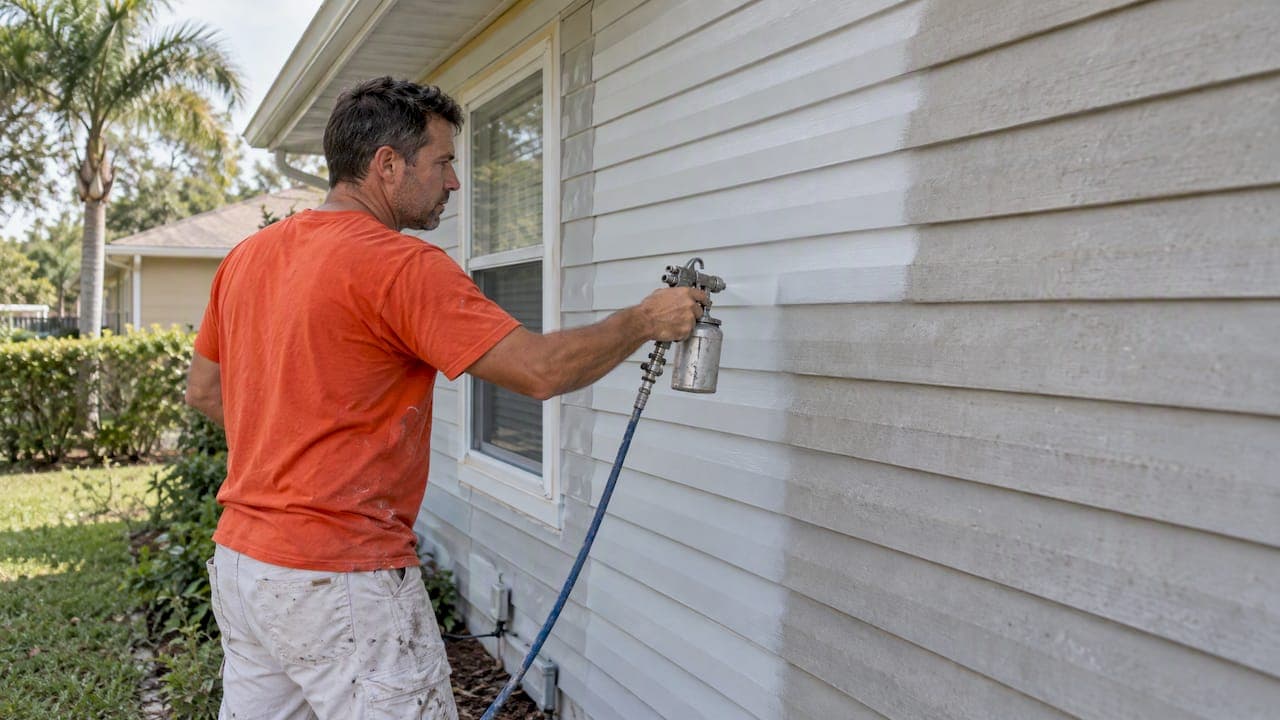
Yes, you can paint aluminum siding, and it usually looks great when you do. The paint is the easy part. Results depend on cleaning off the chalky oxidation, priming any bare or pitted metal, and applying a flexible 100% acrylic exterior paint in the right weather. Skip any of those and the paint peels. Do them well and a repainted aluminum house can look new for years.
We paint homes across Lake County and Central Florida, so this guide is written for Florida conditions: heat, humidity, afternoon storms and older homes that may have more going on under the siding than you think.
TL;DR
- Aluminum siding takes paint well, but only after a hand scrub removes the chalky oxidation. Pressure washing alone will not do it.
- Use a 100% acrylic latex exterior paint. Oil-based paint is generally not recommended for aluminum.
- Prime any bare, pitted or corroded metal with a rust-inhibitive acrylic primer before the topcoat.
- If your home was built before 1978, test for lead before you sand, scrape or remove anything.
- Spray the paint, then back-roll it. October through spring is often a good window in Lake County, as long as you watch the dew point.
Table of Contents
- Is aluminum siding worth painting?
- Step 1: Inspect before you do anything else
- Step 2: Clean the right way
- Step 3: Prime where it counts
- Step 4: Choose the paint
- Step 5: Apply with a sprayer, then back-roll
- When to paint in Lake County
- What does it cost, and how long will it last?
- DIY or hire a painter?
- Our perspective on painting aluminum siding
- Get your aluminum siding painted by a local crew
- FAQ
- Sources
Is aluminum siding worth painting?
Aluminum siding was installed on homes from the 1940s to the early 1980s, and it is still common because it is durable, low-maintenance, and resistant to fire, insects and rot. The factory finish, though, does not last forever. After decades of Florida sun, it fades, chalks and goes dull.
Painting is a good fit when the panels are structurally sound: no wide cracks, no loose sections, no heavy dents. In that case a fresh coat costs far less than replacing the siding and changes how the whole house looks. Painting is not a fix for panels that are loose, badly buckled or letting water in behind them. Repair those first.
There is no rule that says you must paint aluminum. If the finish is still even and you only see dirt, a careful wash may be enough. Paint when the color is faded, the surface is chalking, or you simply want a new look.
Step 1: Inspect before you do anything else
Walk the whole house in daylight. Look for:
- Chalking. Rub a dry hand across a panel. If a gray or white powder comes off, that is oxidation, and it must go.
- Bare metal or corrosion. Pitted spots or exposed metal need primer, not just paint.
- Dents and loose panels. Fasten or replace these now.
- Mildew. Green or black growth is common on shaded Florida walls. It needs a mildew treatment, not just a rinse.
- Failed caulk and trim gaps. Water gets in at windows, corners and penetrations.
- Moisture stains. Streaks or soft spots can point to a leak. Our guide on diagnosing moisture before repainting explains what to check.
Test for lead if the house is older
Aluminum siding is often nailed over older wood siding. If your home was built before 1978, the siding may be covering lead-based paint. Disturbing that surface, for example when removing siding, can trigger the EPA's Renovation, Repair and Painting Rule when more than 20 square feet of painted surface is disturbed. Painting the aluminum face itself does not disturb what is underneath, but any repair that opens the wall does. Test first, and use a lead-safe certified contractor if the test is positive.
Step 2: Clean the right way
This step decides whether the paint holds. Professionals agree that painting aluminum is less about the paint and more about surface preparation. You are painting over a factory-baked finish that has aged for decades.
Wash gently, from the top down
A pressure washer removes loose dirt, but it must never be aimed upward. Spraying up forces water behind the panels, where it can cause trapped moisture, rot and interior damage. Use low or medium pressure and work from the top of the wall down.

Then scrub by hand
Here is the misconception we hear most: that a pressure washer does all the work. It does not. It rarely removes the stubborn oxidation layer that stops paint from sticking. Hand-scrub with a nylon brush and a mild, non-film-building detergent, such as a TSP substitute, even if the siding looks clean. Rinse thoroughly, because leftover cleaner can interfere with adhesion.

If mildew is present, treat it with a mold and mildew remover as the label directs, then rinse with a low-pressure washer or garden hose, as this prep guide describes.
Let the siding dry fully. In Florida humidity that can take longer than you expect, especially on north and shaded walls.
Repair, caulk and mask
Fill or replace damaged sections, caulk gaps with a paintable exterior sealant, and mask windows, fixtures and landscaping. On older homes, drywall and trim repairs near entries and soffits are worth doing now too.
Step 3: Prime where it counts
If the existing finish is sound and fully cleaned, many jobs need only spot priming. If the aluminum is pitted, corroded or showing bare metal, prime those areas before painting.

Look for a primer made for metal. For example, Sherwin-Williams' Pro-Cryl Universal Primer is a self-cross-linking acrylic primer described as rust inhibitive. Check the data sheet for the specific product you choose, since surface prep and recoat times vary.
Primer matters most in three places:
- Bare or pitted metal
- Spots where oxidation was scrubbed down to raw aluminum
- Patches and repairs
A full-wall prime coat adds time and cost, and it is worth it on heavily weathered siding. Ask your painter which approach fits your walls and why.
Step 4: Choose the paint
100% acrylic latex
For aluminum, 100% acrylic latex exterior paint is widely considered the best choice. It flexes as the metal expands and contracts with temperature, which reduces the risk of cracking, peeling and flaking. Oil-based paints are generally not recommended on aluminum. The same source notes that quality acrylic can hold its color and resist moisture for roughly 5 to 10 years before maintenance is due.
If you want a second perspective on why flexible paint suits metal, this Dutch guide on painting aluminum frames covers the same principle for aluminum doors and windows.
The manufacturer's data sheet is the final word on a product. For instance, A-100 Exterior Latex is recommended for aluminum, vinyl and wood siding, and the sheet lists minimum application temperatures. We cover brands and product lines in our contractor guide to exterior paint in Florida, and the low-maintenance paint guide helps if you want to repaint less often.
Pick the sheen carefully
High gloss is durable, but it shows every flaw in the metal. Many professionals suggest satin or eggshell: good durability and washability while hiding the small dents and pitting on older siding. For more on how sheen behaves outdoors, see our exterior sheen guide.
Color matters on metal
Dark colors absorb more heat, and aluminum moves with temperature. Mid-tone and lighter colors are kinder to the paint and to your cooling bill in a Florida summer. Ask for a large sample on a panel and look at it in morning and afternoon light.
Step 5: Apply with a sprayer, then back-roll
The most effective method is spraying followed right away by back-rolling. Spraying gives even coverage across the ribbed profile, and a high-quality synthetic roller with a 3/8 to 3/4 inch nap pushes the paint into the surface for better adhesion and a uniform look. We explain why we insist on it in our back-rolling article.
A few practical rules:
- Work one wall at a time, from top to bottom, and keep a wet edge so laps do not show.
- Follow the siding's seams and run lengths whole where you can.
- Apply two coats unless the product and your surface truly allow one. Respect the recoat time on the label.
- Roll or brush at the end of each panel run to avoid drips at the lap.
- Remove masking while the final coat is slightly tacky, not fully dry, to protect the edges.
Rolling alone is possible on small areas, but it is slow and can leave roller marks on ribbed profiles. A brush-only job is rarely worth it on a whole house.
When to paint in Lake County
Timing is a real factor here. October can be a strong month to paint in Lake County, with milder temperatures than mid-summer. Keep an eye on three things:
- Temperature. Product sheets set a minimum air and surface temperature, typically in the range of 35°F to 50°F depending on the paint.
- Dew point. Surfaces should be at least 5°F above the dew point. Cool, humid mornings can leave an invisible film of moisture on metal, and metal cools fast.
- Rain. If rain is expected within a couple of hours of application, pause.
Aluminum heats up quickly in direct sun. Follow the shade around the house so you are not painting a hot panel in the afternoon. Our Florida painting season and dew point checklist goes deeper, and the exterior painting timeline shows how long a typical job and cure period take. A full repaint of an average home often runs several days when you count cleaning, repairs, priming and two coats.
What does it cost, and how long will it last?
Cost depends on the size of the house, the condition of the siding, how much repair and priming is needed, and the paint you choose. We do not publish flat prices, because two houses of the same size can need very different prep. We scope and quote each job in writing.
On lifespan, a quality acrylic over well-prepped aluminum can last years, and Florida sun and humidity shorten that if prep is rushed. Our view on repaint frequency in Florida is that proper prep is what separates a repaint that lasts from one that fails early.
DIY or hire a painter?
A confident DIYer can paint a small shed or a section of siding. A whole house is different:
| Factor | DIY | Professional crew |
|---|---|---|
| Cleaning and hand scrubbing | Many hours, easy to cut short | Part of the scope |
| Spraying and back-rolling | Needs equipment and practice | Standard method |
| Lead concerns on older homes | You must test and manage risk | Handled with proper procedures |
| Ladders and height | Real safety risk | Equipment and crew |
| Warranty | None | Workmanship coverage if offered |
If you do it yourself, the steps above still apply. If you hire, ask any contractor how they remove oxidation, what primer they use on bare metal, whether they back-roll, and what the warranty covers.
Our perspective on painting aluminum siding
Most of the aluminum jobs that come back to us were not paint failures. They were prep failures. Someone pressure washed, saw clean metal, and rolled on a coat. Six months later the paint lifted in sheets because the chalky layer was still there.
We do not compete on being the cheapest. Prep is where the labor is, and it is the part nobody sees when the job is done. That is why our approach centers on thorough preparation, premium products and clear communication. Our three service packages, Cosmetic Refresh, Enhanced Prep & Durability and Maximum Prep & Protection, let you decide how much protection and investment suits your home and budget.
On aluminum, we lean toward the more thorough prep levels when the siding is decades old, heavily oxidized or pitted. If your siding is in good shape, a lighter package can make sense, and we will tell you so.
Our advice: get the scope in writing, ask exactly how the siding will be cleaned, and do not accept a plan that treats a pressure washer as the whole prep.
— Kyle
Get your aluminum siding painted by a local crew
If you would rather hand this off, we are a locally owned painting contractor serving Lake County and Central Florida. We look at your siding, explain what it needs, and recommend the package that fits. See our residential exterior painting services, compare the three service packages, or start at our home page to schedule your appointment.
FAQ
Do I need primer to paint aluminum siding?
Not always on the whole wall. If the existing finish is sound and fully cleaned, spot priming may be enough. Bare, pitted or corroded metal should be primed with a rust-inhibitive acrylic primer first. A painter can tell you which applies after checking the siding in person.
What is the best paint for aluminum siding?
A 100% acrylic latex exterior paint is widely considered the best choice because it flexes with the metal as temperatures change. Oil-based paint is generally not recommended. Satin or eggshell is a popular sheen because it hides small dents.
Is October too late to paint outside in Florida?
No. In Lake County, October is often a good month because temperatures are milder than in summer. You still need to check the product's minimum temperature, keep the surface at least 5°F above the dew point, and stop if rain is close.
Can I just pressure wash and paint?
No. Pressure washing removes loose dirt but rarely the chalky oxidation that blocks adhesion. Scrub by hand with a nylon brush and non-film-building cleaner, rinse well, and let the siding dry before priming or painting. Never spray upward, which pushes water behind the panels.
Should I test for lead before painting aluminum siding?
If your home was built before 1978, yes, particularly if any repair or removal will disturb the wall underneath. The EPA's rule can apply when more than 20 square feet of painted surface is disturbed. Ask a certified professional about testing.
Sources
- How to Paint Aluminum Siding, The Spruce
- Best Paint for Aluminum Siding, Angi
- EPA: removing aluminum siding from a pre-1978 home
- Preparing and Painting Aluminum Siding, Househappy
- Pro Industrial Pro-Cryl Universal Primer data sheet
- A-100 Exterior Latex product data sheet